






“Their brains are not….” Psychiatrist Daniel G. Amen says sending young people away to college may do more damage than good

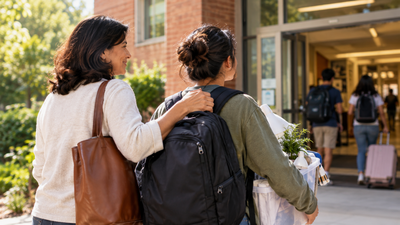
For many parents, sending a child to college is a moment of pride. It is also the first time they may have little idea what their son or daughter is doing after dinner, who they are spending time with or what happens behind the closed doors of a hostel room.Psychiatrist Daniel G. Amen recently raised this concern while discussing young people leaving home for college. He questioned the idea of sending young adults, whose brains are still developing, into an environment with limited adult supervision. He also pointed to the changing nature of college-party culture, where alcohol may coexist with cannabis and psychedelic substances such as psilocybin.
21 Sept 2026 | 12:54
How do you handle relatives who give unsolicited parenting advice? Share your most diplomatic or funniest response.
His comments may sound alarming, but they raise a more useful parenting question: When children leave home, does parental influence really end?Research suggests it does not.
The brain is still developing
The popular phrase that the brain is not fully developed until 25 is often repeated without context. Brain development is a gradual process, and areas involved in planning, decision-making, impulse control and weighing consequences continue to mature through adolescence and into young adulthood.That matters when teenagers and young adults encounter situations where immediate social rewards can compete with longer-term consequences.Cannabis, for example, is not simply a harmless substance because it is increasingly normalised in some social settings. The US National Institute on Drug Abuse notes that cannabis can affect memory, attention, learning and decision-making, with young people considered particularly vulnerable because their brains are still developing.That does not mean every young person who experiments with cannabis will develop a problem. But it does mean parents should avoid presenting it to teenagers as something with no meaningful risks.
College changes the equation
One of the biggest changes after school is not necessarily college itself, but independence.A young person who previously came home to parents every evening may suddenly be making decisions about alcohol, parties, friends and sleep without anyone immediately around to intervene.Research following young people through the transition from high school to emerging adulthood has found that leaving home and entering college can coincide with increases in heavy episodic drinking. The same research also found that stronger parental monitoring during the final year of high school was associated with lower increases in heavy drinking and, among college students, fewer increases in marijuana use.This is important because monitoring does not have to mean surveillance.For an 18-year-old living away from home, it may simply mean parents continuing to know what is happening in their child’s life: who their close friends are, how college is going, whether they are struggling and whether something about their behaviour has changed.
The conversation should happen before the hostel room
A common mistake is to have the first serious conversation about drugs after a child has already left home. By then, the child may already have encountered situations where saying no feels socially difficult. Parents can start much earlier by talking about real situations rather than delivering a lecture.What would you do if someone handed you a drink and you did not know what was in it? What if your roommate was using cannabis? What if friends wanted you to take something before a party? What if you felt uncomfortable but were afraid of looking boring?These conversations give children something more useful than a list of forbidden substances: a script for handling pressure. It is also worth telling children that they can call home when something goes wrong without immediately fearing punishment.A young person who believes, “If I call my parents, I will be in bigger trouble,” may hesitate at precisely the moment when help is needed.
Psilocybin needs a separate conversation
Amen also mentioned “mushroom parties”, referring to psilocybin-containing mushrooms. The growing interest in psychedelics can make teenagers assume that because psilocybin is being studied for certain medical applications, taking it recreationally is automatically safe. That is not the same thing.The National Center for Complementary and Integrative Health notes that research into psilocybin-assisted therapy is being conducted under controlled conditions, while also highlighting safety concerns and the importance of the mental state and physical setting in which the substance is taken.Parents therefore need to help children understand an important distinction: a substance being studied in a controlled therapeutic setting does not make unsupervised recreational use equivalent to medical treatment.
Parenting does not end at 18
Interestingly, research has found that parental behaviour can continue to matter even during later college years.A prospective study of 1,429 students at three US universities found associations between parental permissiveness toward alcohol and student drinking during both the first and fourth years of college. The researchers concluded that parenting remained relevant even as students moved further into adulthood.This does not mean parents can control every decision their adult children make. They cannot. The goal is different: to make sure that independence is accompanied by preparation.That preparation includes teaching children how alcohol affects judgement, discussing the risks associated with cannabis and other drugs, helping them recognise peer pressure and making sure they know when and how to seek help. It also means parents need to keep the relationship strong enough that their child can tell them the uncomfortable truth.College will inevitably bring new freedoms. Children will meet people their parents have never met and make decisions their parents cannot supervise. The most useful thing parents can give them before they leave may therefore not be another warning about parties.It may be the confidence to pause, think about the consequences, walk away when something feels wrong – and call home when they need help.