




Where India will be 5 to 10 years from now? EAM Jaishankar answers | India News
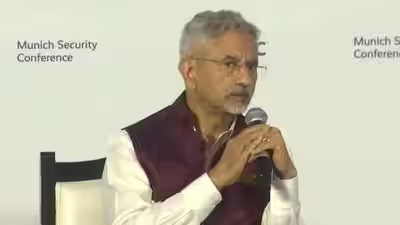
External affairs minister S Jaishankar said India has the potential to move rapidly up the global power hierarchy over the next five to 10 years, citing decades of high growth ahead, a supportive demographic profile and the emergence of new economic opportunities.Speaking at the Munich Leaders Meeting in New Delhi on Sunday, Jaishankar was asked where India would be positioned in the global order five to 10 years from now. He said countries currently classified as middle powers would not necessarily follow the same trajectory.“Some powers are more middle, and some are upper middle,” Jaishankar said. “Some of the powers have considerable and realistic potential even in the near short medium term to grow very rapidly.”Turning to India, Jaishankar said the country has “decades of high growth” ahead and argued that its demographic profile could help sustain that growth.“In the case of India, because we have decades of high growth ahead of us, and we have all said and done, a demography that will sustain that growth,” he said.Jaishankar also argued that India may not need to follow the traditional industrialisation path taken by earlier economies, pointing to the emergence of new possibilities in a rapidly changing global economy.“I would even argue, a world that is much more creative, where many new possibilities are there, so that we don’t necessarily have to tread the earlier path of industrialization,” he said.“The orthodox path will have to devise something much more contemporary for what awaits us,” he added.India’s place among middle powersJaishankar said the global power hierarchy is likely to evolve unevenly, with countries currently grouped together as middle powers potentially moving in different directions.“Among the middle powers, some will peel off, some will stay put, some may drop down a bit,” he said.“That is the reality. That will be part of the evolution of the global order,” Jaishankar added.His remarks came during a wider discussion on the changing international power structure at the Munich Leaders Meeting in New Delhi. The meeting is being held on October 4 and 5 and brings together senior decision-makers and experts to discuss foreign and security policy issues.Jaishankar’s wider power assessmentEarlier during the discussion, Jaishankar said the United States and China should not be viewed as middle powers, highlighting their vastly different levels of global influence.“When we say what the prospects are, we are also looking at an international landscape. As I said, what is important to define is what is not a middle power,” he said.
Share your thoughts in the comments
Be respectful · TOI community guidelines
On the US, Jaishankar said Washington has been the “underwriter of the global system for many decades” and has “a significant lead over any other power”.He then pointed to China’s economic strength, saying it accounts for “one third of the global manufacturing” and that its economic capabilities are translating into political influence.“This is really, in a sense, the subject matter of our discussion,” Jaishankar said.The Munich Leaders Meeting is a platform organised by the Munich Security Conference, a leading international forum on security and foreign policy. The New Delhi meeting on October 4 and 5 brings together senior decision-makers and experts from the Indo-Pacific, Europe and the US for discussions on major geopolitical, foreign and security policy issues.