





In 2007, Chandrakala took over her late husband’s Tirupati woodcarving workshop; today the Andhra Pradesh enterprise reports over Rs 1 crore in annual turnover and supports more than 100 workers
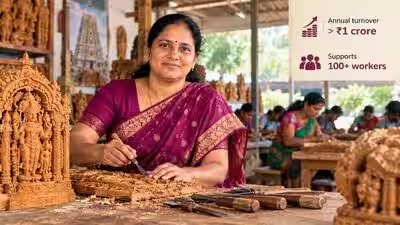
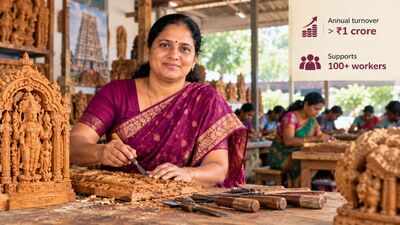
When Chandrakala took charge of her late husband’s woodcarving workshop in 2007, she had more than a family business to protect. She had to keep orders moving, maintain the confidence of skilled artisans and learn to manage customers, accounts and business decisions. Nearly two decades later, the enterprise in Tirupati, Andhra Pradesh, reports an annual turnover of more than Rs 1 crore and provides work to over 100 people.Her journey, highlighted by thePress Information Bureau (PIB) in its account of the National SARAS Mela 2026, shows how a traditional family craft can become a growing enterprise when women gain access to support networks and wider markets. Chandrakala, a member of the Lotus Self-Help Group (SHG), now hopes to take the business further by creating livelihood opportunities for 500 rural women.
A family craft became her responsibility
The woodcarving workshop began in 2002, when Chandrakala’s family, which came from a farming background, started the business. Five years later, her husband passed away, leaving her to take over its operations. The transition brought responsibilities she had not previously handled on her own. The craft itself was familiar from being around the workshop, but managing customers, tracking accounts and making decisions required a different set of skills.Keeping the business running meant ensuring that orders continued and that the artisans working with the workshop could trust her leadership. Rather than allowing the enterprise to stop with the loss of its founder, Chandrakala continued the work and gradually looked for ways to reach more customers. Her experience also reflects a challenge faced by many small traditional businesses: preserving the skill behind a craft while building the commercial relationships needed to sustain it.
How the Lotus SHG helped her move forward
Being part of the Lotus SHG gave Chandrakala a network of women who could understand the pressures she was facing. It offered her a space to discuss challenges and think through the next steps for her business. Over time, exhibitions and trade fairs became important opportunities to introduce her woodcarvings to buyers beyond her immediate area. She travelled to Chennai, Mumbai, Vijayawada, Visakhapatnam and Delhi to display and sell the products.Each event brought new experiences, from setting up stalls in unfamiliar cities to speaking directly with customers interested in buying her work. The response helped her understand the possibilities of taking a local craft to a wider market. One particularly memorable experience was a fair where her stock sold out before the day ended. For a business that had started within a family, such moments demonstrated that its products could find buyers well beyond its home market. The enterprise now supplies products through Lepakshi Emporium showrooms in several cities. According to the PIB account, its woodcarvings have also been procured for gifts intended for ministers and celebrities.
From a local workshop to a Rs 1 crore enterprise
The business has grown considerably since Chandrakala took over. It now reports annual turnover exceeding Rs 1 crore and provides employment to more than 100 people. The scale of the enterprise is significant not only for its sales but also for the livelihoods connected to it. Traditional woodcarving requires skilled hands and time, and a growing business can help sustain the work of artisans while keeping the craft commercially relevant.Chandrakala’s journey is also part of the wider story represented at the National SARAS Mela 2026, held at Punnami Ghat in Vijayawada. Organised by the Ministry of Rural Development in collaboration with the Government of Andhra Pradesh, and supported by NABARD, NIRDPR and Kudumbashree, the event brings together women entrepreneurs and traditional craftspeople from self-help groups.The Lakhpati Didi initiative aims to help women from SHG households achieve a sustainable annual household income of at least Rs 1 lakh. Through the Deendayal Antyodaya Yojana-National Rural Livelihoods Mission, women can access skills, financial support and market opportunities to strengthen their livelihoods. For Chandrakala, the journey has moved well beyond reaching that income milestone. Her business demonstrates how a family skill, supported by market access and collective networks, can develop into a larger source of employment.
Her next goal: Work for 500 rural women
Despite the business’s growth, Chandrakala’s ambition is not limited to increasing turnover. She wants more rural women to benefit from the enterprise and the opportunities it creates. “I want to take this business forward and create work for 500 rural women. That is how I hope to carry this legacy ahead.” Her goal connects the future of the workshop with the livelihoods of other women. Expanding employment would mean taking the family craft beyond its existing workforce and creating opportunities for more people to earn through their skills.From taking charge of a workshop after her husband’s death to building a business with more than Rs 1 crore in annual turnover, Chandrakala has kept the craft moving forward while expanding its reach. Her next challenge is to make that growth meaningful for hundreds of rural women who could become part of the enterprise’s future.