





‘Azam the, Azam hain’: Will the Khan factor help or haunt Akhilesh in 2027 UP elections? | India News
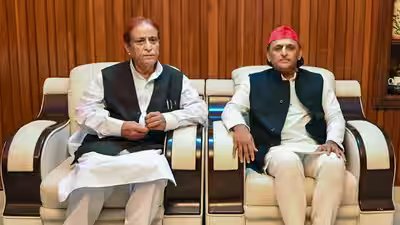
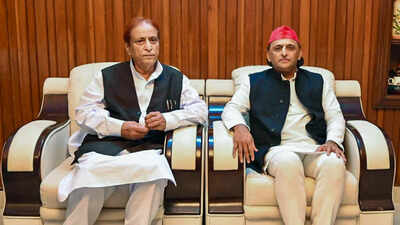
NEW DELHI: “Azam the, Azam hain aur Azam rahenge” (Azam was, Azam is and Azam will remain).With that emphatic declaration, Samajwadi Party chief Akhilesh Yadav sought to end speculation about his equation with one of the party’s tallest Muslim leaders. But the political reality surrounding Mohammad Azam Khan is far more complicated than the slogan suggests.Nine days after Akhilesh’s October 22 visit to Azam at Rampur jail, the veteran leader walked out of prison with his son Abdullah Azam after the Allahabad high court granted them bail in the dual PAN card case. His freedom, however, lasted barely minutes. The Enforcement Directorate arrested him in a separate money-laundering case linked to Mohammad Ali Jauhar University, and a court subsequently remanded him to 14 days’ judicial custody.The dramatic turn has put Akhilesh’s declaration to the test. Once among the most powerful figures in the SP, Azam remains central to the party’s political calculations in Rampur and its relationship with Muslim voters. But his legal battles, the erosion of his family’s electoral stronghold and the growing challenge from Asaduddin Owaisi have turned his return into a complicated political proposition.As Uttar Pradesh heads towards the 2027 assembly election, Akhilesh faces a question that goes beyond personal loyalty: can he hold on to Azam’s political legacy without becoming hostage to its baggage?
The brief freedom
Azam and Abdullah had been in custody since November 2025 following their conviction in the dual PAN card case. The Allahabad high court’s order suspended their 10-year sentences and granted them bail, paving the way for their release.However, the ED had a separate case waiting. The agency arrested Azam shortly after he walked out of Rampur jail, while Abdullah was allowed to go home.The money-laundering investigation relates to alleged financial irregularities in the construction of Mohammad Ali Jauhar University in Rampur. The ED has alleged that government funds were diverted for the university’s construction. Azam is the founder of the university and heads the trust that runs it. These are allegations being investigated by the agency, not findings of guilt in the present case.Speaking to reporters after his release, Azam alleged that he was being punished for being a Muslim and for establishing a university and schools. “What is there left to say? What can I say? The law has ceased to exist. Is this the punishment for being a Muslim?” he said.The following day, a special PMLA court in Ghaziabad sent him to 14 days’ judicial custody. The court proceedings ensured that the brief release did not translate into a return to political activity.
Akhilesh turns arrest into political battle
Samajwadi Party chief Akhilesh Yadav responded sharply to the ED action, accusing the BJP government of using cases to repeatedly send an elderly political leader to jail.In a post on X, the SP chief said: “Let today’s rulers remember that thrones change when the time changes. The conspiracy being hatched against Mr Azam Khan through these cases is being watched not just by the entire country, but by the whole world.”He added that repeatedly implicating an elderly man in cases and sending him to jail was “an utterly cowardly act”, warning that injustice could eventually turn into a calamity for those responsible.The response was significant because it came barely nine days after Akhilesh had visited Azam in jail. That meeting had already signalled that the SP chief was unwilling to distance himself from the veteran leader despite the legal controversies surrounding him.The ED arrest has now sharpened the political messaging. For Akhilesh, the issue is no longer simply Azam’s return to the party’s political fold. It is also about positioning the SP against what it describes as the misuse of investigative agencies to target opposition leaders.The BJP, on the other hand, has defended the ED action, maintaining that the law applies equally to everyone.
The Muslim vote and the Owaisi challenge
For the Samajwadi Party, the stakes in the Azam Khan question go well beyond the fortunes of one leader. They concern the party’s hold over a crucial section of its traditional support base: Muslim voters. Muslims account for roughly 19% of Uttar Pradesh’s population, making them one of the state’s largest voting blocs. Their concentration in several constituencies gives them considerable electoral influence. In the 2022 assembly election, the community was a decisive factor in around 70 constituencies where Muslims formed at least 30% of the population.The 2022 results also showed how strongly the community rallied behind the SP. The party fielded 64 Muslim candidates, of whom 31 won, taking the total number of Muslim MLAs in the assembly to 36, up from 24 in 2017. The BSP fielded 88 Muslim candidates and the Congress 75, while AIMIM fielded more than 60. Yet neither the BSP nor Congress managed to elect a single Muslim MLA. The results suggested that the SP had emerged as the principal beneficiary of Muslim consolidation, even as smaller parties remained relevant in individual constituencies.
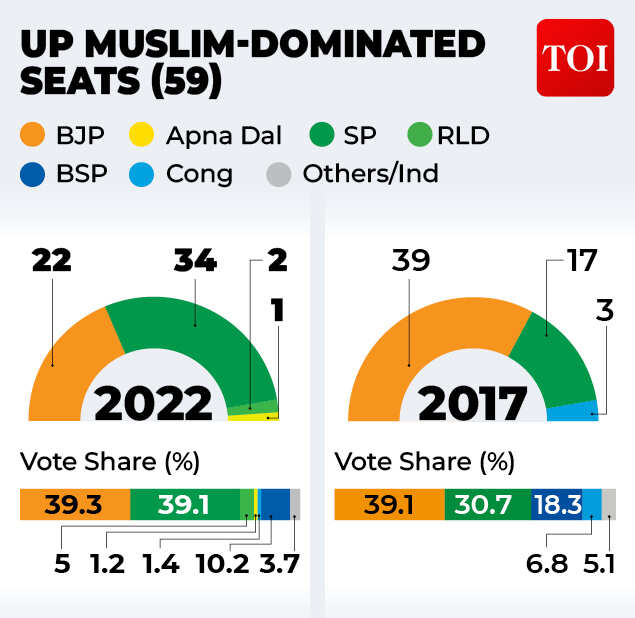
Muslims account for at least 30% of the population in around 70 constituencies.
Azam Khan was central to this political equation. His influence in Rampur and his standing among sections of the Muslim community gave the SP an important local and regional network. His electoral record, along with that of his wife Tazeen Fatima and son Abdullah Azam, made the family one of the most prominent Muslim political establishments in the state. His absence from active politics has therefore left a space that other political players may seek to occupy.It is this space that AIMIM chief Asaduddin Owaisi is attempting to enter. His October 18 rally in Tanda was a reminder that the SP cannot take Muslim support for granted. Owaisi accused Akhilesh of treating Muslims as a vote bank while prioritising the Yadav community, and questioned why the SP leadership had not done more for Azam Khan. His pitch was for independent Muslim political representation, arguing that the community should produce its own MLAs and MPs rather than remain a support base for established political families.Owaisi’s intervention is significant because the SP’s electoral arithmetic depends not just on retaining Muslim support but also on preventing its fragmentation. The 2022 results showed the limits of smaller parties: although BSP and AIMIM fielded substantial numbers of Muslim candidates, neither managed to convert that presence into Muslim representation in the Assembly. However, even without winning seats, such parties can potentially affect the outcome in closely contested constituencies by splitting votes.Akhilesh’s October 22 visit to Azam in Rampur jail was therefore also a political signal. His declaration, “Azam they, Azam hain aur Azam rahenge” (Azam was, is and will remain), aimed to reassure the veteran leader’s followers that the SP had not abandoned him. The visit came amid growing questions over whether Owaisi could use sympathy for Azam to make inroads among Muslim voters.The challenge is compounded by the SP’s wider social coalition strategy. Akhilesh has sought to move beyond the traditional Muslim-Yadav combination through his PDA (Pichhda, Dalit, Alpsankhyak) framework, bringing backward classes, Dalits and minorities under a broader political umbrella. But the party cannot afford to lose its Muslim support base while attempting to expand its reach among other communities.
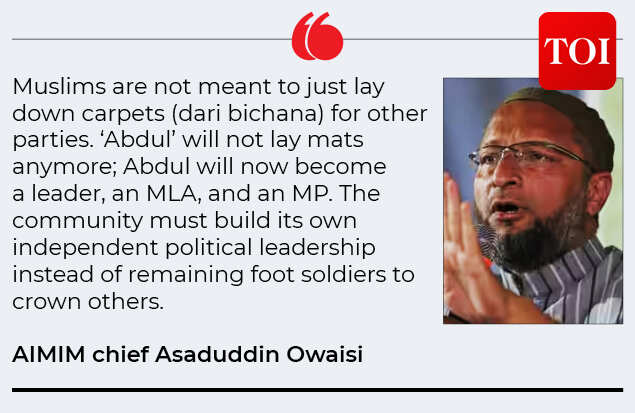
Owaisi has attacked Akhilesh Yadav over the treatment of Azam Khan’s family.
As the 2027 assembly election approaches, Akhilesh faces a delicate balancing act. He must reassure Azam’s supporters that the SP continues to value the veteran leader and his political legacy, while ensuring that the party’s Muslim support base does not become an opening for Owaisi or other rivals. The 2022 election demonstrated the electoral value of Muslim consolidation behind the SP. The question now is whether Akhilesh can hold that coalition together without relying too heavily on one leader or one political family.
From kingmaker to political liability?
To understand Akhilesh Yadav’s dilemma, one must first understand the extent of Azam Khan’s influence in Rampur. For decades, Khan was not just the Samajwadi Party’s most powerful face in the district but the man who dominated its political landscape. He challenged the influence of Rampur’s erstwhile Nawab family and gradually built a formidable political network, winning the Rampur Sadar assembly seat 10 times. His influence extended beyond his own electoral victories: his wife, Tazeen Fatima, succeeded him as MLA in a 2019 bypoll, while his son Abdullah Azam twice won the Suar assembly seat. The Azam family’s political presence became so entrenched that Rampur’s electoral fortunes were often seen through the prism of Khan’s influence.That hold was not easily broken. In the 2022 assembly election, Azam Khan won Rampur Sadar for the 10th time despite campaigning from jail. The BJP’s Akash Saxena, one of his most prominent political adversaries who had pursued several cases against Azam Khan and his family, lost that contest. But the equation changed after Khan was disqualified following his conviction in a hate speech case. In the December 2022 bypoll, Saxena defeated Azam Khan’s close aide Asim Raza by around 34,000 votes, delivering the BJP its first victory in Rampur Sadar and making Saxena the first Hindu candidate to win the constituency. The result marked a significant breach in a political stronghold that Khan and his family had dominated for decades.The erosion of the Azam family’s influence became more apparent in the 2024 Lok Sabha election. With Khan, his wife and son facing imprisonment, the SP fielded Maulana Mohibullah Nadvi from Rampur. The choice reportedly upset Khan’s loyalists, many of whom stayed away from campaigning, exposing a growing rift between the local Azam camp and the party leadership. It was a reminder that Azam Khan’s network could still matter to the SP even in his absence, but also that Akhilesh could no longer assume the family would automatically fall in line with the party’s decisions.His treatment by the central agencies gives the party an opportunity to frame the issue as one of political targeting and due process. But the party will have to contend with the electoral consequences of being closely associated with a leader whose legal record has become a recurring political flashpoint.The challenge for Akhilesh is to retain the political value of the Azam network without allowing the controversies surrounding Khan and his family to define the SP’s wider campaign. In Rampur, the question is no longer simply whether Azam Khan can return to politics. It is whether the political machinery he built can still deliver for the Samajwadi Party, and on whose terms.
BJP’s counter: ‘Mafia raj’ and law and order
In 2022, UP CM Yogi Adityanath famously said: “Even Akhilesh doesn’t want Azam Khan to come out of jail because it will pose a threat to his position [chair]. The state government has nothing to do with these cases, whether they are related to Azam Khan or anyone else. It is the court that grants bail.”“Under previous governments, mafias were running a parallel administration. When we took action against the land mafia who grabbed poor farmers’ land for private universities and personal fiefdoms, the Samajwadi Party developed sympathy for criminals instead of the victims,” he had said.The above remarks are at the core of the BJP’s attack.The BJP has consistently used the Azam Khan issue to attack the Samajwadi Party’s record on law and order. The party’s broader political narrative has sought to associate the SP’s previous tenure with alleged criminal influence and what it describes as ‘mafia raj’.That gives the BJP an obvious line of attack if Akhilesh makes Azam’s rehabilitation a central political theme. The ruling party can frame the SP’s outreach as evidence that it has not moved away from its past.
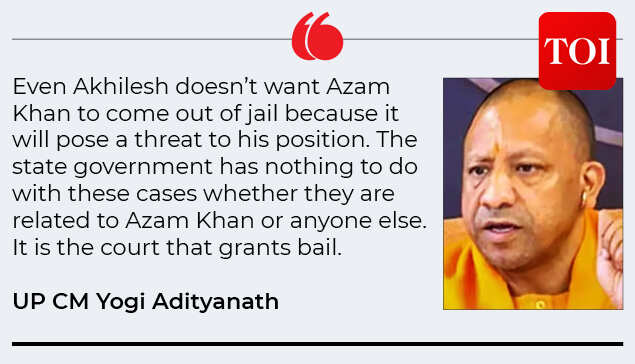
UP accused Akhilesh of opposing Azam Khan’s release out of concern that the veteran leader could challenge his position in party.
The SP, meanwhile, has to navigate the distinction between allegations, court findings and the political narrative built around them. It can point to the legal process and the need for due process, but it cannot wish away the electoral impact of the cases and convictions.The BJP’s attack also puts the SP’s broader coalition strategy under pressure. Akhilesh has sought to expand the party’s social base beyond its traditional support groups through the PDA framework. A campaign dominated by the Azam Khan controversy could complicate that effort.Akhilesh’s jail visit, his response to the ED arrest and the party’s continued engagement with Azam Khan send a message to the SP’s traditional supporters: the party has not abandoned a leader who played a major role in building its political presence.But the message also carries risks. The SP has to decide how much political space to give the Azam family, how prominently to project its association with them and how to prevent the issue from becoming a defining feature of its 2027 campaign.
Share your thoughts in the comments
Be respectful · TOI community guidelines
For Akhilesh, the Azam question will ultimately be about the political arithmetic as much as loyalty. He needs to reassure sections of the Muslim electorate that the SP remains attentive to their concerns, while keeping the PDA coalition broad enough to bring together backward classes, Dalits and minorities.As Uttar Pradesh moves towards 2027, Akhilesh’s tightrope walk will be to retain the political value of an old ally without inheriting all the baggage that comes with him. Azam may be an asset the SP cannot easily discard, but he may also turn out to be a liability the party cannot afford to let define its next election.