









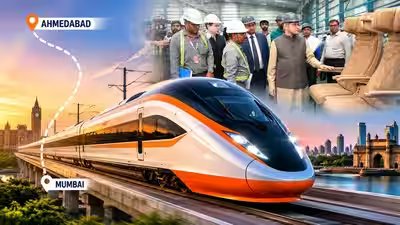
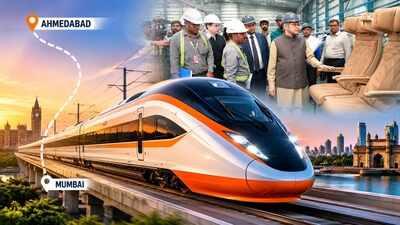
India’s first indigenously developed high-speed bullet train, B28, has cleared an important stage of its safety evaluation and is undergoing the vehicle body shell assessment, commonly called the “squeeze test”.The assessment was carried out at BEML’s manufacturing facility in Bengaluru. The central public sector undertaking (PSU) is building the country’s first two indigenous bullet trains, with each train consisting of eight coaches.Indian Railways is working towards starting trial runs of the B28 train on the 100-km Surat-Vapi stretch of the Ahmedabad-Mumbai High Speed Rail corridor by May-June 2027. Commercial services on this section are expected to commence in August 2027.What will be special about India’s first bullet train? What are the features that passengers can look forward to? We take a look:
India’s first bullet train: Top 20 features you must know
Designed specifically with Indian operating conditions in mind, Indian Railways says that the train combines engineering capabilities with domestic manufacturing expertise, while placing emphasis on passenger safety and comfort.
- Designed for a maximum testing speed of 280 km/h and an operating speed of 249 km/h.
- Total train length of approximately 202 metres.
- Eight-car configuration comprising four motor cars and four trailer cars.
- Passenger capacity of around 557, including dedicated space for two divyangjan or persons with reduced mobility. Information signage includes Braille to assist visually impaired passengers.
- Seven standard-class coaches featuring 3×2 seating and one executive-class coach with a 2×2 seating arrangement.
- Driver’s cabs at both ends, equipped with an intelligent on-board control system to facilitate quick decision-making and coordination with the operation control centre.
- Two eight-car trainsets can be coupled to operate as a 16-car train in the future.
- Ergonomically designed seats with sufficient legroom.
- LED lighting throughout the interiors.
- Overhead racks for carrying baggage.
- Additional luggage stands on the floor for larger bags and suitcases.
- Power outlets for charging mobile devices and operating laptops.
- Modern bio-digester toilets designed to minimise effluent.
- Large windows alongside every row of seats, allowing passengers to enjoy the view.The train will also feature sealed, single-piece gangways connecting its coaches, enabling passengers to move between cars comfortably.
- LCD screens inside the coaches display information in English, Hindi and regional languages.
- Public address and automatic announcement systems provide audio information to passengers.
- Emergency talk-back units installed in passenger cabins and vestibules allow travellers to contact the train crew during emergencies.
- A Wi-Fi-based passenger infotainment system gives travellers access to preloaded entertainment and other infotainment content.
- Retractable steps fitted into the doors help reduce the horizontal gap between the train and the platform.
- The heating, ventilation and air-conditioning (HVAC) system is designed to regulate the temperature and humidity inside the train, helping maintain comfortable conditions for passengers. Each coach is fitted with two HVAC units.
- Sound insulation within the car body and floor structure. Special coatings designed to dampen noise. Skirts, bogie covers and fairings that form part of the train’s noise-reduction measures.
- It is also equipped with regenerative braking technology, which recovers energy during braking and helps improve overall energy efficiency.
What is a squeeze test?
The test examines whether the train’s outer structure can bear intense pressure and external forces without suffering excessive deformation or structural damage in the event of a collision or crash.Officials familiar with the development said the exercise assumes particular importance because of the high speeds at which these trains will run. Their body structures must be strong enough to withstand substantial external forces if they are involved in an accident or collision.“After the successful completion of this test, the prototype should ideally be ready in less than six months. Since the B28 (Bharat 28) train is not being built on Japanese Shinkansen technology, the development process should not take much time. The squeeze test establishes whether the body retains its shape under pressure and whether the passenger compartment maintains its structural integrity,” an official told TOI.Earlier, while approaching the Cabinet for approval of the increased cost of the country’s first bullet train project, the railway ministry had indicated that two prototype trains would be ready for trial operations in the first quarter of 2027.The ministry had also outlined the broader construction timeline for the corridor. The entire Gujarat section is expected to be completed by December 2027, while the full 508-km Mumbai-Ahmedabad High Speed Rail corridor has a completion target of December 2030.
What feature are you most looking forward to in the B28 bullet train?
3k+ users shared opinion today
5k+ users already voted today
3k+ users shared opinion today