











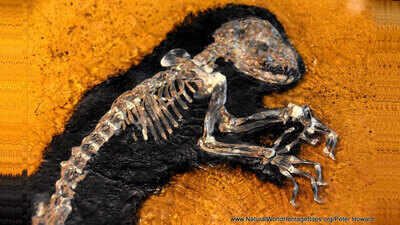
A tiny owl that lived around 47 million years ago has offered scientists an unusual clue to one of the biggest questions about the evolution of these birds: when did they become predominantly nocturnal? The answer may lie in an unexpected place, inside the fossilised bird’s stomach, where researchers found the remains of its last meal, an iridescent cockroach.The newly identified species, named Masillastrix blattophaga, lived during the Eocene epoch and was discovered at Germany’s Messel Pit, a fossil site known for its exceptionally preserved remains. Although its skull is missing, much of the bird’s skeleton has survived. Measuring less than 12 centimetres, the owl appears to have been active during daylight, according to a study published in the journal Current Biology on November 2, 2026.
What the cockroach revealed about the ancient owl
The cockroach preserved inside the owl’s stomach was greenish-blue and iridescent. Researchers identified it with the help of a similar, exceptionally preserved cockroach found in sediments close to the bird fossil.The insect offered one clue about the owl’s behaviour. Iridescence is commonly associated with insects active during daylight, suggesting that the bird may have hunted during the day rather than at night.However, the researchers did not rely on the last meal alone. The appearance of the owl’s feathers and the structure of its upper-wing bones also supported the possibility that it was diurnal, meaning primarily active during daylight hours.Study first author Gerald Mayr, a paleontologist and head of ornithology at the Senckenberg Research Institute and Natural History Museum Frankfurt, pointed to the bird’s stout upper-wing bones, known as humeri, as another important clue.Modern nocturnal owls generally have more elongated and slender humeri, an anatomical feature associated with their ability to fly almost silently. The stockier bones of Masillastrix blattophaga suggest a different flight adaptation, potentially suited to daytime activity.
When did owls become nocturnal?
The discovery indicates that owls were not necessarily nocturnal 47 million years ago. Researchers estimate that the transition towards predominantly nocturnal behaviour occurred sometime between 47 million and 35 million years ago.The earliest known owl fossils showing features associated with modern nocturnal owls date to around 35 million years ago, during the Late Eocene. These birds had more elongated upper-wing bones, resembling those of many owls living today.The fossil record also includes Ogygoptynx wetmorei, the oldest known owl, dating to approximately 60 million years ago. However, the evidence remains limited, with many early owl species known from only a small number of isolated bones.The researchers therefore describe the 47-million-to-35-million-year window as the best current estimate, rather than a precisely established date for the evolutionary transition.
Why did owls start hunting at night?
The discovery helps narrow down when owls may have adopted their predominantly nocturnal lifestyle, but it does not explain why the change happened.Earlier theories suggested that becoming nocturnal helped owls avoid competition with daytime birds of prey or take advantage of the growing population of nocturnal mammals. However, the major expansion of these groups appears to have happened much later, around 20 million to 25 million years ago.That leaves scientists without a clear explanation for what drove the change.The new fossil adds an important piece to the evolutionary puzzle, showing that at least some ancient owls may have been active during daylight. Further discoveries could help researchers understand how their anatomy and behaviour changed over millions of years.