









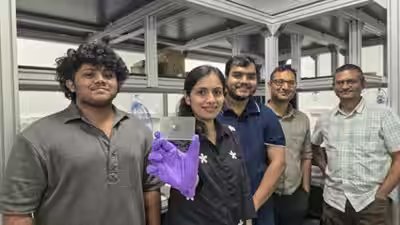
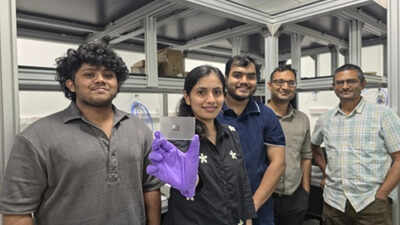
BENGALURU: As the world prepares for the next generation of wireless communication, researchers are working on a problem that could determine how fast future networks become: how to keep signals strong as they travel through increasingly compact devices.A team from Bengaluru’s Jawaharlal Nehru Centre for Advanced Scientific Research (JNCASR) has developed a silicon chip that could help solve this problem. The chip allows high-frequency signals to pass through deliberately created barriers and sharp turns without losing much of their strength, while carrying data at speeds of up to 100 gigabits per second.The development could contribute to building smaller and more efficient circuits for sixth-generation (6G) communication networks, which are expected to use terahertz waves to transmit large amounts of data.Terahertz waves occupy a part of the electromagnetic spectrum between microwaves and infrared light. They can carry much more information than the frequencies used by today’s wireless networks. But working with these waves presents a challenge. When they encounter bends, junctions or obstacles inside a circuit, some of their energy can scatter or bounce back, weakening the signal.The JNCASR team found a way to overcome this using a specially designed silicon structure. They arranged tiny triangular holes in the silicon in a pattern that allows terahertz signals to travel along a defined path. By changing the sizes of these holes over a short section, they created a barrier that the signals could cross with very little loss.In their experiments, a single barrier reduced the signal by just 1-2%, while two barriers placed one after another resulted in a loss of only 2-3%. In conventional circuits, similar obstacles can significantly weaken signals.Researchers tested the technology in three different chip designs, including one that routed signals through four sharp bends and another that split a signal into two pathways. The devices were tested at frequencies between 310 and 360 gigahertz.In data transmission experiments, one of the devices achieved speeds of 100 gigabits per second using a technique that allows information to be encoded through changes in a signal’s strength and phase. At this speed, a 5GB high-definition film could theoretically be transferred in less than half a second.“Showing that terahertz waves can cross a barrier created simply by changing the hole geometry, while carrying 100 gigabits per second, suggests that this effect can become a useful design tool for terahertz chips,” said Abhishek Kumar, assistant professor at JNCASR, who led the study.
Share your thoughts in the comments
Be respectful · TOI community guidelines
The team included Samina Mulla and Sangram Kumar Sadhu as joint first authors, along with collaborators from research institutions in India, Singapore and France.An important aspect of the work is that the chip is made using high-resistivity silicon, a material compatible with established semiconductor manufacturing processes. This could make it easier to translate the research into practical devices.The findings, published in the journal Advanced Materials, could help develop compact circuits capable of directing and splitting terahertz signals on a single chip. Researchers now plan to explore ways of controlling the barriers using electrical, thermal or mechanical changes, potentially allowing signals to be redirected between different paths when required.