










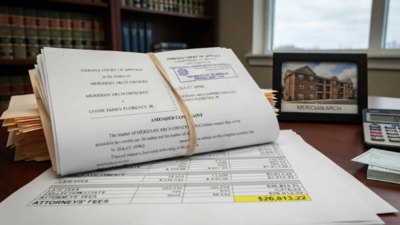
An Indiana man who bought a condominium in 2020 has lost his appeal after a dispute over unpaid homeowners’ association fees grew into a $26,813 debt, even though he had already paid $9,489. On November 19, 2026, the Indiana Court of Appeals upheld the ruling against him and sent the case back to a lower court to decide how much he must pay for the association’s legal bills.The legal fight is between Onnie James Florence Jr. and the Meridian Arch Owners Association. Florence claimed the association made several mistakes in its court case, raising questions about how his payments were handled, how court papers were delivered to him, and how his mortgage lender was involved. However, the appeals court disagreed with his claims, noting in its written decision that Florence did not show any proof that his $9,489 payment was left off his account and that he missed the deadline to fight an earlier ruling against him. According to the court decision published by Justia, the conflict started over $5,229.80 in unpaid condominium fees and eventually turned into a foreclosure case, multiple court requests, and a much bigger bill.
A condominium purchase followed by unpaid fees
Florence bought a unit at Meridian Arch Condominiums in 2020. The property is run by the Meridian Arch Owners Association, which collects regular fees from owners to pay for building and community costs. According to the Indiana Court of Appeals, Florence first planned to live in the condominium with his daughter, though those plans fell through and he stayed at his home in Illinois instead. Even though he did not live there, he still had to pay the monthly fees, as unpaid bills under the association’s rules can become a legal claim, or lien, on the condominium that lets the association push for foreclosure to sell the home.By May 2021, Florence owed $5,229.80 in unpaid fees, prompting the association to file a lawsuit asking the court to foreclose on its claim. The association first tried to hand the court papers to Florence in person, and when that did not work, it sent a new summons and a copy of the lawsuit by certified mail to his home in Illinois, which arrived on June 15, 2021. Florence did not answer the lawsuit or show up in court, so on September 28, 2021, the association asked the court for an automatic win, called a default judgment. According to court records, the association filed a sworn statement showing Florence owed $9,213.50 as of September 14, 2021, covering unpaid fees, late charges, collection costs, and legal bills, and the trial court agreed and ruled against him.
Foreclosure proceedings begin
The association then moved to sell Florence’s condominium to get the money it was owed, asking the court in November 2021 to schedule a sheriff’s sale of the unit. Florence finally joined the case and asked the judge to cancel the automatic ruling against him, claiming the association had not properly delivered earlier court papers to him and had started the foreclosure too early under Indiana law. The association pushed back against those claims, stating that mailing the lawsuit and summons by certified mail to his Illinois home met all legal rules and arguing that a different Indiana law for condominium groups allowed it to start the foreclosure case when it did.In September 2022, Florence asked the court to throw out the case or merge it with a separate foreclosure lawsuit filed by his mortgage lender, CrossCountry Mortgage LLC, arguing that the association failed to tell CrossCountry about his unpaid fees before suing him despite requirements in its own rules. In October 2022, the case was moved to the same court handling the mortgage lender’s lawsuit after the judge noted that both cases involved the same home, people, and money, so combining them would prevent conflicting rulings. On January 29, 2024, the court denied Florence’s requests to cancel the default judgment and throw out the case.
$9,489 payment did not end the dispute
In April 2024, a foreclosure order went to the sheriff to start the sale of the property, though that sale was called off after Florence paid the association $9,489. The association counted that money as a partial payment toward the existing court judgment, but it did not cover everything he owed. In September 2024, the association told the court that Florence still owed $1,922.84 on the original judgment because of interest that had piled up since the first ruling, and it also wanted to collect new unpaid fees and costs that had built up since the lawsuit began.The association stated that Florence owed another $19,368.17 in association fees, late charges, expenses, and legal bills, covering monthly fees from September 14, 2021, through December 31, 2024, plus other costs added up through August 31, 2024. At first, the judge turned down the request, explaining that the association could not simply tack years of new fees onto a lawsuit after a final ruling had already been made. After the association asked the court to set aside the old default judgment and foreclosure order so it could update its original lawsuit, the judge agreed in November 2024, and the association filed an updated lawsuit asking for the extra unpaid fees, expenses, and legal bills while officially adding CrossCountry Mortgage and an unknown resident living in the unit to the case.
Court upholds $26,813 judgment
In September 2025, the association asked the judge to decide the case without a trial, filing money records and sworn statements showing Florence owed $26,813.22 in unpaid fees, late charges, collection costs, and lawyer bills, while also showing that his $9,489 payment had been applied to his balance. The trial judge gave Florence two extra deadlines to reply to the request, said no when he asked for a third delay, and ruled in favour of the association on February 3, 2026, after Florence never filed a response. Florence then asked the judge to rethink the decision and halt a sheriff’s sale set for April, claiming the association had not properly counted his earlier $9,489 payment and demanding a full, line-by-line record showing exactly where that money went, which the trial judge denied before Florence filed an appeal.In its November 19, 2026, decision, the Indiana Court of Appeals reviewed four main points Florence raised. First, the judges ruled that he had run out of time to fight the January 2024 decision that kept the original default judgment in place, as he missed the 30-day window to appeal that order under Indiana court rules. Second, the court rejected his claim that the case should be thrown out because CrossCountry was left out at the start, finding that the issue no longer mattered since the mortgage lender was later added to the updated lawsuit. Third, the judges said the association did not have to send Florence a brand-new court summons after updating its lawsuit because his lawyer was already involved in the case, meaning sending the papers to his attorney followed Indiana Trial Rule 5.
Appeals court says payment was credited
Turning to the main fight over the $9,489 payment, Florence claimed the association’s math ignored the money he paid in August 2024, but the appeals court pointed to the association’s sworn debt record clearly listing the payment. That record stated, “The last payment was received and credited to [Florence]’s account on August 20, 2024, in the amount of $9,489[],” and the judges noted that Florence offered no proof showing that statement was wrong. He also claimed he had a right to “a verified accounting identifying each payment and its application,” though the appeals court said he waited too long to bring up that point by only asking for it after losing the summary judgment, meaning he could not use it to win an appeal and leaving the court with no reason to overturn the judgment against him.The association also asked the court to make Florence pay its legal bills for the appeal, and the judges agreed, pointing to the association’s governing rules allowing it to recover reasonable lawyer fees when suing to collect unpaid assessments. On November 19, 2026, the Indiana Court of Appeals upheld the lower court’s ruling and sent the case back to the trial judge to calculate the exact legal fees Florence owes for the appeal. Judge DeBoer wrote the opinion, with Judges Foley and Felix concurring, keeping the $26,813.22 judgment active and letting the trial court set the final amount of extra legal fees Florence must pay to the Meridian Arch Owners Association.