









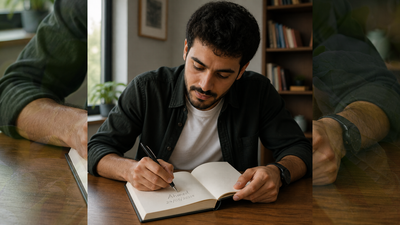
Whenever we buy a new book, the smell of a new book almost pulls us into a slew of nostalgia all the way going back to school and the love for the idea of belonging itself.The smell of the pages, the crisp spine, the cover that has never been bent, all give a feeling of novelty.But there’s a unique habit we tend to follow, and even before we read a single line, we open the first page and write our name and maybe a short note. It takes five seconds, and most of us do it without thinking about why.Yet the habit is common, and it is quietly powerful. That page is not like the rest of the book. It is the first thing you see when you open the cover, and once your name is there, the book changes. It is no longer just a book from a shop. It is yours.Think of the books you have lent to a friend, or the old ones you found in a second-hand shop with someone else’s name inside. A small signature can carry a whole story.So what is really going on in our minds when a pen touches that first page? Let us look at what psychology has to say about this tiny ritual.
Why do we write our names on a new book? What does psychology say about it?
Open a new book, pick up a pen, and write your name on the first page. It looks like a tiny, thoughtless habit, but psychology suggests there is more to it. Researchers who study ownership say that what we feel about our things is not just about money or law. It is also about who we think we are.Psychologists call this feeling psychological ownership. According to a study published in a 2003 paper in Review of General Psychology, it is the state in which a person feels that something, or part of it, belongs to them. The authors associate with basic needs, including feeling effective, expressing identity, and having a place that feels like home. A freshly signed book can quietly meet all three.
Our things quietly become part of “me”
Marketing scholar Russell Belk argued in his 1988 paper in the Journal of Consumer Research that people see their possessions as part of the self. Possessions can become part of the owner’s extended self and according to researcher named Mann, who says, “What I own feels like a part of me.” A book you picked yourself shows your taste, curiosity and mood at that moment, so signing it feels natural.
A name is a quiet marker
A 2005 paper published in the Academy of Management Review explains that people use territorial behaviours to build, communicate, maintain and restore their claim over things. Their focus was the workplace, but the idea fits well here too. A name on a page tells everyone, including your future self, that this copy is yours. It also helps if the book is borrowed and helps to avoid mixing up with someone else’s on a shelf.
Owning something raises its value to us
In a 1990 study in the Journal of Political Economy, researchers gave coffee mugs to half of the participants at random, then set up a market. Owners wanted much more to sell than non-owners would pay, and fewer mugs changed hands than economic theory predicted. This is called the endowment effect. Signing a book is a small act of making it yours, and that sense of ownership may be one reason a signed book is harder to give away.So, the next time you sign a new book, you are doing more than writing a name. You are not only stating your ownership but also associating your belonging with the small piece of the world and saying, quietly, that this story is now part of your life.