









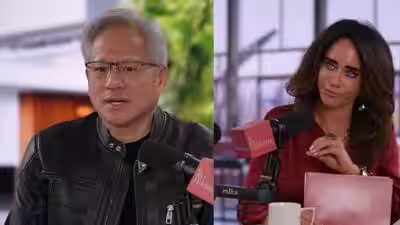

For years, being considered intelligent often meant being good at mathematics, solving difficult problems, understanding technology or writing computer code. But as artificial intelligence becomes increasingly capable of performing such tasks, could the qualities we associate with intelligence be changing? Nvidia CEO Jensen Huang believes they are.During a conversation with Jodi Shelton on the ‘A Bit Personal’ podcast, Huang was asked a seemingly straightforward question: Who is the smartest person he has ever met? Rather than naming an individual, he used the opportunity to explain why he believes people have a limited understanding of intelligence.“I can’t answer that question,” he responded, before challenging the conventional idea that intelligence is primarily about technical knowledge and problem-solving. His answer offered an interesting perspective on how human abilities could become even more valuable as AI advances.
Why traditional measures of intelligence may no longer be enough
Huang explained that people have traditionally associated intelligence with the ability to understand complex subjects, solve problems and demonstrate strong technical skills. However, he believes these abilities are becoming less distinctive as AI systems improve. “The definition of smart is somebody who’s intelligent, solve problems, technical. But I find that that’s a commodity,” he explained.He pointed to software programming as an example. For a long time, coding was considered one of the most intellectually demanding professions. Yet AI tools are increasingly capable of writing code, identifying errors and assisting with complicated programming tasks.Huang questioned this traditional understanding of intelligence, suggesting that technical problem-solving alone may not be enough to distinguish people in the future. His argument was not that technical knowledge has become unimportant. Rather, he believes the qualities that make someone truly valuable are expanding beyond what machines can increasingly perform.
The combination of technical knowledge and human empathy
Instead of focusing entirely on academic achievements or technical expertise, Huang offered his own definition of intelligence. He believes truly smart people possess a combination of technical understanding and human empathy. He explained that such individuals can understand what others are thinking without everything being explicitly communicated. They can recognise situations that others might overlook and anticipate challenges before they become obvious.In his words, intelligence involves “the ability to infer the unspoken, the around-the-corner, the unknowables.” This ability to understand people and situations beyond the information immediately available is something Huang considers particularly valuable.For instance, someone managing a team might notice that an employee is struggling even when they have not directly expressed it. Similarly, a business leader might recognise early signs of a problem before it becomes visible in reports or performance figures. Such decisions require more than analysing numbers. They involve experience, observation, judgement and an understanding of human behaviour. For Huang, these qualities represent an important part of what intelligence should mean in an increasingly technology-driven world.
What does it mean to ‘feel the vibe ’?
One of the most interesting parts of Huang’s explanation was his reference to something he described as ‘feeling the vibe’. He suggested that people who can sense potential problems before they arise often rely on a combination of different abilities. He explained that this instinct comes from “data analysis, first principles, life experience, wisdom” and the ability to sense other people.In other words, it is not simply about making decisions based on feelings. It involves combining available information with experience, logical thinking and an understanding of people. Someone with this ability may recognise that something is not right even when there is no obvious evidence yet. Their experience helps them connect different signals and identify possibilities that others may miss.Huang believes people who can anticipate challenges in this way will become increasingly valuable. He also made an interesting observation about conventional academic assessments. According to him, someone with these qualities might actually perform poorly on a standardised examination such as the SAT.His point was that examination scores cannot necessarily capture every form of intelligence, particularly qualities such as empathy, judgement and the ability to understand situations that have no straightforward answers. The conversation offers a thought-provoking perspective on how people might need to rethink intelligence as AI becomes more capable.For students, professionals and those entering the workforce, the message is worth considering. Learning technical skills remains important, but developing the ability to understand people, think independently and make sound decisions could be just as valuable. Huang’s answer also leaves readers with an interesting question: In a world where machines can increasingly solve complex problems, will the ability to understand what cannot easily be measured become one of the most important forms of intelligence?