






From oil to rice, here’s how Middle East crisis may spread across global economy
The Middle East conflict is entering another week, and its ripple effects are already being felt across the global economy. As tensions intensify, trade flows, energy supplies and food production are coming under strain at a time when markets already spent the last year grappling with tariffs and other disruptions.Although the latest escalation began just a week ago, early signs of pressure are already emerging across global trade networks. Shipments of crucial commodities have been delayed, shipping routes disrupted and prices of critical inputs have spiked. According to economists cited by CNN, the ultimate economic damage will depend on how long the conflict continues. Before the United States and Israel carried out attacks on Iran over the weekend, the International Monetary Fund had projected global economic growth of 3.3% this year. The IMF has not yet revised this forecast, saying it is still “too early” to determine the full impact. However, the institution said it is “closely monitoring developments” and warned of several potential risks to the world economy, including further trade disruptions, “surges in energy prices” and “volatility in financial markets”.Dan Katz, deputy managing director at the IMF, said that the expanding conflict could have broad consequences, noting that it could be “very impactful on the global economy across a range of metrics,” including inflation and economic growth.Key ways the conflict could impact the global economyBased on early developments and industry assessments, the war could affect the global economy through several major channels:
1. Rising energy prices
Energy markets are at the centre of the economic risks. Concerns about supply disruptions have pushed Brent crude, the global oil benchmark, to its highest levels in more than 18 months.A major worry is the potential disruption of the Strait of Hormuz, a narrow waterway between Iran and Oman that serves as a vital route for global energy shipments. According to the US Energy Information Administration, around one-fifth of the world’s daily oil and liquefied natural gas production passes through this corridor.If the route becomes effectively impassable, the consequences for energy markets could be severe. Goldman Sachs estimates that European benchmark natural gas futures could more than double from levels seen before the conflict if shipments through the strait are halted for more than two months.Higher energy prices would likely feed into broader inflation across economies.In Europe, consumer inflation, which stood at 2% in January, could rise by more than one percentage point if the conflict lasts several months, according to Holger Schmieding, chief economist at Berenberg bank, as cited by CNN. In that scenario, economic growth in the European Union could also be reduced by up to half a percentage point.Fuel costs are already increasing. Germany has seen double-digit rises in petrol and diesel prices over the past week, according to the country’s largest automobile association, ADAC. Petrol prices have also risen in the United Kingdom, while in the United States they have climbed to their highest level in 11 months.Goldman Sachs estimates that if oil prices remain at current levels for several months, US consumer inflation could rise from 2.4% in January to 3% by the end of the year. That would make it harder for the Federal Reserve to cut interest rates.
2. Greater vulnerability for Asian economies
Asian economies may be particularly exposed to energy shocks linked to the conflict. Consultancy Capital Economics estimates that between 80% and 90% of the crude oil and liquefied natural gas transported through the Strait of Hormuz is headed for Asia.China is among the largest buyers of these supplies. The conflict comes at a sensitive moment for the country, which has recently set its lowest economic growth target in decades.Capital Economics said the attacks on Iran could push inflation higher across Asia. “Most economies in Asia are worse off and facing higher inflation as a result of the attacks on Iran,” the firm’s economists wrote in a note Tuesday.They added that inflation could increase by around half a percentage point in many Asian countries if Brent crude prices remain at their current levels.
3. Disruption to exports and global trade
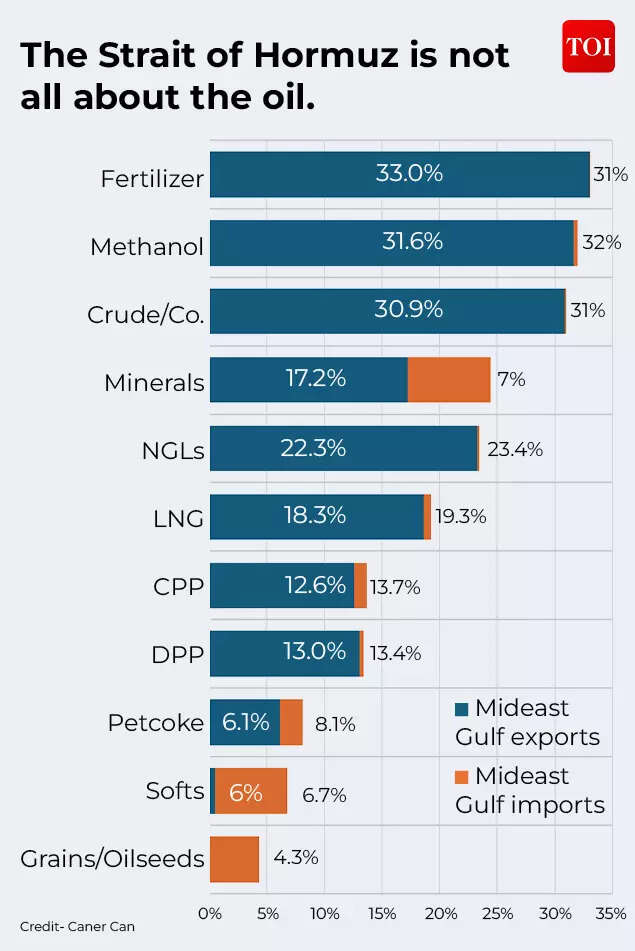
Trade flows are also starting to feel the impact of the conflict. Shipping disruptions across the Middle East have already begun affecting exports.India is one of the countries facing consequences with more than 400,000 metric tons of basmati rice grown in the country for export currently stuck at ports or in transit, because shipping routes through the region have been disrupted.According to Satish Goel, president of the All India Rice Exporters’ Association, around 75% of India’s annual basmati rice exports, roughly 6 million tons, are shipped to the Middle East.The region has become an important export destination for Asian economies that have faced higher tariffs from the United States. Deepali Bhargava, head of Asia-Pacific research at ING, said that if the conflict continues, exporters in India and China could suffer the most.
4. Pressure on fertiliser supply and food production
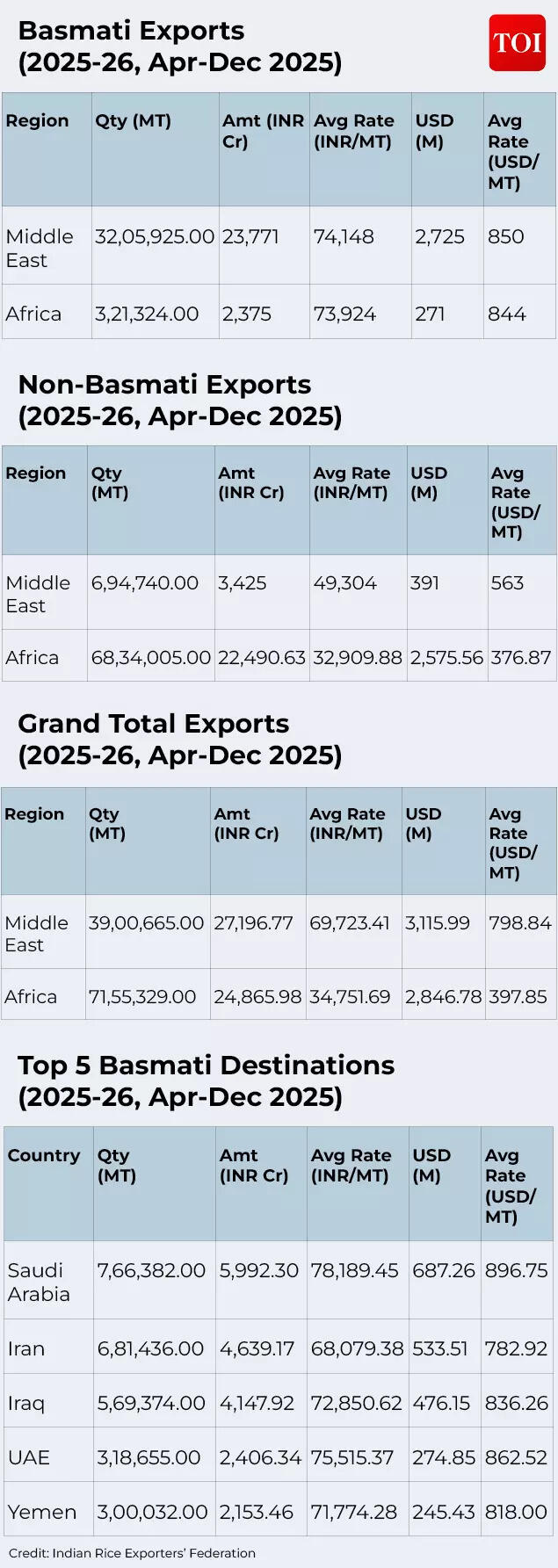
Another critical concern is the impact on fertiliser supplies, a key component of global food production.Svein Tore Holsether, CEO of Norwegian chemical company Yara International, warned that the Strait of Hormuz is crucial for the fertiliser trade.“The Strait of Hormuz is essential for global food production,” he told CNN.Holsether noted that around one-third of the world’s urea exports, one of the most widely used fertilisers, pass through the strait. Significant volumes of other raw materials used in fertiliser production also move through the same route.“Fertilizers are not just another commodity – nearly half of global food production depends on them.”Prices are already reacting. Egyptian urea prices, a key benchmark, have surged 35% this week, according to data provider CRU Group. Prices of sulphur, another ingredient used in fertiliser production, have also risen sharply. Nearly half of global sulphur trade originates from Middle Eastern countries.
5. Shipping congestion and supply chain delays
Shipping networks are also beginning to experience disruptions.Containers bound for the Middle East are starting to accumulate at Indian ports after several major shipping companies suspended services to the region, according to Judah Levine, head of research at logistics firm Freightos.If the situation continues, container shortages and reduced shipping capacity could spread to other markets.Shipping analytics company Xeneta warned that the conflict is creating immediate uncertainty for logistics networks. “Escalating conflict in the Middle East is creating immediate uncertainty for supply chains, with vessel movements changing by the hour and shippers left managing cargo that may no longer reach its intended ports.”
6. Impact on air cargo and global trade flows
Air freight operations are also facing disruption. Many aircraft have been grounded in the Middle East while airspace across parts of the region has been heavily restricted.Sportswear company Adidas has already warned that some shipments transported by air freight may face delays.Middle Eastern carriers such as Emirates, Qatar Airways and Etihad together account for about 13% of global air cargo capacity, according to Freightos.Air freight plays a major role in global trade. The International Air Transport Association estimates that it carries roughly one-third of global trade by value, including high-value goods such as smartphones, microchips and electronics.With vessel routes shifting, shipments stalled and airspace restricted, the ongoing conflict is beginning to test the resilience of global supply chains, and the longer the disruption continues, the wider its economic effects could become.