






Smartphones in classrooms Is a complete ban the way forward? | India News
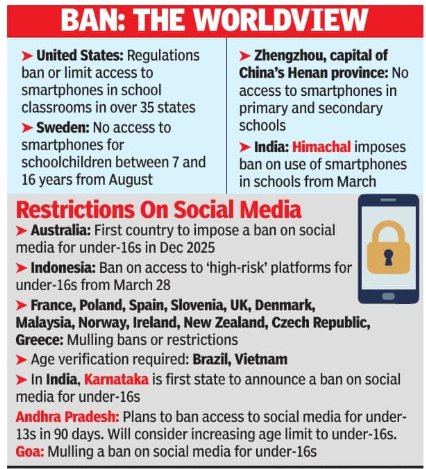
Hamlet’s existential dilemma — ‘To be or not to be?’ — is finding an echo in Indian schools: To ban or not to ban smartphones in classrooms.With Himachal Pradesh chief minister Sukhvinder Singh Sukhu announcing a ban on the use of mobile phones by students in all govt and private schools from March, and his Karnataka counterpart Siddaramaiah in his budget speech on March 6 announcing a ban on social media for under-16 children, concerns over excessive smartphone use and its impact on children’s cognitive abilities are back in the spotlight.These decisions align with a growing global push to curb the use of smartphones in schools amid rising concerns about shrinking attention spans, social media addiction and distraction in classrooms. In the United States, nearly 35 states have enacted laws requiring public schools to restrict or ban the use of mobile phones by students on campus, with exceptions for students with disabilities who have individualised education programmes. Sweden will implement a nationwide mobile phone ban in all schools from Aug to improve security and study conditions for students. The new rule, which will affect children between the ages of seven and 16, will make it compulsory for all schools and after-school clubs to collect students’ phones and hold them until the end of the day.In January 2025, Zhengzhou, capital of Henan province, became the first Chinese city to implement a law, prohibiting the use of mobile phones in primary and secondary schools unless specifically needed for teaching purposes.Restrictions On AccessInstead of imposing a ban on mobile phones for teens, some countries are opting for restrictions on social media. In Dec, Australia became the first country to ban certain social media platforms for teens under the age of 16, while Indonesia announced its decision to ban access to “high-risk” platforms for under-16s from March 28.France’s National Assembly has backed similar plans for children under 15. Poland too is planning to introduce a legislation to prohibit children under the age of 15 from accessing social media, with tech firms directly responsible for age verification.Calls for such measures have been gathering steam in India too, including in the recent Economic Survey. After Kar nataka, Andhra Pradesh govt announced its plan to curb access to social media for under-13s within 90 days and will consider extending the ban to under-16s. Goa also has set up a panel to investigate what such a ban might look like and how it can be implemented.Rules For Smartphone UseIndia is yet to formulate a national policy or a specific law on access to social media apps and smartphone use in educational institutions. However, calls for regulation of smartphone use are growing. The matter reached the Delhi high court last year, but it refused to order a complete ban, calling it impractical and undesirable. Instead, the court issued guidelines for regulating and monitoring use of smartphones.The reasons for concern are obvious, says Jyoti Arora, principal of Delhi-based Mount Abu School, adding that mobile phones can be great tools for learning, communication, and accessing digital resources, but distraction remains a concern. “Almost every day, our office is flooded with several parents complaining about games, social media, and constant notifications diverting the attention of their children from studies. Many of them have started complaining about eye strain and poor posture,” Arora says.
Academic PerformanceShe linked excessive use of smartphones to a decline in student academic performance. “We also saw a decline in students’ academic performance if they were too glued to the screen. An even bigger concern is that of exposure to cyber risks, such as online bullying and access to inappropriate content.”A 2023 Unesco report* showed that mere proximity to a mobile device distracted students and led to a negative impact on learning in 14 countries. It cited research studies to point out that “banning mobile phones from schools improves academic performance, especially for lowperforming students.”Finding WorkaroundsAmeeta Mulla Wattal, chairperson of DLF Foundation Schools and Scholarship Programmes, says the word ‘ban’ has never really helped anybody, particularly in school systems. “Anything oppressive is not right, especially for teenagers. The learning ecosystem has become so tech-integrated that even in a classroom, platforms like Whats -App, Instagram, and games are all accessible. Students are very adept at finding workarounds,” she says. The Covid-19 pandemic, which saw education systems across the world shift online, deepened this integration, with everything from classes to parentteacher meetings being conducted remotely.Wattal, who is also the former long-term principal of Delhi’s Springdales School, says the real issue isn’t the device, but teaching responsible digital use and focus. “There are so many WhatsApp groups that teachers use to share resources, homework, and foster discussions. The parent community is all on WhatsApp groups too, receiving notices and updates from school. Many students come by other means of transport or go for private coaching afterwards. A phone, therefore, becomes crucial for communication,” she adds.Need For A Holistic ApproachFinding a middle path is the need of the hour, Wattal emphasises, a process that would require dialogue among teachers, parents, and students.A team of researchers from the University of Birmingham drew a similar conclusion in a Feb 2025 study** of 1,227 students across the UK. Bans in isolation, the study argued, are not enough to tackle the negative impact, and it called for a more holistic approach to lowering phone use among students.Some schools in India are using lockers or sealed pouches to keep phones away from students during lessons, while others require formal requests to be submitted for exceptional cases. Arora says her school does not allow students to bring mobile phones, except on the specific written request of parents, in case they need to use the phone after school hours.Students deposit their phones in the morning and take them when they leave. However, allowing students to use smartphones during school hours is unlikely any time soon. “We need to have more talks, discussions, and digital ethics workshops before we allow that. We are doing our bit by inviting specialists to discuss cyber threats, or even the need for digital detox,” she adds.The Delhi high court ruling in March had also pointed out that schools must educate students on responsible online behaviour, digital manners, and the ethical use of smartphones. Students should be counselled that high levels of screen time and social media engagement can lead to anxiety, diminished attention spans, and cyberbullying, the court had added.However, schools are only a part of the equation, Arora emphasises. “The lessons for responsible use of phones and digital ethics must also be taught at home, with parents shouldering equal responsibility as the teachers.”*Unesco study: Technology in education: https://www.unesco.org/ gem-report/en/publication/ technology**UK study: School bans alone not enough to tackle negative impacts of phone and social media use: https://www.birmingham.ac.uk/ news/2025/school-bans-alone-notenough-to-tackle-negative-impactsof-phone-and-social-media-use