






Kalambo Falls Discovery: A 476,000-year-old wooden structure found in Kalambo Falls is changing human history | World News
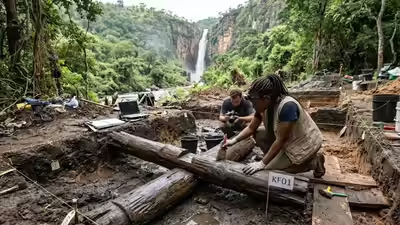

A wooden structure, dated 476,000 years old, was found at Kalambo Falls in Zambia. This discovery has significantly altered our view of early hominin intelligence. Researchers from Aberystwyth University and the University of Liverpool uncovered these logs that fit together, marking the oldest known example of wood used in building. Remarkably, this structure existed over 200,000 years before Homo sapiens appeared. The waterlogged clay preserved the artefacts, showing advanced carpentry skills like using stone tools for notching timber to join pieces. These findings indicate Pleistocene ancestors were more than just wandering foragers; they had the mental ability to alter their surroundings for permanent living spaces. This revelation changes what we thought about our ancestors’ technological progress and history.
Study shows early humans had abstract thinking and design ability 476,000 years ago
A study in the journal Nature reveals that the wooden structure is made of two logs that fit together with a notch crafted on purpose. This shows early hominins, such as Homo heidelbergensis, had the cognitive ability to create a mental model and an abstract design. It challenges the old belief that wood was only used to make simple tools like digging sticks in the Middle Pleistocene.
How scientists dated the world’s oldest wood
Scientists wanted to figure out how old the find was, so they used a technique called luminescence dating on the sand around it, as noted at Aberystwyth University. This way, they could see when the minerals last saw sunlight. They discovered the wood is about 476,000 years old. That’s way older than any wooden structure known before, compared to the previous record for a wooden structure of 9,000 to 11,000 years.
Evidence of high-level cognitive planning
The artefacts reveal that our ancestors used stone tools to shape objects on purpose. Researchers at the University of Liverpool found evidence that they crafted wood pieces to fit together, similar to how modern joiners work. This finding changes the archaeological view from focusing mainly on stone tools to recognising a significant ‘Wooden Age’. It implies that species before Homo sapiens had advanced cognitive and physical skills.
Why didn’t the wood rot at Kalambo Falls
The well-preserved condition of these wooden artefacts is due to the special waterlogged environment at Kalambo Falls. Because oxygen couldn’t reach them, the wood survived for almost 500,000 years. Situated near a high waterfall on the Zambia-Tanzania border, this site holds an extensive record of human history from the Stone Age through to the Iron Age.