






Quote of the day by Franz Kafka: “It’s only because of their stupidity that they’re able to be so sure of themselves” – lessons on false confidence, why certainty is not the same as understanding, from the writer behind The Trial |
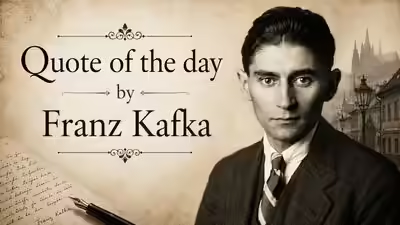
Today’s quote of the day comes from Franz Kafka’s novel The Trial, first published in 1925. The line reads, “It’s only because of their stupidity that they’re able to be so sure of themselves.” It is spoken by the novel’s protagonist, Josef K. , as he grows increasingly frustrated with the minor officials who arrest him without ever explaining the charge against him. He watches them speak with total confidence about a case they clearly do not understand, and the observation he makes has outlived the novel itself. It shows up today in conversations about overconfident colleagues, loud opinions on social media, and anyone who mistakes certainty for competence. Kafka wrote it about faceless bureaucrats a century ago, yet it still describes a very familiar type of person.
Quote of the day by Franz Kafka
“It’s only because of their stupidity that they’re able to be so sure of themselves”
Who says this line, and why it matters in The Trial
Josef K. is arrested on his thirtieth birthday by two officials who never tell him what crime he is accused of. What follows is a maze of courts, lawyers and officials who all speak with total assurance about a legal process that makes no logical sense, even to them. The line about stupidity and self-assurance comes at a moment when K. has simply had enough of listening to functionaries discuss his case as though they understood it, when it is obvious to him that they do not.Kafka was not writing about a specific court system. He was writing about the strange confidence that low-level authority can produce in people, regardless of whether they actually know what they are talking about. The officials in The Trial are not villains in any dramatic sense. They are ordinary people who have convinced themselves that their small amount of power means they understand more than they do.
The link between overconfidence and not knowing enough
The observation Kafka makes through Josef K. lines up closely with something psychologists would only formally describe decades later: the tendency for people with limited knowledge of a subject to be the most confident about it. The less someone understands the complexity of a situation, the easier it is for them to feel certain about it, simply because they cannot see everything they are missing.This is precisely the trap the quote is pointing at. Confidence is often read as a sign of competence, but the two do not automatically travel together. Someone who has spent years mastering a subject usually becomes more aware of how much they still do not know, which tends to make them more careful, not less. It is often the person standing furthest from real understanding who speaks with the least hesitation.
Kafka’s own life, and the word he accidentally gave the world
Franz Kafka was born in Prague in 1883 and spent most of his working life as an insurance clerk, a job that gave him a front-row seat to exactly the kind of bureaucratic absurdity he wrote about. He wrote fiction mostly at night and in secret, publishing very little during his lifetime. Much of what we now consider his greatest work, including The Trial, was released only after his death in 1924, against his own wishes, by his close friend Max Brod.Kafka’s writing left such a distinct mark on how we describe senseless bureaucracy and absurd authority that his name became an adjective. Anyone who has dealt with an illogical process, an unaccountable official, or a system that seems designed to confuse rather than help, has probably heard that experience described as Kafkaesque. It is one of the rare cases where a writer’s private, largely unpublished frustrations went on to give the world exactly the vocabulary it needed to describe them.
Why certainty without understanding still bothers us today
The quote has aged well because the type of person it describes has never really gone away. Every workplace has someone who speaks about a subject with total confidence despite having only a surface-level grasp of it, and it is often that same confidence that makes their opinion carry more weight than it should. Online, this effect is amplified. A short, assertive statement travels much further than a careful, qualified one, even when the careful answer happens to be right.What makes Kafka’s line sharper than a simple complaint about arrogance is the cause and effect he draws between the two. He is not just saying that certain people are both stupid and overconfident. He is saying the overconfidence exists specifically because of the gap in understanding. Remove the stupidity, in his telling, and the false certainty would not be able to survive alongside it.
How to actually use this quote
The most useful way to sit with this quote is not to go looking for other people it applies to, though that is admittedly tempting. It is to ask where it might apply closer to home. Real understanding of a subject usually comes with a few nagging doubts attached, because genuine expertise tends to reveal how much more there is to learn. If a topic makes you feel completely certain with no room for doubt at all, that feeling is worth questioning rather than trusting outright.Kafka never offered a solution to the officials in The Trial, because the point of the novel was that the system had no interest in being questioned. Outside of fiction, though, the lesson is more useful. Confidence without curiosity is usually a warning sign, not a strength, and the surest way to avoid becoming one of Kafka’s functionaries is to stay a little suspicious of your own certainty.That habit of mild self-doubt is not the same as insecurity, even though the two can look similar from the outside. It is closer to intellectual honesty, the willingness to admit that a subject is more complicated than a confident soundbite can capture. Josef K. never gets the clarity he is looking for in the novel, and in some ways that is the entire point Kafka is making. Certainty was never actually available to the officials either. They had simply stopped noticing that it was missing.