





Donald Trump’s 200% tariffs on pharma: Why India’s generic medicines could still remain competitive
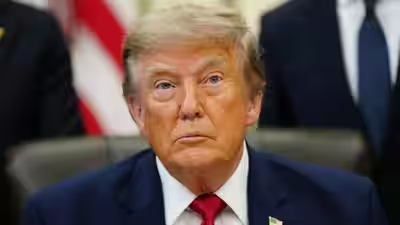
In a blow to India’s pharmaceutical industry, the Donald Trump administration has announced up to 200% tariffs on generic drugs that will be applicable in the coming years.US President Donald Trump on Tuesday announced the final stage of his pharmaceutical tariff plan, under which imported generic medicines will continue to enter the US without duties until August 1, 2028. After that, they will be subject to some of the highest tariffs ever proposed for the pharmaceutical sector.The latest announcement effectively completes Trump’s broader strategy to bring nearly every category of pharmaceutical imports under a tariff framework.The United States imported pharmaceutical products of $213 billion in 2025. Of this, finished medicines sold in retail packs (a category that includes generic medicines) accounted for $94.1 billion, according to a report by Global Trade Research Initiative (GTRI).
Trump’s 200% tariff proposal
In a Truth Social post, Trump said generic drug imports would remain exempt from tariffs for the next two years. Beginning in August 2028, they would attract a 100% tariff for one year, followed by a 200% tariff from August 2029, unless manufacturers shift production to facilities located in the United States.According to Trump, the two-year window is intended to provide pharmaceutical companies sufficient time to relocate generic drug manufacturing to the US. Firms that continue importing generic medicines after the transition period would be subject to punitive tariff rates.On September 25, 2025, he proposed imposing a 100% tariff on imported branded and patented medicines. That proposal, however, was never implemented and was later replaced.Subsequently, on April 2, 2026, the administration formally introduced tariffs of up to 100% on selected branded medicines and key pharmaceutical ingredients under the Section 232 national security framework, while generic medicines were kept outside its scope.With the July 21 announcement, generic drugs have now been brought into the proposed tariff regime, meaning virtually every major pharmaceutical category is covered under Trump’s reshoring strategy.
India’s pharma exports to US
When it comes to exporters of generic medicines, India actually has the highest exposure to the new Trump tariffs, says Ajay Srivastava, founder of GTRI. As per the think tank’s data, India’s pharmaceuticals exports to the US were $9.7 billion in 2025, which is 37.7% of its total pharma exports which stood at $25.8 billion globally. In fact, the US is India’s largest overseas market for pharmaceutical products.“Indian companies supply 47% of all generic prescriptions dispensed in the United States, making India the country’s largest source of affordable generic medicines. However, because generics are sold at very low prices, India’s share of the value of US generic imports is estimated at only 30%, well below its share of prescriptions,” the GTRI report says.
How big a blow is it for Indian pharma?
The impact is expected to vary across product categories:“Many Indian generic medicines sell for seven to ten times less than branded alternatives. Even after a 100% tariff, many products could remain cheaper than branded medicines, meaning much of the additional cost would likely be passed on to US healthcare providers, insurers and patients rather than immediately eliminating Indian exports,” the report said.The greatest impact is likely to be on higher-value generic formulations and branded generics, where shifting production to the United States may become commercially attractive.Also, several of India’s leading pharmaceutical companies already have manufacturing operations in the US. Sun Pharma, Zydus Lifesciences, Lupin, Aurobindo Pharma, Cipla and Dr. Reddy’s Laboratories all operate US FDA-approved manufacturing facilities in the country.Among them, Cipla is expanding capacity at its manufacturing plants in Massachusetts and New York. Dr. Reddy’s Laboratories has indicated that it is prepared to increase production in the US if doing so is commercially viable. Sun Pharma, however, has said its current manufacturing footprint in the United States is adequate and that it has no immediate plans to expand further.But, moving large-scale generic drug manufacturing back to the United States is unlikely to be straightforward. The generic medicines business operates on very narrow profit margins and relies heavily on global supply chains, particularly for active pharmaceutical ingredients (APIs), a significant share of which continues to be sourced from India and China.Establishing an entirely domestic manufacturing ecosystem in the US would require substantial capital investment and would almost certainly lead to higher medicine prices, says GTRI.The proposal is also subject to a lengthy implementation schedule. In the context of US politics, a two-year window leaves considerable scope for the policy to be revised, postponed or even overturned because of legal or political developments.For the moment, however, Trump’s message is clear: pharmaceutical companies have two years to determine whether to manufacture generic medicines in the United States or face exceptionally high tariffs on products exported to the US market.
A larger long-term challenge for India
For India’s pharmaceutical industry, dependence on China may pose a more significant strategic challenge than US tariffs.“About 70% of the chemical-based active pharmaceutical ingredients (APIs) used by Indian drugmakers and nearly 90% of biologic inputs come from China. Yet until the 1990s, India was a leading API producer,” explains GTRI.If China were to curb exports of APIs while simultaneously expanding shipments of higher-value finished pharmaceutical products, India’s drug industry could face severe supply-chain disruptions.“India should therefore make rebuilding its API manufacturing base a national priority by expanding domestic production and reducing reliance on a single supplier. At the same time, Indian pharmaceutical companies should reduce their dependence on the US market by expanding exports to Europe, Latin America, Africa and Asia,” says Ajay Srivastava.