





Viking Textile Fragments: Rare textile fragments have survived for around 1,300 years inside a Viking woman’s Danish grave because metallic salts released by two brooches inhibited microbes that would normally destroy the cloth
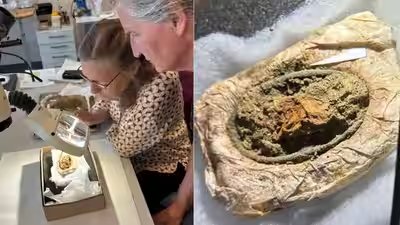
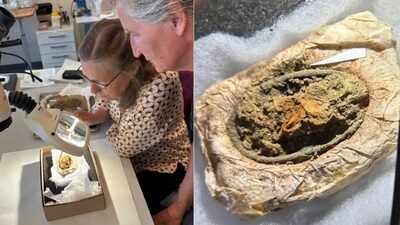
Danish archaeologists have unearthed rare textile remains from a Viking woman’s grave near Varde, in the heart of Western Jutland. During excavations at the Skonager site (ARV 661), a team of archaeologists discovered a Viking Age burial in which fragments of clothing survived against all odds. This discovery gives a rare glimpse into Viking dress from around 1,300 years ago. The fragments of wool and linen were still preserved, thanks to the two brooches that once fastened the clothing of the Viking woman. Radiocarbon dating will now determine whether she wore a newly woven dress with a repaired family heirloom, or if both pieces belonged to the same era.
When metal became a time capsule
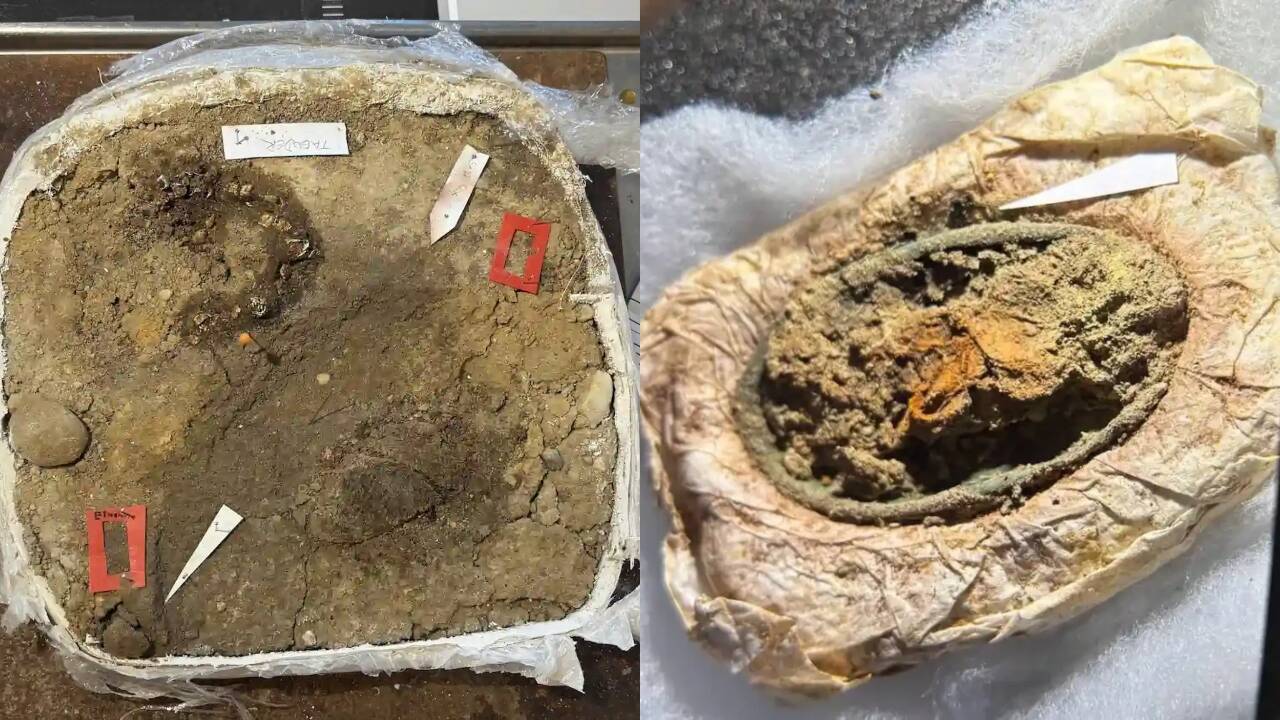
Credit: Arkæologi Vestjylland
The discovery at Skonager in Western Jutland, Denmark, has given researchers something almost impossible to find: textile scraps from an 8th-century burial, preserved not in some ideal climate-controlled cave but in soil so acidic it normally dissolves cloth to nothing. So what prevented this? It turns out that metal became the time capsule. The two scoop brooches, with their concave shape, did the heavy lifting. The bronze and silver corroded on the woman’s skeleton, which released metallic salts into the surrounding soil. Those salts created a hostile environment, which prevented bacteria and fungi from consuming the fibres. In life, those very ornaments held her dress together, and after death, they ended up preserving it for history!The brooches were positioned to fasten the fabric across her torso. The brooches held bits of cloth clinging to both their upper and lower surfaces. The researchers can now map the construction of her garment, the outer fabric she showed the world and the inner layer against her skin, giving a sneak peek of Viking fashion from 1,300 years ago. Woven textile fragments don’t come up often in Viking archaeology anywhere. The new discovery could reveal more information about the kind of fibres used, the sewing techniques and potentially the structure of female garments from 8th-century Denmark. Finding them, especially in soil, makes them one of the most miraculous discoveries of the time.The extraction and analysis of these fragile textile remains is complex. The museum in charge of this excavation has put together a top-tier multidisciplinary team to ensure that every grain of sand surrounding the remains is extracted with the meticulousness of a surgical procedure.The Vejle Conservation Center (Konserveringscenter Vejle) didn’t just dig. They removed the remains particle by particle with utmost precision. One wrong move and fibres crumble. One careless shovel stroke and context vanishes. Lise Ræder Knudsen, an ancient textile specialist, will examine the recovered fibres to determine weaving patterns, thread quality and the technical skill involved in making the ancient Viking Jutland garment. All these could help to determine if the woman who wore it had access to fine cloth or made do with rougher weaves.The teeth of the young woman found were preserved in surprisingly good condition. The Anthropology Unit at the University of Southern Denmark will analyse them for clues to understand her age, health and diet. Isotope analysis of tooth enamel can reveal where she spent her childhood, whether she moved between regions and what kinds of physical stress her body endured during development.However, dating the textile remains is going to be a rather difficult task. The researchers are hoping that radiocarbon (C14) testing may help to obtain an absolute and precise dating of the textile assemblage.One of the brooches shows repair marks, suggesting it had been broken and mended sometime before ending up in this grave. That raises an archaeological puzzle: Was the brooch made at the same time as the dress, or was it inherited? If a young woman wore a newly woven garment fastened with her grandmother’s jewellery, it changes how we read her burial. Radiocarbon dating of the fabric and the metal will answer whether these pieces belong to the same era or if she chose to wear old ornaments with new clothes. All these could tell us what objects meant to her community.The researchers are also hoping to find out other aspects of the cloth beyond its weave and morphology. For example, the colour. Nobody knows what colour the dress was. Dye molecules degrade faster than weave structure. Researchers have launched what they’re calling the Textile Colours of the Viking Age project to find out. Ulla Mannering and Charlotte Rimstad will conduct spectral analyses of the fibres to identify any remaining organic dye compounds. If there is enough colour on the fabric, they could perhaps reconstruct the palette. Colour in Viking garments carried meaning. A wealthy woman might wear dyed textiles that signalled status. A poorer woman wore undyed wool. The hues themselves tell part of her story. It could reveal the social, economic and ritual connotations of the deceased woman.The research has funding from the Agnes Geijers Foundation, named for one of the first scholars to seriously study Viking women’s clothing. Geijer made detailed drawings of what dresses held by scoop brooches might have looked like. Now, after decades of speculation based on fragmentary evidence, researchers can check whether her historical reconstructions were anywhere close to reality.