






Scientists found a fungus that turns female flies into zombies, then uses their dead bodies to spread spores to healthy flies |
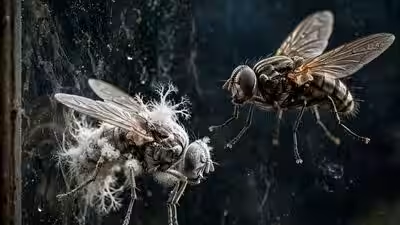
A fungus that infects house flies has evolved a remarkable way to send spores towards new hosts. Entomophthora muscae grows inside an infected fly and, after the insect dies, it produces microscopic stalks that emerge from its body. Each stalk forms a single spore at its tip. Instead of simply dropping away, the spore is forcefully expelled in a burst of liquid. A study published in the Journal of The Royal Society Publishing titled ‘Fungal artillery of zombie flies: infectious spore dispersal using a soft water cannon’ investigated this unusual launch using high-speed videography and a biomimetic ‘soft cannon’.The researchers found that pressure slowly builds inside the fungal stalk until it breaks at a weak spot. This sudden burst pushes the spore into the air. The study also showed that the size of the spore matters, and it needs to be large enough to move through the thin layer of still air around the dead fly, but small enough to be picked up by air currents. This balance helps the spores travel away from the dead fly and increases their chances of reaching another house fly.
How does the zombie fly fungus develop inside its host
Entomophthora muscae (fungus) starts its life cycle when its spores land on a house fly. The spores grow on the fly’s body and then enter it through the outer layer of its skin. After that, the fungus grows and spreads through the insect’s body. As the infection progresses, the fungus eventually produces tiny stalks that emerge from gaps between the fly’s abdominal segments. Each stalk develops a single spore at its tip. The fungus also needs to get them away from the dead fly so they can reach another host. Researchers studied this final stage and found that the fungal stalks use built-up pressure to shoot the spores into the air. This allows the fungus to send its spores away from the dead insect and continue its life cycle.
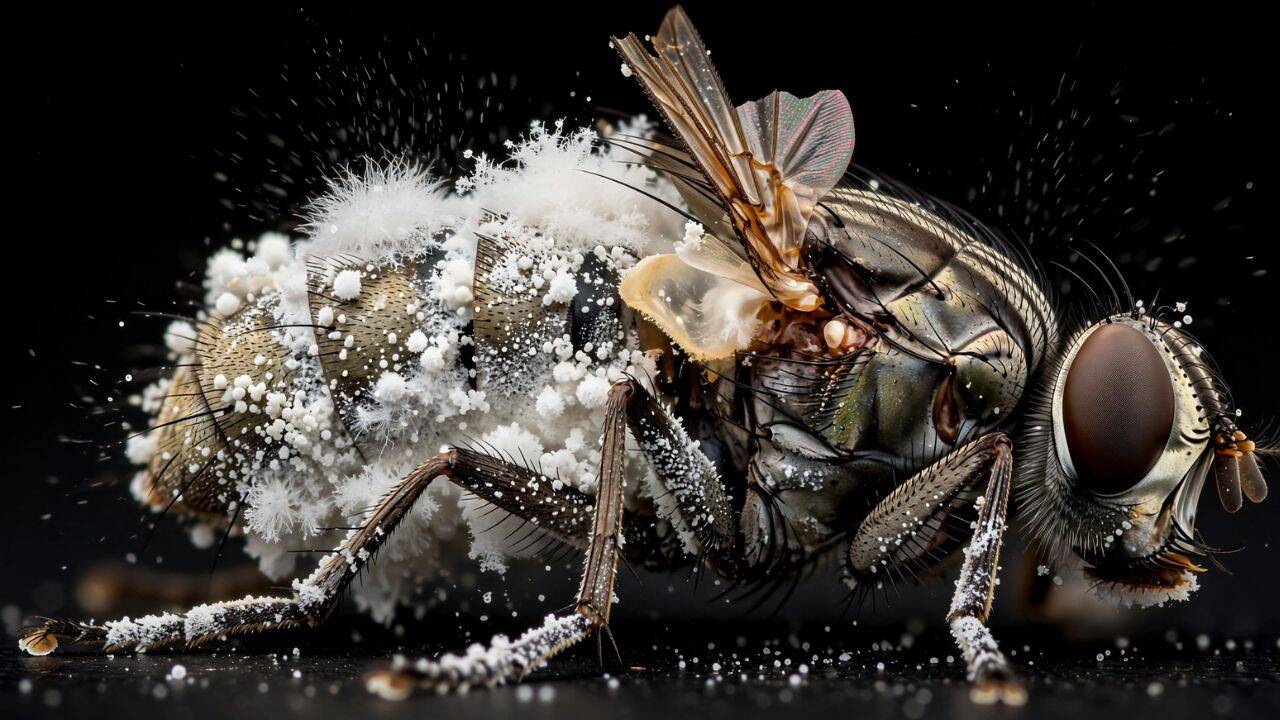
PC: AI Generated
How does the fungus build enough pressure to spread spores
The researchers used high-speed cameras to capture how the fungus launches a mature spore from its stalk. As pressure builds inside the stalk, it eventually becomes strong enough to release the spore. A weak spot below the spore then breaks, which creates a sudden burst that shoots it into the air. Earlier observations showed that the spores can be launched at speeds of up to about 10 metres per second. To understand how this process works, the researchers also built a small model inspired by the fungus. The model used a flexible tube, liquid pressure and a small object to recreate the way the fungus fires its spores.
Why does the fungus need spores of a particular size
Getting a spore into the air is only the beginning of the process. It must move through the thin layer of still air surrounding the dead fly before air currents can carry it away. The study found that a spore needs to be roughly 10 micrometres in size to cross this layer, which extends a few millimetres around the fly. But being too large can also be a problem because larger spores are harder for air currents to carry. Under moderate airflow, the upper limit is estimated to be around 40 micrometres. The fungus’s spores fall comfortably between these two limits. They are typically about 26 micrometres wide and 30 micrometres long. This size gives them enough momentum to move away from the fly while still allowing air currents to carry them towards another host.
How do flies help spread the fungus to new hosts
Dead female flies carrying E. muscae spores can attract males, which may land on or touch them. This contact can trigger the release of spores. The movement of the visiting fly can also stir the air and help carry the spores away from the dead insect. Once a spore reaches another suitable fly, the infection can begin again. The study also found that the fungus has another way to spread. Its first spores can produce a second type of spore that can also infect new flies. These secondary spores are smaller, measuring about 20 micrometres, but the researchers found that they can still move through the layer of still air around the dead fly.