






A man using a metal detector near a Finnish village finds more than 4,000 Viking Age silver coins in two birch-bark containers buried 39 feet apart | World News
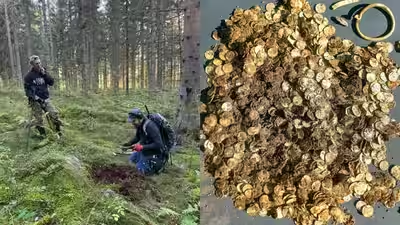
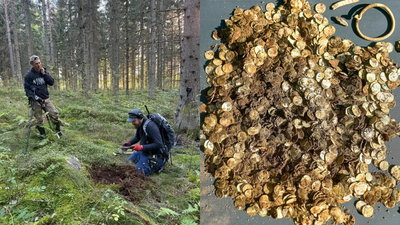
A Finnish metal detectorist has uncovered what is believed to be the country’s largest known Viking Age silver coin hoard after finding thousands of ancient coins near the village centre of Sysmä. Kalle Lappinen discovered the hoard on September 3, 2026, and reported the find to authorities, allowing archaeologists from Lahti Museums to begin recovering the material the following day. The discovery contains thousands of silver coins weighing about 4.5 kilograms, along with other silver objects. What makes the find particularly unusual is that the treasure was divided between two birch-bark containers buried about 12 metres, or 39 feet, apart. The hoard is preliminarily dated to around AD 1000 to 1050.
Metal detector leads to thousands of Viking Age silver coins
Lappinen was searching near Sysmä when his metal detector led him to the buried material. The discovery soon revealed an unusually large concentration of silver coins, far exceeding the scale of most Late Iron Age hoards previously found in the area. Archaeologists from Lahti Museums began recovering the objects on September 4. The coins and other material were carefully removed for conservation and examination, with archaeologist Esko Tikkala overseeing the recovery. The recovered coins weigh approximately 4.5 kilograms, or nearly 10 pounds. Alongside the coins, archaeologists found hack silver, a silver bracelet, a mount and a bead, adding to the archaeological significance of the discovery.
Two birch-bark containers found 39 feet apart
The silver was not hidden in one single cache. Instead, the treasure had been divided between two deposits located roughly 12 metres, or 39 feet, apart. Both deposits were placed in birch-bark containers and buried about 45 centimetres underground among stones. The unusual arrangement has led Frida Ehrnsten, keeper of the numismatic collections at the National Museum of Finland, to describe the discovery as a kind of “double hoard”. The two deposits provide an unusual glimpse into how valuable possessions could be concealed during the Late Iron Age. Why the silver was divided into two locations, however, remains unknown.
Hoard contains coins from across Europe and beyond
The coins reveal how widely silver circulated during the period. Among the discoveries are coins associated with areas corresponding to modern-day Sweden, Britain and Germany, as well as Islamic dirhams originating from regions corresponding to present-day Turkey and Iran. The mixture points to extensive connections between the region around Sysmä and wider trading networks. Researchers can use the coins’ designs, inscriptions and dates to establish where they were produced and trace the movement of silver into Finland. The find therefore offers more than evidence of a large personal fortune. It could provide new information about trade, wealth and economic connections across northern Europe around 1,000 years ago.
Hoard dates to around AD 1000 to 1050
The hoard is currently dated to approximately AD 1000 to 1050, placing it within the period known as the Viking Age. Researchers are continuing to clean and examine the coins, which will allow them to establish more precise dates for individual pieces. The term Viking Age refers to the broader historical period and does not establish that the people living in Finland at the time were Vikings. The range of coins also reflects the complex movement of silver during this period, when precious metal could travel considerable distances through trade and other forms of exchange.
Why the treasure was buried remains a mystery
The person who accumulated the silver and buried it has never been identified. Tikkala has suggested that the hoard could have belonged to a merchant who temporarily buried part of his wealth for safekeeping and planned to retrieve it later. Another possibility is that a wealthy local resident hid the silver because of the threat of conflict or an enemy attack. The treasure’s owner never returned, leaving the reason for its burial unknown. The decision to divide the silver between two deposits adds another unanswered question to the discovery.
Sysmä was an important Late Iron Age hub
The hoard is also shedding light on the history of Sysmä itself. Although the area may appear relatively modest today, archaeological evidence suggests it was a significant location during the Late Iron Age. Tikkala said the discovery provides further evidence that Sysmä was an important hub with trade connections extending in several directions. The presence of silver from Scandinavia, Britain, Germany and regions farther east supports the picture of a community connected to wider networks. The newly discovered hoard could therefore help researchers understand the role that Sysmä played in the movement of silver and other goods.
Previous Finnish record had about 1,700 coins
The scale of the discovery becomes clearer when compared with Finland’s previous largest known Viking Age coin hoard. That hoard was discovered in Nousiainen in 1895 and contained approximately 1,700 coins. The Sysmä discovery has surpassed that record, with thousands of coins recovered so far. Some reports have estimated that the new hoard contains more than 4,000 coins, although researchers are still cleaning, separating and cataloguing the material to establish the final count. The Sysmä discovery is already substantially larger than the previous record in terms of recovered coins and silver, making it an important addition to Finland’s archaeological record.
Researchers continue to study the ancient fortune
The investigation is now focused on identifying and documenting the individual coins and other objects. Researchers will examine their dates, origins and inscriptions while studying the birch-bark containers and the circumstances in which the two deposits were buried. The work could reveal when the silver was accumulated, how it reached Sysmä and what the different groups of coins say about trade networks of the period. For now, the discovery has left archaeologists with a remarkable archaeological puzzle. Thousands of pieces of silver, accumulated from places stretching across Europe and beyond, were hidden in two containers just 39 feet apart and remained underground for roughly 1,000 years before a metal detectorist uncovered them.