





Homeschooling debate in Connecticut: What it means for students, skills, and future pathways
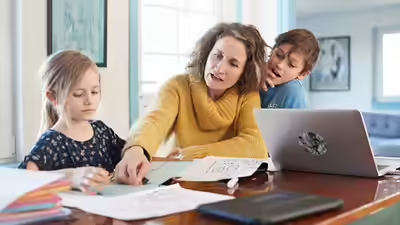

A closely contested bill on homeschooling regulations in Connecticut has sparked a wider conversation—not just about policy, but about how students learn, build skills, and prepare for future careers. According to reporting by the Associated Press, House Bill 5468 recently advanced through the Education Committee despite bipartisan opposition, highlighting deep divisions over oversight, student welfare, and educational freedom.Why the Bill Matters for StudentsAt its core, the proposed legislation introduces basic checks for families opting out of public schooling. Parents would need to formally withdraw their children in person, confirm their homeschooling status annually, and provide evidence of “equivalent instruction.”Supporters argue this is a minimal safeguard. “To annually…submit a form…showing that you have educated your child in some way is a very, very low bar,” Education Committee co-Chair Jennifer Leeper said, as reported by the Associated Press. The goal, she emphasized, is not to interfere with learning styles but to ensure that no child disappears from the system unnoticed.For students, this poses an interesting question: what does this mean in terms of academic credibility and career readiness?The Skill Debate: Flexibility vs StandardisationOne of the arguments that homeschooling advocates often cite is the high level of academic achievement and early readiness for a career. Some lawmakers noted that there were instances of homeschool students graduating early or completing college-level coursework prior to their 18th birthdays.However, critics of the bill worry that aligning homeschooling too closely with public school benchmarks could limit flexibility. “This bill is pressuring families to mirror the public school system,” said Sen. Heather Somers, reflecting concerns that creativity and personalised learning may be compromised.From a career perspective, this tension mirrors a larger global debate: should education prioritise standardised assessment or individualised skill-building?Oversight, Safety, and Learning GapsThe bill emerged after serious concerns about student safety and lack of state oversight. A 2025 report found that minimal monitoring allowed some cases of abuse to go undetected. In effect, by requiring a certain level of documentation and interaction with authorities, lawmakers hope to bridge the gap. However, critics have also raised another point: whether documentation actually reflects academic learning. One lawmaker explained: “The simple act of presenting a portfolio doesn’t always translate to academic progress.”For students, this simply emphasizes the need to have measurable skills. Whether in a homeschooling program or a conventional one, students need to have skills such as critical thinking, communication, etc., to get into a university or a job. Bigger Questions for Education SystemsIt’s interesting to note, however, that some critics have shifted attention to issues facing public education. As the Associated Press noted, some lawmakers have suggested that parents resort to homeschooling because public education does not live up to expectations.This brings the debate full circle, as the future of education may not be a choice between systems, but rather a combination of flexibility and accountability.What Students Can Take AwayThe lesson for the student is obvious. No matter what type of education system they are in, be it homeschooling, private, or public, the key to success in the future will be to continue to learn, develop skills, and be able to prove what they know.