





How rain turns a salt desert into the world’s largest mirror in Bolivia | World News

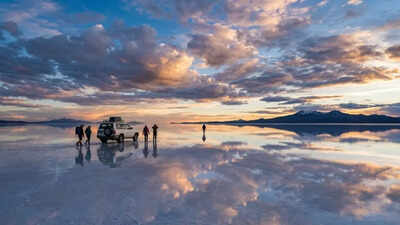
The Salar de Uyuni – the contiguous remnants of an ancient lake, covering more than 10,000 square kilometres in the Andes of Bolivia, South America – has now become a vast and flat white salt pan. In the rainy season, when water collects on the impervious crystalline crust of the salt pan and creates a large shallow pool, a natural mirror forms. The resulting natural mirror reflects the sky below as if it were flat – nearly perfectly; thus, space agencies use these flat/pools to test their satellite altimeters. In addition to being beautiful, this natural mirror also sits just above a large brine body containing high levels of lithium; therefore, the Salar de Uyuni marks a unique intersection of a geological phenomenon, an atmospheric event, and today’s technology.
How Salar de Uyuni in Bolivia turns into the world’s largest natural mirror
The extreme flatness of Salar de Uyuni, which has an elevation change of less than 1 meter across the 10,582 square kilometres area, enables it to transform into a completely flat surface. The area is flooded from surrounding mountain runoff during the rainy season (December to April), which creates a thin layer of uniform water due to the imperviousness of the salt crust and the perfectly flat ground. That is, the layer of water is very shallow (a few centimetres thick), creating a liquid lens that reflects the sky and clouds, creating a uniform horizon.
Why NASA and ESA look to Bolivia to fix their satellites
The natural mirror of Salar de Uyuni is additionally very large and chemically stable. As a result, it is essential to the science of space-based observation of Earth. For example, NASA and ESA satellite vehicles utilise the flooded Salar de Uyuni to calibrate the satellite’s radar and laser altimeters. Additionally, because the surface of the water is a perfect ‘level,’ and highly reflective, scientists can compare the satellite measurements against the precisely surveyed terrestrial elevation of the flat to verify data accuracy; therefore, the Bolivian desert is a very important geodetic benchmark for satellite sensors in terms of measuring sea level change and ice sheet change of the Earth.
The 40,000-year transformation: How ancient lakes became a modern mirror
The mirror effect is the culmination of a 40,000-year geological history. The Salar de Uyuni was created by evaporation from several ancient lakes, such as Lake Minchin and Lake Tauca. As these lakes dried up from the high-altitude Andean sun, they left behind large amounts of sodium chloride and other minerals. Beneath this white crust lies a very large deposit of lithium-rich brine. The high concentration of minerals in the water during the rainy season increases the brine density, which suppresses ripples to create a steadier reflection for visitors today.
Why the thin air is ideal for reflections
The dry air of the Altiplano, sitting at 3,656 meters above sea level, is remarkably low in humidity, and this is key to the mirror’s clarity. With minimal water vapor and pollution in the atmosphere, light can pass through with little scattering, thanks to the absence of aerosols and moisture. When the water is perfectly still, a whiteout effect emerges, blurring the line between earth and sky.This phenomenon is caused by the specular reflection of sunlight off the smooth water’s surface, which reflects at a consistent angle, recreating the celestial dome directly beneath the observer’s feet.