





International Women’S Day 2026: More girls in universities, fewer women in leadership: Why education isn’t translating into opportunity


If global gender equality were a classroom exam, women would already be among the top scorers. The problem begins after graduation.According to the Global Gender Gap Report 2025 by the World Economic Forum, the gender gap in education is more than 95% closed globally, making it one of the biggest success stories of the past two decades. Yet equality across society remains much further away. The same report notes that only 68.8% of the overall gender gap has been closed, and at the current pace, full parity could take about 123 years.In other words, women are acing the classroom—but the workplace still hasn’t quite caught up. As the world marks International Women’s Day, global data suggests that while education has opened doors for women, many still face barriers walking through them.
The classroom comeback story
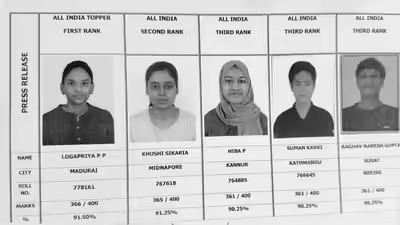
Education is where the gender equality story looks most promising.According to the Global Gender Gap Report 2025, the global education gender gap is now about 95% closed, reflecting decades of improvements in literacy, secondary schooling, and university access.In fact, in many countries today, women outnumber men in tertiary education, highlighting a major shift in academic participation over the past generation. According to the UNESCO, female enrolment in higher education has expanded significantly worldwide, with many regions seeing women graduate at higher rates than men.These numbers point to a powerful trend: more girls are staying in school, finishing university, and building the qualifications needed for professional careers.But the moment the focus shifts from classrooms to careers, the numbers begin to tell a different story.
The great education-to-career disconnect
Despite their academic achievements, women continue to face barriers in the workforce.According to the Global Gender Gap Report 2025, the gender gap in economic participation and opportunity is only about 61% closed globally, making it one of the largest remaining inequalities.Leadership positions highlight the gap even more clearly. According to the World Economic Forum, women hold less than one-third of senior leadership roles worldwide, despite the growing number of highly educated female professionals.Career interruptions also play a role. As per the same report, women are more than 50% more likely than men to take career breaks, often due to caregiving responsibilities. According to the data, the average career break lasts nearly 20 months for women compared with around 14 months for men, which can affect promotions and long-term earnings.The result is a familiar paradox: the talent pipeline is full of qualified women, but the leadership ladder still seems narrower for them.
The leadership gap persists
The imbalance is visible even in sectors where women form the majority.According to the Global Education Monitoring Gender Report 2025 by UNESCO, women make up a large share of the global teaching workforce but remain underrepresented in leadership roles such as school principals and education policymakers.Similarly, according to the World Economic Forum, women hold only around 28% of top management positions globally, highlighting how leadership opportunities continue to lag behind educational gains.These disparities underline a key challenge: access to education has improved dramatically, but power and decision-making roles remain unevenly distributed.
India reflects the same paradox
India’s experience mirrors the global trend.According to the Global Gender Gap Report 2025, India ranks 131st globally in gender parity, though the country performs relatively well in education.The report notes that India has achieved an education parity score of about 97.1%, indicating that gender gaps in schooling and higher education have narrowed significantly.However, workforce participation and leadership representation continue to lag behind educational achievements, suggesting that the transition from education to employment remains a key challenge.
A long road ahead
The world has undoubtedly made progress. More girls are in classrooms today than at any other time in history, and higher education is no longer a male-dominated space in many countries.Yet the broader journey toward equality remains slow. According to the Global Gender Gap Report 2025, no country has yet achieved full gender parity, and at current rates, it could take more than a century to close the remaining gap.That timeline may sound daunting, but the data also offers hope. The pipeline of educated, ambitious women has never been stronger.The next challenge is ensuring that their degrees translate not just into jobs—but into leadership, influence, and equal opportunity.