






Uae Fuel Prices: Global oil hits $105 per barrel: Could UAE petrol prices jump to Dh3.80–Dh4 per litre in April? | World News
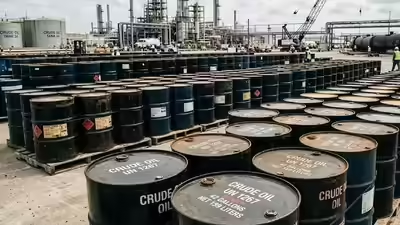
While the Gulf region sits atop some of the world’s largest oil reserves, the prices we pay at the pump aren’t immune to global chaos. Following recent shifts in international policy and escalating tensions involving major energy players, global oil benchmarks have surged. From the boardrooms of Wall Street to the gas stations in Dubai and Doha. For residents in the UAE and the wider GCC, this isn’t just a headline, it’s a direct hit to the monthly budget as regional fuel committees move to align local prices with an increasingly volatile global market.
Global oil prices cross $150
Oil markets have surged in recent days as escalating tensions involving Iran, the United States and Israel raise fears of supply disruptions across the Middle East. Benchmark Brent Crude has climbed close to $105 per barrel, rising sharply as traders worry that conflict in the region could affect energy infrastructure and shipping routes.One of the biggest concerns is the Strait of Hormuz, the narrow channel through which roughly one-fifth of the world’s oil supply passes every day.Any disruption to tanker traffic through this route could push oil prices even higher, sending ripple effects across global energy markets.
What is Brent crude oil and why it matters?
Global oil prices are often measured using Brent Crude, one of the most widely used benchmarks for crude traded across the world.Brent crude represents oil extracted from fields in the North Sea, but its price has become the global reference point for energy markets. Around two-thirds of internationally traded crude oil is priced using the Brent benchmark.Because Brent reflects global supply and demand, its price directly influences how much countries pay for refined fuels such as petrol, diesel and jet fuel.When Brent crude rises sharply, it often leads to higher fuel prices in many countries, including those that produce oil themselves.
Will petrol prices rise in the UAE?
For residents in the United Arab Emirates, rising oil prices can translate into higher costs at petrol stations.Since 2015, fuel prices in the UAE have been adjusted monthly by the UAE Fuel Price Committee, which reviews international crude prices along with refining and distribution costs.Because of this system, petrol prices in the UAE move broadly in line with global oil markets. If crude prices remain high for several weeks, the increase usually reflects in the next monthly fuel price update.This means motorists across the country are closely watching oil markets to see whether the recent surge will affect the next petrol price announcement.
How much could petrol cost UAE residents?
Fuel prices in the UAE have fluctuated throughout 2025 and early 2026 depending on global oil trends.If oil continues trading above $100 per barrel, analysts say petrol prices could increase again in the coming months. Based on previous price patterns, petrol in the UAE could potentially move toward the Dh3.60 to Dh4 per litre range if crude climbs further toward $110–$120 per barrel.However, the exact price will depend on several factors including refining costs, shipping expenses and currency fluctuations. Because prices are reviewed every month, any sustained surge in oil markets could influence fuel prices in the next pricing cycle.
What about rest of the Gulf nations?
The impact of rising oil prices is not limited to the United Arab Emirates. Fuel pricing policies vary across the Gulf Cooperation Council, meaning residents in other Gulf countries may experience the effects differently.In Saudi Arabia, petrol prices are reviewed periodically by the government and the national oil giant Saudi Aramco. While the kingdom produces some of the world’s largest oil volumes, fuel prices can still adjust depending on global market trends and domestic economic policies.Meanwhile, Qatar, Oman, and Bahrain also review petrol prices regularly; adjustments often link to international oil benchmarks such as Brent Crude. This means prolonged spikes in global oil markets can gradually push fuel prices higher across these countries.In Kuwait, petrol prices are more heavily subsidised compared with some of its neighbours, which can help cushion residents from rapid market swings. However, sustained increases in global crude prices may still influence future policy decisions.
Looking ahead
If Brent Crude continues trading above $100 per barrel for an extended period, analysts say petrol prices across several Gulf countries could gradually rise in the coming months. At the same time, higher oil revenues may strengthen government finances across the region.Ultimately, the direction of fuel prices will depend on how the geopolitical situation evolves — particularly around the Strait of Hormuz, one of the most critical energy corridors in the world.For now, motorists in the UAE and across the GCC are watching global oil markets closely, as the next move in crude prices could determine how much they pay at the pump in the weeks ahead.