






UP urban transition after 2017 – A shift to non-agricultural economy | India News
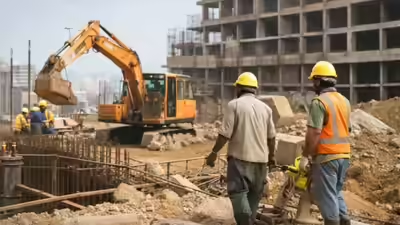
Over the last eight years, Uttar Pradesh has undergone a structural metamorphosis. Historically viewed through its agrarian roots, the state is rapidly pivoting toward an urban-centric economy. Between 2011 and 2021, the shift from agricultural to non-agricultural employment grew at a rate of 7% per decade, outstripping the 5% growth seen in previous decades. This shift is the backbone of a new, diversified economic era for India’s most populous state.
A foundation of governance and funding
The state’s strategy began with expanding the reach of local governance. Since 2017, 117 new Urban Local Bodies (ULBs) were established and 123 were expanded to accommodate a surging urban population. This administrative expansion was backed by a massive fiscal commitment: the budget allocation for urban development saw a staggering 287% increase between 2016 and 2025.Funding via the State and Central finance commissions has also scaled dramatically:
- State Finance Commission (SFC): Increased from Rs 6,406.09 crore in 2016-17 to Rs 14,400 crore in 2024-25.
- Central Finance Commission (CFC): Increased from Rs 1,667.22 crore to Rs 5,118 crore in the same period.
Cleanliness as a culture: The Swachh Bharat revolution
The most visible change has been in sanitation and waste management. Uttar Pradesh has moved from a state of “planning” to one of “execution.”
The introduction of Integrated Command and Control Centers (ICCC) powered by AI has turned cities into “smart hubs,” allowing for real-time monitoring of waste, traffic, and even emergency response—a system that proved vital during the Covid-19 pandemic.
Infrastructure and living standards: AMRUT & PMAY
Through the AMRUT 1.0 and 2.0 missions, the state has prioritised the basic necessities of life: water and sewage.
- Water connections: From zero structured progress in 2017 to 15 lakh connections.
- Sewage connections: Reached 9.40 lakh households.
- Housing (PMAY): A massive leap from 7,409 approved houses in 2017 to over 15.49 lakh by 2025.
Smart cities and modern policing
The Smart City Mission is nearing completion, with 95% of projects finished. Beyond the 10 cities selected by the Central government, Uttar Pradesh launched its own State Smart City initiative for 7 additional cities.A standout achievement is the management of Mahakumbh 2025, which utilised AI and IoT for crowd management and security, achieving a 97% success rate in “lost and found” cases and clearing 161 garbage hotspots through a dedicated force of 12,000+ workers.
Sustainability and social welfare
The “Green” agenda has seen the development of 228 acres of green area and the introduction of the UP Urban Greening Policy. Social welfare has also been modernised:
- Animal welfare: 676 ‘gaushalas’ (cow shelters) providing refuge to 1.4 lakh cattle.
- Aspirational cities: 100 youth-centric/underdeveloped cities have been selected for specialised infrastructure development.
- Chief Minister Urban Creation Scheme (CM-NSY): Focused on the grassroots, constructing 2,534 km of roads and 342 km of drains in newly formed ULBs.
Conclusion
The data paints a picture of a state in a hurry to modernise. By blending technology (AI/ICCC) with massive civil engineering projects and community-led initiatives like the Swachh Bharat Mission, Uttar Pradesh has laid a robust foundation. The result is a network of cities that are not just larger, but smarter, cleaner, and more resilient.