






Women breaking barriers in skilled trades: Why more young professionals are choosing hands-on careers
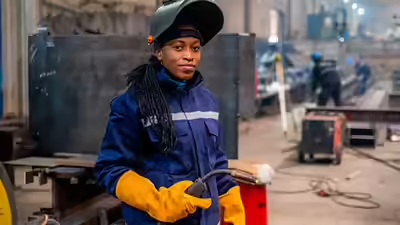
As industries grapple with a shortage of skilled workers and the future of white-collar jobs faces disruption from artificial intelligence, skilled trades are emerging as a promising career path. Yet, despite the rising demand and competitive wages, these professions—from plumbing to diesel mechanics—remain largely male-dominated.However, that landscape is slowly changing as more women enter fields traditionally seen as men’s work, driven by the promise of job stability, faster career progression and financial security.Recent occupational data shows that women still account for a small share of the workforce in many trades. In the United States, for instance, women made up just 3.1% of carpenters and plumbers and 3.5% of electricians in 2025, according to the U.S. Bureau of Labor Statistics.“We are not where we want to be with a diversified workforce, but we are seeing that number grow,” Ian Andrews, vice president of labor relations at the National Electrical Contractors Association, told CNBC. Two decades ago, only about 1.9% of electricians in the U.S. were women.Skilled trades offer stability and rising payExperts say the growing demand for skilled workers is creating strong career opportunities. As older workers retire and industries struggle to fill roles, wages and job openings in skilled trades are rising.“Women that pursue this path are positioning themselves for job security, stability, growth,” Monster career expert Vicki Salemi told CNBC. “The possibilities are robust in these fields, and they are often underserved.”For many women, these roles also provide a pathway to narrow the gender wage gap while building long-term financial security.Choosing a trade for long-term stabilityCristina Barillas-McEntee, now a plumber with over two decades of experience, switched careers in 1998 after working as a makeup artist in Chicago. Seeking better long-term prospects, she applied to a plumbers’ union apprenticeship.“I was looking at my life and was like, this is not where I want to be at 60,” she told CNBC.The transition required patience and sacrifice. During her five-year apprenticeship, she earned just $9 an hour. But the payoff came later. Today, Barillas-McEntee earns $56 an hour and benefits from union-backed health care and retirement plans.“This is a sacrifice you make for the larger end goal,” she said.Young workers drawn to hands-on careersFor younger professionals, skilled trades offer a way to enter the workforce quickly without the burden of long college degrees.Teagan Hollabaugh, 22, chose to train as a heavy-duty diesel mechanic because she preferred a practical career over a desk job.“I didn’t want to sit behind a desk,” she told CNBC. “I knew I needed something that was very involved to keep me entertained day to day.”Even before graduating high school, she enrolled in technical training and secured a job soon after completing her program—something many young graduates struggle to achieve.Overcoming stereotypes on the jobGender stereotypes still pose challenges. Lilian Hollabaugh, who works as an HVAC installation technician, recalled how employers initially assumed she wanted an office role.“I went dressed like I was going to an interview… and everybody kept offering me an office position,” she told CNBC. “I went to trade school because I want to use my hands.”Despite the hurdles, she quickly moved up in her company and is now preparing to lead a crew.A future-proof career pathFor others, the appeal of skilled trades lies in financial independence and long-term career prospects.Diesel technician Raelee Nicholson chose technical school over a four-year college degree due to concerns about student loan debt.“I think the debt-to-pay ratio works better after a trade school,” she told CNBC.Now seven years into the field, she earns a stable income and contributes regularly to her retirement savings.Even though women remain a minority in many trade jobs, Nicholson believes attitudes are changing. “You’re there to do a job,” she said.As labour shortages persist and automation reshapes traditional career paths, experts say skilled trades could become an increasingly attractive option for the next generation—including more women ready to challenge long-standing norms.