






A Connecticut cemetery leased unused land for 7,000 solar panels, but the ground beneath them could become habitat for bees and pollinators
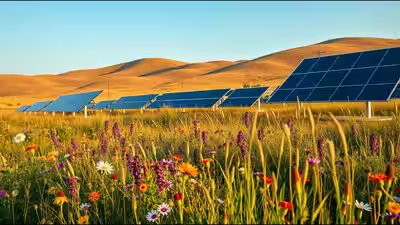
At the back of a Catholic cemetery in Torrington, Connecticut, a wide field once sat empty for years, too far from the graves to ever be needed. Then came rows of dark solar panels, built on land owned by the Catholic Cemeteries Association of the Archdiocese of Hartford. According to reporting by Connecticut Public, the array holds roughly 7,000 solar panels across about a dozen acres, developed by the Hartford-based firm Verogy under a 20-year lease with the cemetery association. None of the panels sits near any graves, and a stretch of forest keeps the array and the burial ground fully separate. What makes the site interesting now is not the panels themselves but the plain green ground running beneath and around them, land that solar developers elsewhere have started treating as a real ecological opportunity rather than something to simply mow flat.
Why Catholic cemeteries in Connecticut are leasing spare land to solar developers
A cemetery association typically owns far more land than it will fill with headstones for decades. Filings with the Connecticut Siting Council for the Torrington site describe a 66-acre parcel, of which just over 11 acres were set aside for the solar array itself, land the association had no near-term burial plans for. As cremation rates rise and traditional burial demand slows, cemetery groups across the state have been looking for ways to generate income from ground that otherwise just costs money to maintain. A solar lease fits that need well, since panels sit lightly on the surface, can be removed if plots are ever required again, and generate steady rent instead of a recurring mowing bill. The Catholic Cemeteries Association has since developed a similar array on cemetery land in North Haven, treating this kind of dual-use lease as a repeatable model rather than a one-off arrangement.
What grows beneath solar panels once the ground is left to native plants
A ground-mounted solar array like the one in Torrington leaves most of its soil exposed in the gaps between and below the rows of panels, and what fills that space is entirely a management choice. Most developers default to gravel or clipped turf grass, kept bare so trucks can reach the rows and so tall growth never shades a panel. But that same ground can just as easily be seeded with native grasses and wildflowers, turning it into something closer to a meadow. A five-year field study titled If you build it, will they come? Insect community responses to habitat establishment at solar energy facilities in Minnesota, USA, led by researchers at Argonne National Laboratory and the National Renewable Energy Laboratory, tracked exactly this kind of planting at two solar sites built on former farmland. The results were striking: total insect abundance tripled over the study period, and native bee numbers rose more than 20-fold, with most of that increase arriving after the second year.
Why solar pollinator meadows matter for nearby farmland too
The benefits of these plantings were not confined to the solar sites themselves. The Argonne-led study found that bees visiting flowers in soybean fields next to the seeded solar habitat matched visitation levels seen near grasslands enrolled in the federal Conservation Reserve Program, and were roughly 2 times higher than visitation recorded at soybean fields with no nearby habitat at all. That spillover effect matters because a large share of global crop production depends on insect pollination, and habitat loss has been steadily shrinking the areas where pollinators can establish. As more farmland across the country gets converted into solar capacity, researchers argue that seeding the unused ground around panels, rather than defaulting to gravel or short turf, could turn thousands of these sites into a meaningful source of pollinator habitat rather than a net loss of it.
What the Torrington site suggests for cemeteries and solar land going forward
Torrington’s cemetery field has the basic ingredients for this kind of planting to work: flat, sunny, cleared ground that is already fenced off and left largely undisturbed behind its screen of trees. Whether it ever becomes a meadow rather than mowed grass is purely a management decision by the developer and the landowner, not something the panels themselves prevent. As cash-strapped cemetery associations and municipalities keep signing similar leases across Connecticut and beyond, the choice of what to plant under and around those arrays is quietly becoming one of the more consequential decisions in how much ecological value these small, scattered patches of solar land end up delivering.