




As Trump nukes science, is India’s brain drain ready for ‘brain regain’?
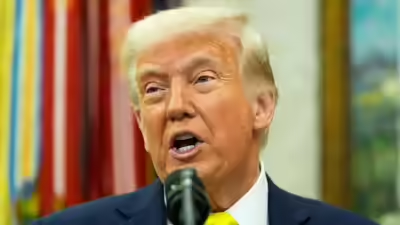
TOI correspondent from Washington: He thinks diet soda kills cancer cells inside the body when consumed because it scorches grass when poured on it. He claims noise from windmills causes cancer. He most famously mused about injecting disinfectants into the body to kill the covid virus. Even in a presidency not known for scientific temper, US President Donald Trump’s latest move has landed with unusual force: the wholesale dismissal of the National Science Board, the independent 22-member body, including three Indian-Americans, that oversees the National Science Foundation (NSF), America’s primary engine for funding basic research. Among those removed were three prominent scientists of Indian origin: Sudarsanam Babu, a leading figure in advanced manufacturing at Oak Ridge National Laboratory; Arun Majumdar, dean of Stanford’s Doerr School of Sustainability and a former US energy official; and Suresh Garimella, a noted thermal sciences expert and university president. Their presence on the board had reflected the global character of American science, and their removal comes at a time when there are calls from some prominent Indian tech elites urging their return. Created by Congress in 1950 and designed to outlast political cycles, the NSB was meant to insulate science policy from partisan swings. Its abrupt termination — delivered via a terse email last week — has instead become a symbol of a broader dismantling of the country’s scientific architecture. Over the past year, the Trump administration has fired advisory panels, canceled more than 1,400 NSF grants, and proposed sweeping budget cuts to major research agencies — including reductions of over 50 percent to NSF funding and deep cuts to the National Institutes of Health (NIH), NASA’s science programs, and the Centers for Disease Control and Prevention (CDC). Fourteen NSF advisory committees have been eliminated. The consequences are already rippling through laboratories and universities. Funding uncertainty has forced hiring freezes and cuts to graduate programs, constricting the pipeline of future researchers, many from India. For many scientists, the cumulative effect is prompting a difficult calculation: stay and adapt, or leave the US Desi expat groups on social media are boiling with questions about relocation to India, including about children’s schools and financial transfers. Specific numbers relating to India are not available, but recent surveys suggest sentiment among foreign-origin scientists to quit America is gaining traction. A Nature analysis reports that roughly 75 percent of US-based scientists are considering opportunities abroad, with a 32 percent jump in international job applications compared to the previous year. More than 10,000 doctoral-level experts — about 14 percent of the federal STEM PhD workforce — left government roles in 2025 alone. Among early-career researchers, the numbers are even starker: about 80 percent of postdoctoral fellows and 75 percent of graduate students say they are contemplating careers outside the US. The destinations vary. Europe, with its stable funding frameworks, is an obvious draw. Canada and Australia are actively recruiting. China, long a competitor for talent, has stepped up incentives for returnees, particularly in high-tech fields. India too is ramping up its calls with “return-to-India” invites like the Ramanujan Fellowship, Ramalingaswami Re-entry Fellowship, INSPIRE Faculty Scheme, and VAJRA (Visiting Advanced Joint Research) Faculty Scheme. Yet the exodus is not inevitable. The United States retains formidable advantages: world-class universities, deep private-sector investment, and a culture of innovation that has long attracted global talent. Still, for many in the scientific community, the concern is less about any single policy than about the erosion of norms in the Trump era. The question is whether the US, long the world’s scientific lodestar, is dimming its own light — and whether others, like India, are already preparing to shine brighter, turning what was once a brain drain into brain regain.