





Beyond degrees and grades: These 5 workplace skills gaining importance in the AI-driven job market
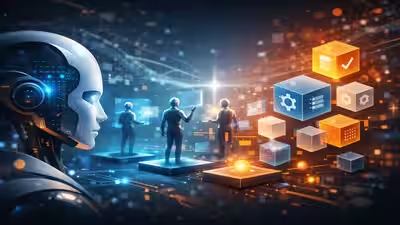
As artificial intelligence and automation reshape workplaces, industry experts and hiring professionals say companies are also changing how they evaluate candidates. Beyond academic scores and qualifications, employers increasingly value how effectively candidates apply knowledge, adapt to new technologies and solve real-world problems. While marksheets and degrees remain important indicators of academic performance, career experts point to a growing emphasis on skills such as AI proficiency, continuous learning, problem-solving and cross-disciplinary thinking. These capabilities are expected to play a bigger role in hiring decisions in 2026 and beyond.Amar Srivastava, CEO- Online & Group CPO, Scaler, says the evolution of hiring is less about whether candidates can access AI tools and more about how effectively they can use them to drive business results. “AI is changing what work looks like, but the biggest shift is not that AI will replace people; it’s that people who know how to work with AI will increasingly outperform those who don’t. The hiring conversations we’re seeing are already shifting from ‘Can you use AI?’ to ‘Can you deliver outcomes with AI?’ That requires far more than prompt writing. It demands critical thinking, business context, systems thinking, and the judgment to know when to trust AI, and when not to. As AI becomes a co-worker rather than just a tool, these human capabilities will become the real differentiator.” Against this backdrop, several emerging skills are gaining prominence as organisations seek professionals who can thrive in an increasingly technology-driven workplace.
AI orchestration: Moving from using AI tools to managing them
Basic familiarity with AI tools is becoming common among professionals. The next level of advantage lies in AI orchestration — the ability to combine multiple AI tools and systems to complete complex tasks.AI orchestration involves using artificial intelligence for research, coding, data analysis, content creation, automation and business problem-solving. Instead of treating AI as a single tool, professionals increasingly need to understand how different AI systems can work together to improve productivity.As organisations integrate AI into daily operations, employees who can effectively guide AI tools and apply their outputs to workplace challenges are likely to gain importance.
Learning velocity: Ability to adapt to constant change
Technology cycles are becoming shorter, with new tools and job roles emerging frequently. As a result, the ability to learn, unlearn and relearn is becoming a significant workplace skill.Employers are increasingly looking for candidates who can adapt when technologies, processes or market requirements change. The focus is shifting from only assessing what a candidate already knows to understanding how quickly they can acquire new skills.Professionals who continue learning throughout their careers may be better prepared for changing workplace demands.
Prompt writing: Communicating effectively with AI
Prompt writing is becoming an important skill in workplaces where AI-assisted tasks are becoming more common.The quality of AI-generated responses depends largely on the instructions provided by users. Effective prompts can help generate better analyses, improve code outputs, create stronger strategies and support creative work.As more professionals use AI tools for everyday tasks, the ability to communicate clearly with these systems is becoming similar to earlier workplace skills such as spreadsheet proficiency and digital literacy.
Market intelligence: Understanding customer and business needs
Technical skills alone do not always determine whether a product or solution succeeds. Companies increasingly require professionals who understand market requirements, customer expectations and business outcomes.Market intelligence involves recognising what users need, understanding industry trends and connecting technical solutions with practical applications.Candidates who can combine technical knowledge with an understanding of business realities may have an advantage in roles involving product development, technology implementation and innovation.
Cross-disciplinary thinking: Connecting different fields
Many modern workplace challenges require knowledge across multiple areas rather than expertise in a single discipline.Professionals who can connect technology with business, engineering with design, or data with customer behaviour are increasingly valuable as industries become more interconnected.Cross-disciplinary thinking helps employees identify patterns, develop new approaches and solve complex problems that do not fit within one traditional area of expertise.Skills gaining importance alongside academic qualificationsAcademic qualifications will continue to play a role in recruitment, particularly for specialised fields and entry-level screening. However, employers are increasingly looking beyond marksheets to understand how candidates apply their knowledge.The changing workplace is creating demand for professionals who can work with emerging technologies, adapt quickly and solve practical problems. In 2026, skills, continuous learning and the ability to create measurable outcomes are becoming important factors in how employers evaluate potential hires.