






Beyond ‘seek help’: What happens when students reach out for mental health support? | India News

Imagine finally admitting that you need help and dialling a 24/7 national mental health helpline, hoping a person will answer, only to hear: “All our counsellors are busy attending to other callers. This is taking more time than expected.” On some calls we made to TELE MANAS at 14416, the wait crossed 10 minutes, and choosing the callback option produced no return call. For a student who may already have spent hours deciding whether to reach out, those minutes arrive after the difficult part has supposedly been done.Versions of this moment have followed India through 2026, as student suicides have continued to surface from IIT campuses to coaching hubs such as Kota. World Suicide Prevention Day, earlier this week, returned with the theme “Changing the Narrative on Suicide”, once again urging people in distress to speak and seek support. The appeal raises another question that receives far less attention: once someone does speak, what awaits them?
How serious is India’s student suicide crisis becoming?
“Serious lapses” and “gross negligence” were the words a University Grants Commission (UGC) committee used while examining how Fakir Mohan Autonomous College in Odisha handled complaints from a 20-year-old B.Ed student. She had complained of alleged sexual harassment by her department head before dying after setting herself on fire on campus in July 2025. The committee also described the response to her complaints as marked by “insensitivity”.At KIIT in Bhubaneswar, 20-year-old Nepali student Prakriti Lamsal had reported harassment before she was found dead in her hostel in February 2025. A UGC committee later said the university failed to lawfully act on her complaints and concluded that the tragedy “could have been averted”. In Dharamshala, the father of a 19-year-old student had warned her college that she was being “bullied and ragged” and was in “utter depression”; after her death, a UGC inquiry found that “no one contacted the student or her family”.“A suicidal thought is a signal of significant psychological distress, not something that should be dismissed or moralised,” says clinical psychologist Apoorva Krishnan, co-founder of Oorvai Wellness. “What matters is understanding the immediacy and severity of the risk.” The National Crime Records Bureau (NCRB), which compiles India’s official suicide statistics, recorded another rise in student suicides in 2024, continuing a decade-long increase, although those figures cannot reveal whether a student had complained or sought help before their death.
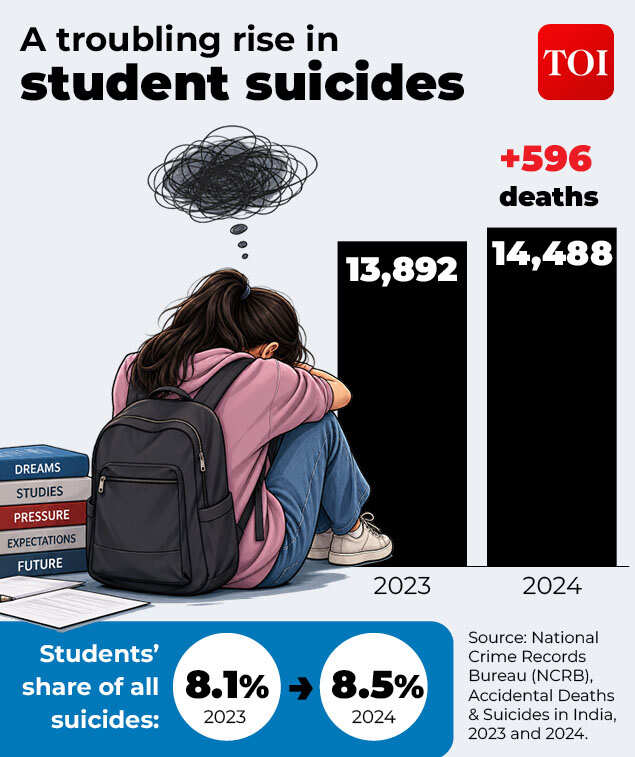
Student suicides in India rose by 4.3 per cent in 2024.
Are India’s institutions failing students in crisis?
What happens when an institution has already identified a student as vulnerable, yet the hostel warden responsible for their everyday residential life remains unaware? The Supreme Court-appointed National Task Force (NTF), created to address student mental-health concerns and prevent suicides, encountered precisely such a situation during one of its field visits. The student had already been identified as vulnerable, but that information had not reached the hostel warden.The NTF reviewed 31 centrally funded institutes, including 23 IITs and four IIMs, of which only 18 reported at least one mental-health service provider. At some institutes, faculty mentors or peer counsellors were counted alongside trained mental-health professionals, meaning that the people included under the broad category of “support” could have very different responsibilities and levels of expertise. For a student facing serious psychological distress, those differences determine who can recognise the level of risk and what happens after it is recognised.
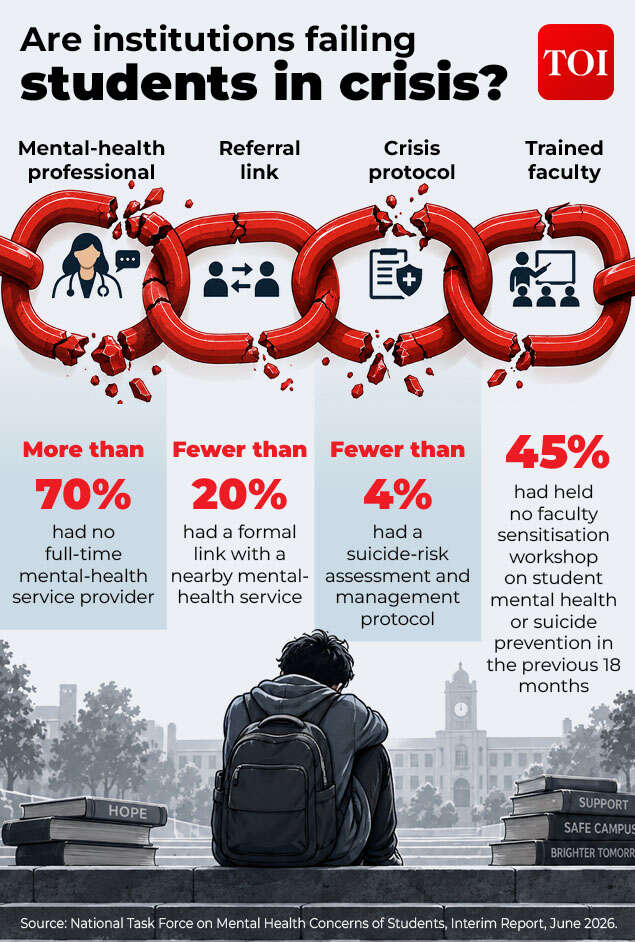
Concerning findings from the 2026 National Task Force (NTF) report on student mental health in India.
“The most important thing is that an institution should have a clear response pathway before a crisis happens,” Krishnan says. “We cannot expect an individual teacher or counsellor to figure out what to do in the moment.” The concern becomes especially immediate when an institution has already identified a vulnerable student but the people closest to their everyday environment remain outside that information loop.
If help exists, why are students still afraid to use it?
“They’ve been told; they’ve been conditioned to think that they can manage everything on their own. So, I think it’s an internal conflict that they have to first fight in order to come to us,” says a Delhi University counsellor, on the condition of anonymity.Once a student decides to seek help, the burden should shift to the institution. Yet only 43 per cent of students surveyed by the NTF said they knew their institution facilitated counselling. If support exists but students do not know where to find it, how accessible is it really?Capacity creates another fault line. “We are only two psychologists in college and there are about 7,000 students,” the counsellor says. “Even if we are able to take 15 to 20 clients in a week each one of us, if we’re able to cater to 40 students in a week, there are still a lot of students who want to take sessions and we would not be able to cater to them.”The strain continues behind the counselling door. “We get paid very little as compared to the work we do,” she says. “There’s also lack of supervision. We pay for our own supervision and if we’re taking supervision from good, seasoned psychologists, the fees is huge.”For a system that asks counsellors to hold students through moments of serious distress, that support cannot depend only on personal commitment. “Sigmund Freud says that psychoanalysis is a cure through love, and I’m a firm believer of this that this job of taking care of other people’s minds requires us to carry that love.” The question for institutions is whether that care is being properly staffed, supported and sustained.
What happens after a student calls for help?
A successful call can still mark the beginning of another journey if the counsellor decides that the person needs care beyond the conversation and refers them to another professional or a hospital. The crucial question then becomes whether the caller reaches that next point of care and whether anybody knows if they do not. For someone already experiencing severe distress, each additional appointment or journey becomes another step they must manage.Tele-MANAS had handled 43.64 lakh calls by August 11, 2026 through 53 cells covering every state and Union territory in 20 languages. By March, 47,487 callers had been referred for non-emergency in-person care, while more than 5,000 urgent referrals had been made to psychiatric hospital emergency departments. Government data does not show how many of those callers subsequently received the recommended care or how quickly that care reached them.“Follow-up is not optional,” Krishnan says, because making a referral does not establish whether the person in crisis actually reached the hospital or professional to whom they were directed. A caller may have completed one difficult act by asking for help and then find themselves responsible for navigating the next stage alone. The effectiveness of the referral therefore depends on what happens after the number is handed over.
How should students and systems respond?
“The immediate priority is safety, not solving the person’s entire life,” Krishnan says, explaining that someone who may act on suicidal thoughts should move somewhere safer and avoid being alone. Asking a trusted person for company can begin with a sentence as simple as: “I am not feeling safe being alone right now. Can you stay with me?” If an attempt has already occurred or the situation is life-threatening, emergency medical help becomes necessary.Even putting distress into words can feel overwhelming, which is why Krishnan says, “Help-seeking doesn’t begin by having a detailed conversation or even being verbal.” A student can send a message or show somebody something they have written when speaking feels too difficult. They can simply say: “I don’t know how to explain this, but I need help.”
Share your thoughts in the comments
Be respectful · TOI community guidelines
What happens after those words are heard cannot rest entirely with one professional, particularly when the student will eventually return to the academic and residential environment in which their distress developed. “The counsellor cannot be the institution’s entire suicide-prevention system,” Krishnan says. “If the student returns to the same academic, interpersonal or residential environment without any coordination or support, we have not really addressed the problem.”The student at the beginning of this story has already picked up the phone, while another student may have entered a counselling room or told somebody that they no longer feel safe. In each case, the act that every awareness campaign asks for has already happened because the student has reached out. What follows is the question Krishnan leaves with the system: “What happens next, who is responsible for it, and how do we know that the student has actually received help?”