








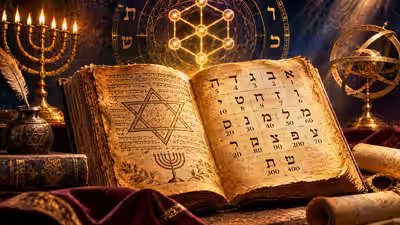
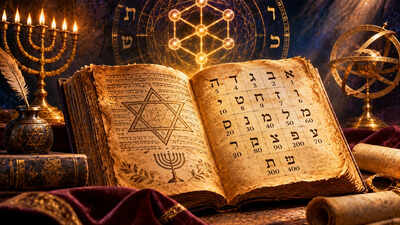
In its oldest form, Hebrew had no separate set of digits. Each letter of the alphabet did double duty, standing for a sound and a value at once. So every Hebrew word also carries a numerical total. For more than two thousand years, scholars and mystics have studied those totals for hidden meaning. The practice is called gematria, a name many believe comes from the Greek word geometria.
How the Letters Add Up
The system is simple. The first nine letters count from 1 to 9. Aleph is 1, Bet is 2, and so on up to Tet at 9. The next nine letters move in tens, from Yod at 10 to Tsadi at 90. The final four cover the hundreds, with Qof at 100, Resh at 200, Shin at 300 and Tav at 400.To find the value of a word, add up its letters. That is the whole method. But what people read into those sums is where the tradition grows deep.
The Number 18 and the Word for Life
The best-known example sits in everyday Jewish life. The Hebrew word chai means “life.” It is spelled with two letters, Chet (8) and Yod (10). Together they make 18.Because of this, 18 is treated as a lucky number in many Jewish homes. Gifts of money at weddings and birthdays often come in multiples of 18, such as 36 or 180. A pendant with the letters of chai is a common present. Few people who follow this custom think of it as mysticism. Yet it comes straight from gematria.
When Love Equals One
Some pairings have drawn attention for centuries. Ahavah, the Hebrew word for love, adds up to 13. Echad, the word for one, also adds up to 13. Teachers in the mystical tradition saw a lesson here. Love draws two people together until they act as a single unit. And since Echad appears in the central Jewish prayer declaring God as one, the link carried spiritual weight too.Another favourite comes from the Talmud. Yayin, meaning wine, totals 70. Sod, meaning secret, totals 70 as well. The rabbis drew a plain conclusion. When wine goes in, secrets come out. Anyone who has watched a quiet colleague turn talkative at an office party will understand the point.
Kabbalah and the Building Blocks of Creation
Gematria gained a larger role in Kabbalah, the Jewish mystical school that took shape in medieval Spain and southern France. An early text called Sefer Yetzirah, the Book of Formation, describes the 22 letters as tools used in creating the world. In this view, letters are far more than marks on a page. They have the power. Their numbers show how one idea is silently linked to another.Kabbalists used gematria to read the Torah on several levels. A plain story could hide a second meaning, found only by counting. Words with equal values were thought to share an inner bond, even when they looked unrelated on the surface.
Do you believe that numbers carry hidden meanings in language?
3k+ users shared opinion today
5k+ users already voted today
3k+ users shared opinion today
Why It Feels Familiar to Numerology Readers
Anyone who works with numerology will notice the overlap. Western numerology also assigns values to letters and reduces names to a core number. The ancient Greeks had a similar practice called isopsephy, and the followers of Pythagoras believed numbers formed the basic order of the universe. Gematria shares that instinct, though it grew out of a separate culture and a sacred text.Still, the purpose differs. Numerology usually looks at personality and timing. Gematria, in its classical form, was a way to study scripture closely and find links between words. It asked questions about meaning far more than about fortune. So a rabbi using gematria in a sermon is doing something quite different from a reader checking a lucky number for the week. Both start with letters and numbers. Only one treats the text itself as the thing to be decoded.