








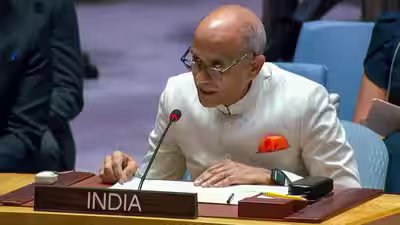
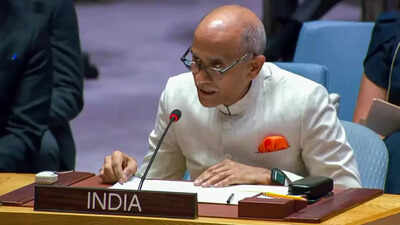
NEW DELHI: India has invoked the devastating Bengal famine of 1943 at the UN Security Council, warning that the economic and humanitarian fallout of global conflicts is borne disproportionately by countries of the Global South.Speaking at a high-level briefing on protecting critical energy infrastructure and Black Sea food supply routes on Monday, India’s permanent representative to the United Nations, Ambassador Harish Parvathaneni, said the food, fuel and fertiliser crisis triggered by conflicts was hitting developing nations hardest.“India has consistently emphasised that the costs of conflict are not shared equally,” Parvathaneni said, adding that Global South countries were among those most adversely affected by disruptions caused by wars.Drawing a parallel with World War II, he said the Bengal famine, which killed more than three million people, remained a stark reminder of how people far removed from the battlefield could suffer the consequences of distant conflicts and wartime decisions.“The pain and suffering caused by the devastating Bengal famine of 1943 in India that killed over 3 million people in India, is a stark reminder of the terrible human cost of a distant conflict caused by unchecked wartime priorities and calculations,” he said.The Ukraine conflict, now in its fifth year, has disrupted interconnected supply chains, with consequences extending far beyond the region, Parvathaneni said. Recalling Prime Minister Narendra Modi’s call for the world to move from “endless war to the end of war”, he said India remained ready to contribute to efforts for a peaceful resolution.India said conflicts deepen food insecurity by disrupting farming, displacing communities, damaging infrastructure and restricting humanitarian access. Their impact spreads through energy and fertiliser supplies, transport networks and agricultural trade, with the Global South bearing a disproportionate burden.“For the Global South, peace is not in the abstract. It is achieved when hungry mouths are fed, when a ship reaches a port, and when a seafarer returns home safe,” Parvathaneni said.India also urged the Security Council to prioritise humanitarian access, protect civilian infrastructure and ensure freedom of navigation, so that humanitarian supplies and legitimate trade could continue without disruption.Parvathaneni said the Black Sea region and India together account for nearly a fifth of global cereal production, while Russia and Ukraine account for almost a quarter of global exports of wheat, maize and barley.He said the importance of the region to global food security showed how disruptions to agricultural production and maritime connectivity could have consequences worldwide.
Share your thoughts in the comments
Be respectful · TOI community guidelines
India also highlighted its humanitarian assistance, including wheat supplies to Afghanistan, rice to Sudan and aid to Palestine, as part of its efforts to support global food security.Parvathaneni expressed concern over attacks on merchant vessels and their crews in conflict zones, noting that Indian seafarers had lost their lives in such incidents.“We call for an end to the targeting of commercial shipping and seafarers, and for safe navigation through international waterways to be restored at the earliest,” he said.India and Liberia launched the Group of Friends on Safety and Security of Shipping and Seafarers during the UN high-level week in September. Parvathaneni said India was also engaging directly with both sides on shipping safety and grain corridors, while supporting the work of the International Maritime Organisation and the International Labour Organisation.