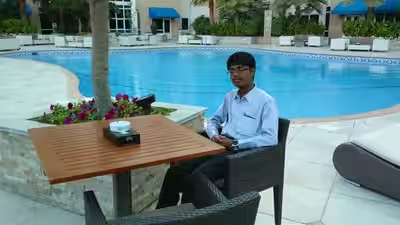






“I could not afford expensive coaching”: How Mumbai slum boy Abhishek Sharma made the best use of borrowed internet to crack IIT
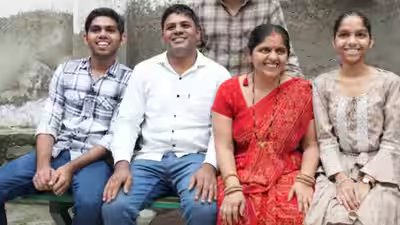
For most students preparing for JEE Advanced, a stable internet connection is hardly something they think about. For Abhishek Sujit Sharma, it could determine whether he would be able to attend a class or access his study material that day.When his mobile data ran out, the Mumbai student would head to the terrace and rely on his neighbour’s WiFi connection to continue studying. There was no quiet study room waiting for him downstairs. He lived with his family in a small rented room in Harad Chawl, in Mumbai’s Lokmanya Tilak Nagar, where space, money and even basic amenities were limited.Yet, from that difficult setting, Sharma went on to crack JEE Advanced 2024 and secure admission to IIT Delhi. He scored 199 marks and secured an All India Rank of 2456, along with an OBC-NCL rank of 415. He became the first IITian from his slum.
When the terrace became his classroom
Sharma’s JEE preparation did not happen in the kind of environment usually associated with competitive-exam preparation. His family of four lived in a small rented room and paid Rs 3,000 a month in rent. His father worked as a labourer at a steel fabrication company.The family also did not have a private washroom and had to use community toilets. The surroundings came with their own set of distractions and difficulties, making it even harder for a student to find uninterrupted time and space to study. Internet access was another challenge.Speaking to India Today, Sharma explained that financial constraints and limited internet access forced him to find an alternative when his mobile data ran out: “I resorted to studying on the terrace using a neighbour’s Wi-Fi connection.”The detail may sound simple, but it captures the reality of his preparation. While many JEE aspirants were attending online classes from dedicated study spaces, Sharma was sometimes taking his lessons to the terrace simply to get access to the internet. That terrace eventually became part of his journey to IIT Delhi.
His parents made their own sacrifices
Sharma’s preparation was not a solo battle. His parents, despite their limited means, tried to make sure their son had whatever little comfort they could provide.Sharma described his family as his biggest source of support during his entrance-exam preparation. He recalled how his parents would sleep on the floor so that he could have the bed and a more comfortable place to study. For him, that sacrifice became motivation.“My family was my biggest support system,” Sharma said. His mother also spoke about his preparation in a video shared by Physics Wallah, describing how he continued studying despite the difficulties around him.
He chose an affordable online route
Sharma had wanted to become a scientist and develop a career in physics. But expensive coaching was not an easy option for his family. He therefore turned to online preparation.For Abhishek, finding an affordable and reliable source of education could be difficult when money was a constraint. The online classes gave him access to structured preparation without the expense of conventional coaching. His preparation eventually took him beyond JEE Main and into the much more competitive JEE Advanced examination. And when the results arrived, the student who had once depended on a neighbour’s WiFi had earned himself a place at one of the country’s most prestigious engineering institutes.
From a crowded Mumbai neighbourhood to IIT Delhi
Sharma’s achievement was not just about a rank on a JEE scorecard. For the community he came from, it represented something much bigger.He had studied amid the noise and limitations of a Mumbai slum, sometimes sitting on a terrace to access a neighbour’s internet connection. His parents had made personal sacrifices so that he could study. And despite the lack of resources, he continued working towards a goal that had seemed distant from his circumstances. Now, IIT Delhi was no longer just an aspiration.Sharma says that he wanted to focus on physics research during his time at IIT Delhi and eventually use his education to work on real-world problems. He also hoped to mentor young students and create greater educational opportunities for those from disadvantaged backgrounds. His message to other students was equally direct: “Our circumstances do not define our potential.” That line perhaps best captures the journey.A student from a Mumbai slum, studying on a terrace whenever his mobile data ran out, had to borrow access to the internet before he could access the opportunities that came with it. Today, that same student is headed to IIT Delhi. The neighbour’s WiFi may have helped him connect to his classes. But it was his persistence that carried him to the IIT campus.