






In the 1800s, red foxes were brought to California for hunting. Decades later, the light-footed Ridgway’s rail declined to just 5 breeding pairs |
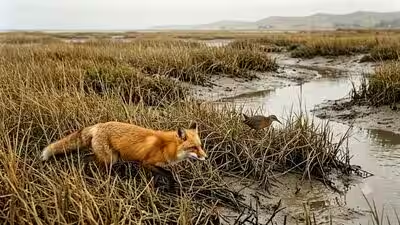
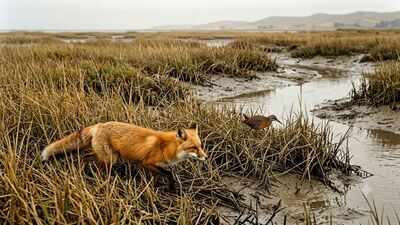
A red fox introduced to California more than a century ago might seem far removed from the fate of a small marsh bird. Yet the two became linked in the coastal wetlands of Southern California, where the light-footed Ridgway’s rail has struggled to survive. The bird spends much of its time concealed among cordgrass and pickleweed, moving through vegetation that provides cover and nesting sites. Red foxes, meanwhile, spread beyond the places where they were originally kept after being brought to California for hunting and fur farming in the late 1800s.At Seal Beach National Wildlife Refuge, their presence was followed by a sharp decline in the rail population. Within seven years, the refuge had just five breeding pairs. The decline added another layer of pressure to a bird already dependent on a shrinking network of coastal marshes. Listed as federally endangered in 1969, the light-footed Ridgway’s rail remains closely tied to these fragile wetlands, where changes in habitat and the arrival of non-native predators can have consequences for a population with little room for losses.
Light-footed Ridgway’s rail has faced decline in California since 1969
The light-footed Ridgway’s rail is not the sort of species most visitors to a California wetland are likely to notice. Its grey-brown plumage provides effective camouflage, while its body and behaviour suit a life among dense marsh plants. It occupies coastal wetlands extending from the Santa Barbara area south towards San Diego and across into Baja California, Mexico.Its habitat has become increasingly fragmented, leaving populations separated across relatively small patches of marsh. The species was placed on the US federal endangered species list in 1969, followed by a California endangered-species listing in 1971.According to the US Fish and Wildlife Service, numbers remain low. A federal species review estimated that California had 308 breeding pairs in 2019, compared with 656 three years earlier. Those figures are estimates of breeding pairs rather than individual birds, but they give a sense of how limited the remaining population is.For a species with so little room to spread out, changes within a single marsh can matter.
How red foxes were introduced to California in the late 1800s
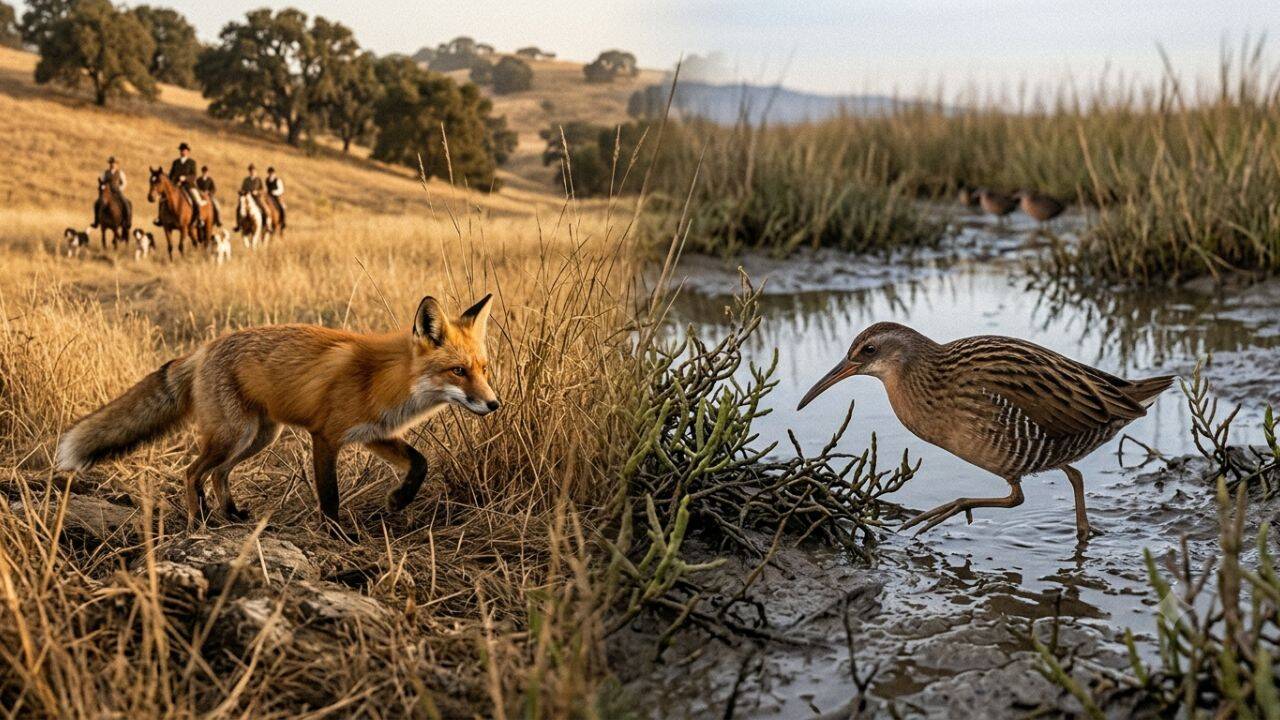
The red fox was not simply a natural newcomer to the California lowlands. Its presence there was tied to human activity during the late 19th century.Foxes were brought into California for sport hunting and fur farming. The animals did not remain neatly within the boundaries people intended for them. Some escaped from captivity, while others were released, including animals no longer wanted by owners or fur farmers.From there, the foxes established populations in parts of the state. They spread through agricultural and wetland landscapes, including the Sacramento and San Joaquin valleys, the San Francisco Bay region and, eventually, the coastal plains of Southern California.The original reasons for introducing the animals were economic and recreational. The effects, however, extended into ecosystems where native species had evolved without the same predator pressure.
Seal Beach’s light-footed Ridgway’s rail population fell to five pairs
For the rail, the danger was particularly serious because it spends much of its life close to the ground and breeds in marsh vegetation. A predator moving through the same habitat can reach places that might otherwise provide shelter.The history of the species at Seal Beach illustrates the scale of the problem. According to a 2020 US Fish and Wildlife Service species review, which cited a 1994 California Department of Fish and Game report, the introduction and spread of non-native red foxes was followed by a dramatic decline in the local rail population.Within seven years, only five breeding pairs remained at the refuge.That decline was not simply a matter of the birds becoming less common in an abstract sense. A breeding population this small has little margin for further losses. Fewer pairs mean fewer nests, fewer young and a greater vulnerability to anything else that disrupts the marsh.
The conservation challenges facing California’s coastal rail
The rail’s history also shows why the effects of introduced species can be difficult to separate from the broader changes taking place around them. Coastal wetlands have been altered by development, water management, habitat fragmentation and other pressures. A predator introduced decades earlier can become another part of that altered environment.For wildlife confined to isolated wetlands, there may be nowhere else to go when conditions deteriorate. A bird can survive only where suitable marsh remains, and even an apparently healthy patch of vegetation may not be safe if predators can reach it.This creates a difficult conservation problem. Protecting habitat is necessary, but habitat alone does not necessarily remove the threats that have accumulated within it.
The long-term impact of California’s red fox introduction
The red fox story is more than a historical footnote because introduced populations can persist long after the original activity that created them has disappeared. The people who brought foxes to California in the 1800s could not have known how those animals would interact with a rare coastal rail generations later.That is part of what makes introduced species such complicated conservation issues. The original decision may have been made for a short-term purpose, while the ecological consequences can continue for decades.By the time a native species begins to decline, the chain of events behind the problem can be difficult to see. The landscape may look natural. The predator may look as though it belongs there. Yet neither necessarily has a long evolutionary relationship with the species at risk.
The uncertain future of California’s light-footed Ridgway’s rail
The light-footed Ridgway’s rail has persisted despite those pressures, but its numbers show how precarious that survival remains. Hundreds of breeding pairs may sound like a sizeable population until they are spread across fragmented coastal wetlands and exposed to changing conditions.The bird’s future therefore depends on more than its ability to reproduce. The marshes must continue to provide suitable cover, food and nesting areas, while threats from predators and other pressures need to be managed.For a bird that spends much of its time hidden among reeds and marsh vegetation, its decline can happen largely out of public view. The history behind it is much easier to see: a species introduced for human purposes, a predator that found a new home, and a native bird left dealing with the consequences long afterwards.