






In the early 1900s, Henry Ford observed meatpacking disassembly lines; that insight led to the automobile assembly line |
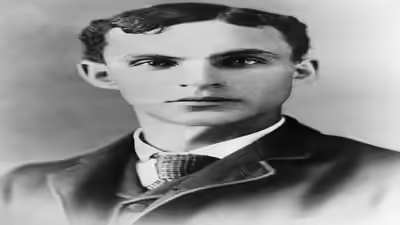
The invention of the assembly line is generally depicted in history as one of those “eureka” moments where the idea for the assembly line came into the mind of Henry Ford out of nowhere when he was working by himself in an isolated workshop. This makes a nice story, but real history is more complicated and far more intriguing than such simplified accounts. The moving assembly line did not come out of thin air; it emerged because of an open-minded inventor who viewed the world through a broad lens.In the first decade of the twentieth century, much of Ford’s and his staff’s time was devoted to studying work processes in other industrial sectors. The stop at the meat-packing factories in Chicago was one of the most notable among many others. It may seem strange that a manufacturer of automobiles would seek advice from butchers, but there were certainly lessons of efficiency to be learned. The process was essentially that of disassembly, not assembly; the carcass was slid past workers who each performed a repetitive task.The transition from dismemberment to reassembly was a crucial pivot point for the industry. In an article published by UC Davis, Ford is presented as an inventor of ideas but not the inventor of inventions himself. He did not come up with the concept of a wheel, but managed to figure out how to get it to move in a straight line. The meatpacking plant was an excellent conceptual prototype: if disassembly can be performed stage-by-stage, then the process of assembly should work similarly.Adapting the blueprint of flowThe new approach allowed Ford to abandon the traditional practice of bringing a crew together around one stationary automobile. Instead, through a well-planned chain of processes, the car would be delivered to the worker to perform his or her task. This was not a straightforward adaptation. Ford’s team needed to find ways to adapt the principle of breakdowns and integrate them into an assembly line process involving conveyors and gravity slides, which were used in grain elevators and breweries.Its greatest virtue was its elegant simplicity. With the order of operations defined, the plant became an organism in action. Every individual attended to his small and specific segment of the operation, eliminating the waste of moving back and forth from job to job and searching for equipment. It brought order to the chaos of the work floor, making production something that could be scheduled and predicted with a precision the world had never seen before.
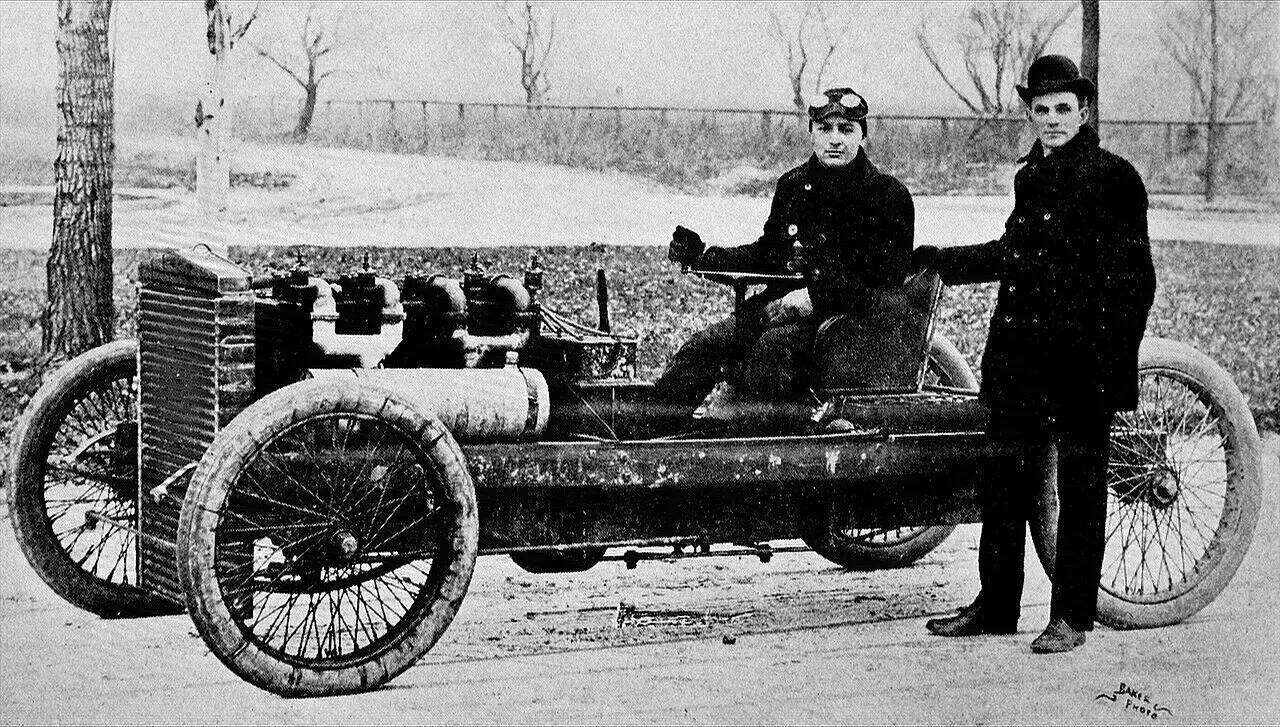
This innovative adaptation, integrating principles from various industries, revolutionized production by organizing labor and machines efficiently, making cars accessible products of a system. Image Credits: Archive.org, via Wikimedia Commons
Despite what is printed on the door, the development of the line was not an individual triumph. As explained in a paper in the journal Animal Frontiers, Ford’s disassembly line in meatpacking predated his use of assembly lines by anticipating it. The paper clearly illustrates that this is not chance but rather one of the fundamentals of staged movement. The industrial advance is depicted as a team effort where teams learn and improve upon each other.The team behind the transformationFord was less of a visionary than a connector. From looking at meat packing to grain and even brewing, there was the commonality of the repetitive motion, thoughtfully arranged to eliminate waste. Before the Model T could be assembled faster than any car previously made, the factory itself was no longer simply a place of work but also a new way of arranging men and machines.This broader perspective helps us understand that the assembly line was not just a piece of machinery. It was a cultural shift. It changed how managers thought about labour and how the world thought about the cost of goods. The car was no longer a luxury item hand-built by artisans. It was a product of a system. This legacy of crossing boundaries between fields is perhaps the most important lesson of the Ford story. It reminds us that progress often starts when someone realises that a problem in their own industry has already been solved by someone else in a completely different field.Indeed, today the same reasoning is as clear as it was then, evident even in busy fast food kitchens and quiet computer rooms where coding for software development is done. It turns out that we have entered the world which Henry Ford created by entering a butcher shop, reminding us that sometimes leaving our comfort zone is not just courteous but the only route to innovation. The story of the assembly line is a lesson that innovations do not necessarily arise from inventions but rather can come through creative adaptation of an existing concept.