






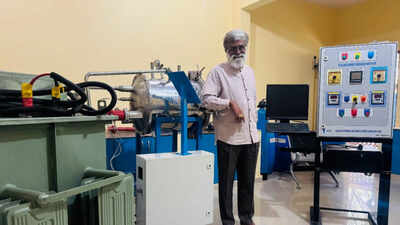
BENGALURU: What if one chemical element could be converted into several others, including gold? An Indian inventor from Bengaluru has received a patent for a process that could do this using specially generated frequencies, without conventional nuclear reactors or radioactive reactions.There is no fission or fusion reaction here. His experiments report the presence of gold, silver and several other elements in processed samples.Rajah Vijay Kumar’s invention, called Gravitoradiophysical Nuclear Transmutation (GNT), has been granted Indian patent (No. 5683222), nearly eight years after it was filed on Nov 21, 2017. The patent was granted in the second half of 2025.“The GNT could eventually find applications in energy, medicine, genetics, industry and space,” Kumar, director and chief scientific officer, Scalene Energy Research Institute, Organization de Scalene Foundation, told TOI.
How it works
To understand the process, it helps to know what makes one element different from another. Every element has atoms, and at the centre of each atom is a nucleus. The number of protons in this nucleus determines the element’s identity.Gold, for example, has 79 protons, while mercury has 80. Turning mercury into gold would therefore require changing the structure of its nucleus by removing (or displacing) one proton and one electron, something an ordinary chemical reaction cannot do.
.
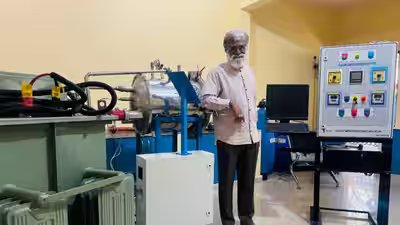
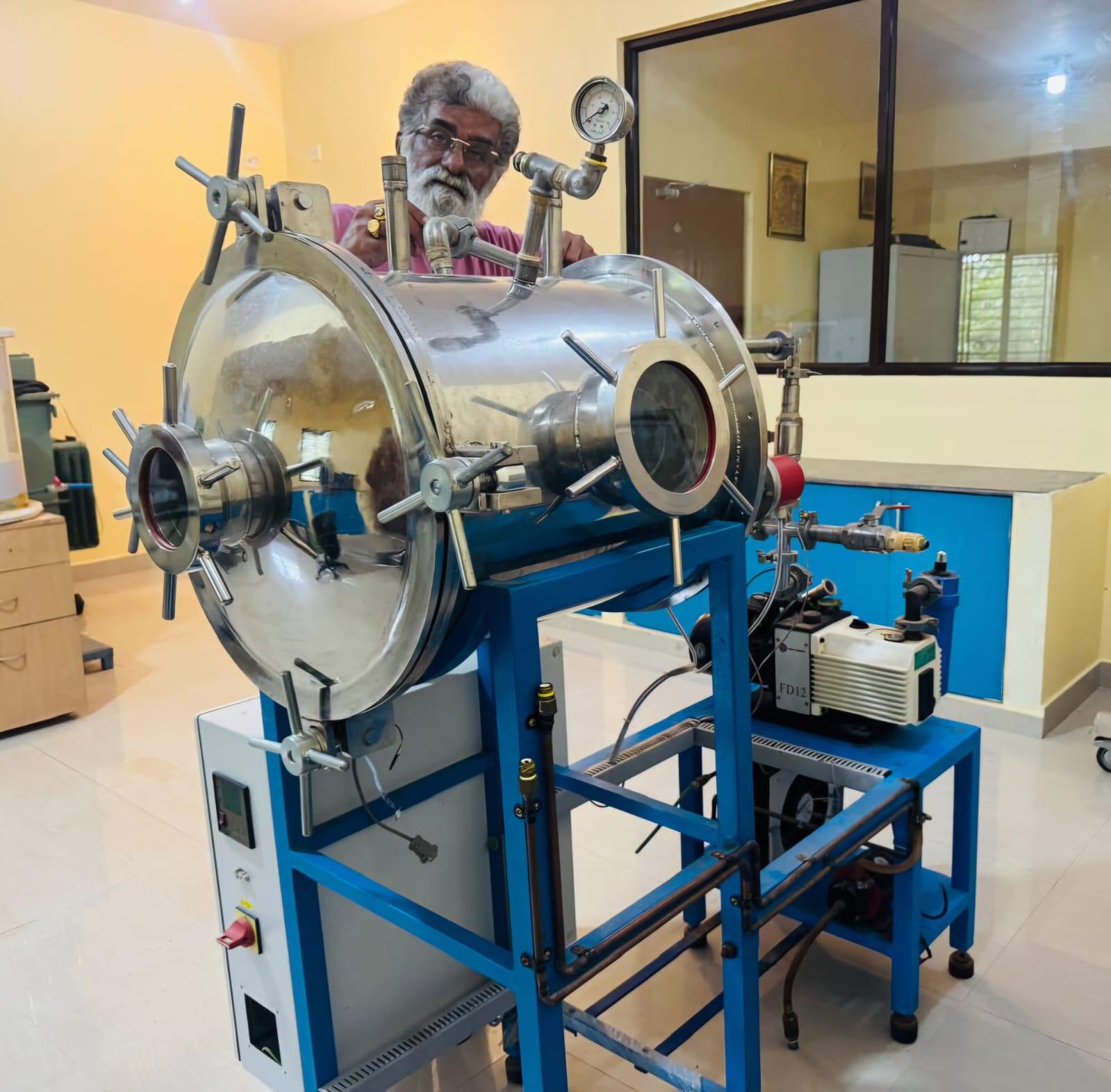
Kumar’s proposed process uses a specially designed reactor to achieve this. Its central component, called the ‘Boom Tube’, a tubular reactor that produces continuous free fall and weightlessness at molecular levels, fitted with antennas made from an aluminium alloy and connected to a high power high frequency generator. The apparatus also has systems to regulate temperature and pressure in a vacuum environment.The process works in two proposed stages. First, one frequency is used to separate the target element from the chemical compound containing it. A second frequency is then applied to bring about the proposed change in the element’s nucleus.The process works in two proposed stages. First, a disassociating frequency depending on the interested elements is used to separate the target element from the chemical compound containing it. Then, an element specific transmutation frequency is then applied to bring about the proposed change in the element’s nucleus. The exact mechanism of action is still being studied.As Kumar explains: “Every element has a unique frequency, or set of frequencies, that can break its chemical bonds and separate it from a compound. For the initial experiments, I chose mercury, which it describes as one of the heavier elements that could be handled relatively safely in its experimental setup. The aim, however, was not simply to make gold.”
Larger ambition
The larger ambition was to develop a process that can convert different elements and isotopes for possible applications in energy, medicine, industry and space exploration.The patent describes experiments in which a mercury compound, mercuric sulphate, was mixed with distilled water and processed through the reactor. An untreated portion was retained for comparison. An accredited laboratory, reportedly unaware of which samples had been processed, analysed both.The results reported gold at 1.91 mg per litre in the first processed sample and 2.3 milligrams per litre in the second. Silver was also detected at 11 milligrams per litre in the second test. Other elements, including magnesium, manganese, phosphorus and zinc, were reported in the processed samples. The mercury came down from 33.45 gm to 8.67 gm while sulphur almost remained unchanged at around 8.5 gm.
Share your thoughts in the comments
Be respectful · TOI community guidelines
The laboratory used a technique called Inductively Coupled Plasma Atomic Emission Spectroscopy (ICP-AES), which identifies and measures the quantities of elements in a sample. The research team acknowledges that considerable work under different conditions remains before the process can be perfected or considered for large-scale applications.There is also an important scientific caveat. Detecting gold, silver or other elements in a sample does not, by itself, mean the technology or process is ready for wider use immediately. The laboratory technique measures what is present, not how it was formed. Independent experiments, including tests of the elements’ atomic structure, would be needed to understand exactly the science of how such claimed transmutation has occurred.