






ITR filing deadline nears: How to file income tax return online on e-filing portal – quick 15-step guide
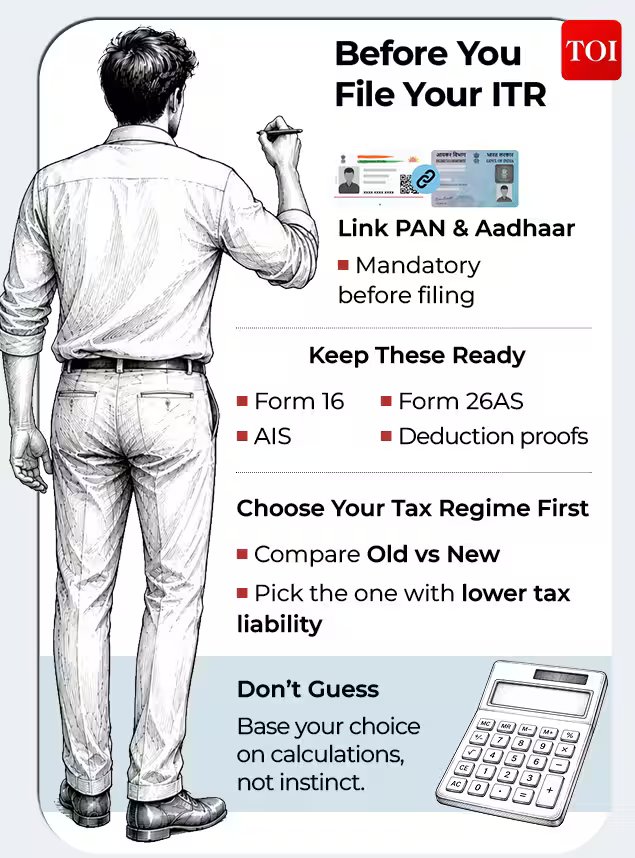

Filing your ITR needs to be a careful process to avoid triggering any unwanted scrutiny.
It’s the last week of July and like every year the income tax return filing deadline is nearing. For salaried taxpayers July 31, 2026 is the last date on which they can file their ITR within the due date.Taxpayers who earn income from business or profession have a longer window to file their returns. The due date is August 31, 2026, for non-audit cases and October 31, 2026, for cases that require an audit.The process to file the income tax return has evolved over the last few years and the income tax portal now pre-fills a lot of your tax related information drawing from information in documents such as Form 16, Form 26AS, Annual Information Statement (AIS), bank records etc. Yet the onus of the accuracy rests with you, and hence filing your ITR needs to be a careful process to avoid triggering any unwanted scrutiny or queries from the Income Tax department.
ITR filing : Complete these steps first
Before you sit down to file your income tax return, gather all the concerned documents.
- Before you log in to the income tax portal confirm that your PAN and Aadhaar are linked, since the portal will not let you proceed without it.
- Know the right income tax return form –
ITR-1 to ITR-7 – which is the right one depends on the source of your income – salary, freelance, business, profession, HUF etc. - Keep your Form 16, Form 26AS, Annual Information Statement (AIS), and the proofs for the deductions you intend to claim within reach.
- Most importantly, decide your income tax regime – new or old – before you begin rather than during filing.
“The old and new regimes reward very different profiles, and the only reliable way to choose is to compute your liability under both and file under whichever leaves you paying less. Treat this as a calculation, not an instinct,” says CA Chandni Anandan, Tax Expert at ClearTax.
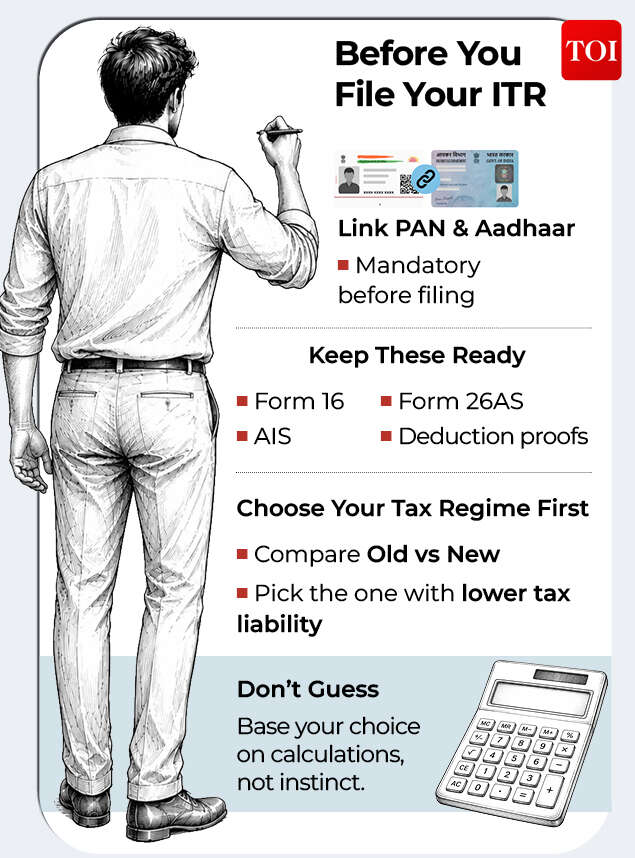
Before You File ITR: Check This
When claiming deductions and exemptions it is always wise to keep your records complete and handy. This documentation should stay with you at least till your tax return is processed so that in case of any queries from the department, you have all the information and proofs ready.
ITR filing: Step-by-step guide
CA Chandni Anandan, Tax Expert at ClearTax shares a quick 15-step guide to filing your income tax return online accurately noting that while the process below is not complicated, each step requires a little attention:1. Log in to the income tax portal (incometax.gov.in/iec/foportal/) using your PAN as the user ID.2. On the “File your return for the year ended 31-Mar-2026” card, select File Now. If you have a saved draft, choose Resume Filing instead.3. Select the Assessment Year 2026-27, which corresponds to income that you have earned in the financial year 2025-26.4. Choose the online mode for a straightforward return. Where your income is more, the offline utility gives you more room to work, after which you upload the generated JSON file to the portal. The online route is the one described here.5. Select your status as Individual, HUF, or other, as applicable.6. Choose the return form suited to your income. Many salaried taxpayers file ITR-1, but the right form depends entirely on the nature and mix of your income, so select the one that genuinely fits rather than the one that looks simplest. Please note that if your capital gains from sale of shares etc. does not exceed Rs 1.25 lakh (above which the gains are taxable), then ITR-1 is applicable for you.7. Verify your personal details and select your income tax regime. To move out of the default new regime, choose Yes against the option to opt out under Section 115BAC(6). This in-return choice is available to those without business or professional income; if you earn such income, opting out requires filing Form 10-IEA separately. While here, confirm your bank details and nominate an account for any refund.
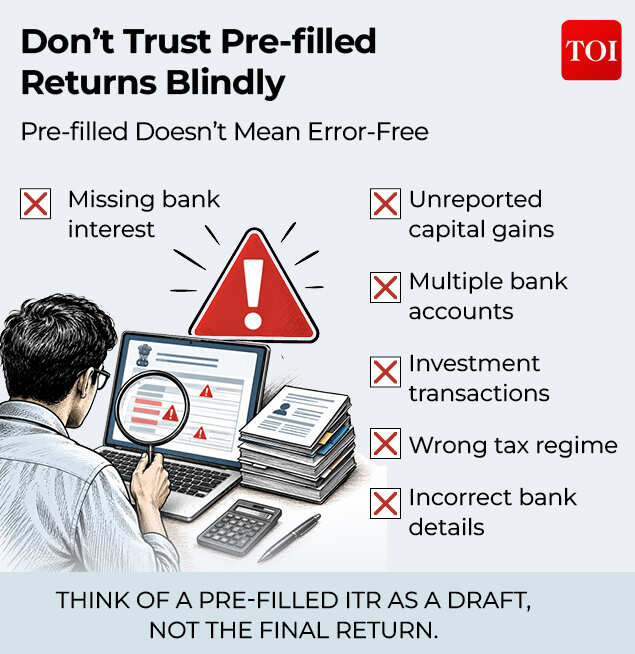
Don’t Trust Pre-Filled Returns
8. Examine the pre-filled income drawn from your Form 16 and from entities that report to the department. Check each figure against your own records, add any income that has not been captured, and claim every deduction you are entitled to. In the case of the new income tax regime, the number of deductions are few, but for those opting for the old regime the list could include medical insurance premium, fixed deposits, HRA or housing loan benefit, Leave Travel Allowance, Section 80C etc.9. Review the taxes that have already been paid on your behalf, TDS and advance tax. All of these appear pre-filled – confirm the figures and the resulting liability.10. Proceed to verification and study the tax summary that the income tax portal presents.11. Preview the return in full, satisfy yourself that it is correct, and only then click on submit.12. Complete the declaration and proceed to validate your income tax return.13. If the portal identifies any defects, resolve them before moving on. They are far cheaper to fix now than after filing.14. If a balance of tax is payable, the sound practice is to pay it before you file so the income tax return goes in fully settled. Filing itself is not conditional on payment, but clearing the dues at this stage spares you interest and a second round of follow-up from the department.
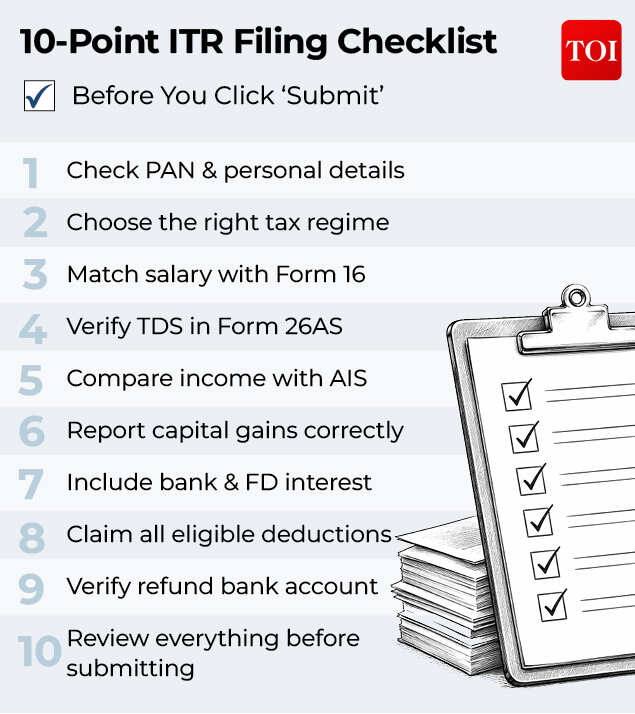
10-Point ITR Filing Checklist
15. Complete e-verification within 30 days, using whichever mode suits you. This step matters more than its placement suggests: the department begins processing only once the return is verified, so verifying promptly is what actually sets your refund and assessment in motion. There are several online options available for verification including Aadhaar-based OTP method which makes the process seamless.
What happens if you miss the July 31, 2026 deadline?
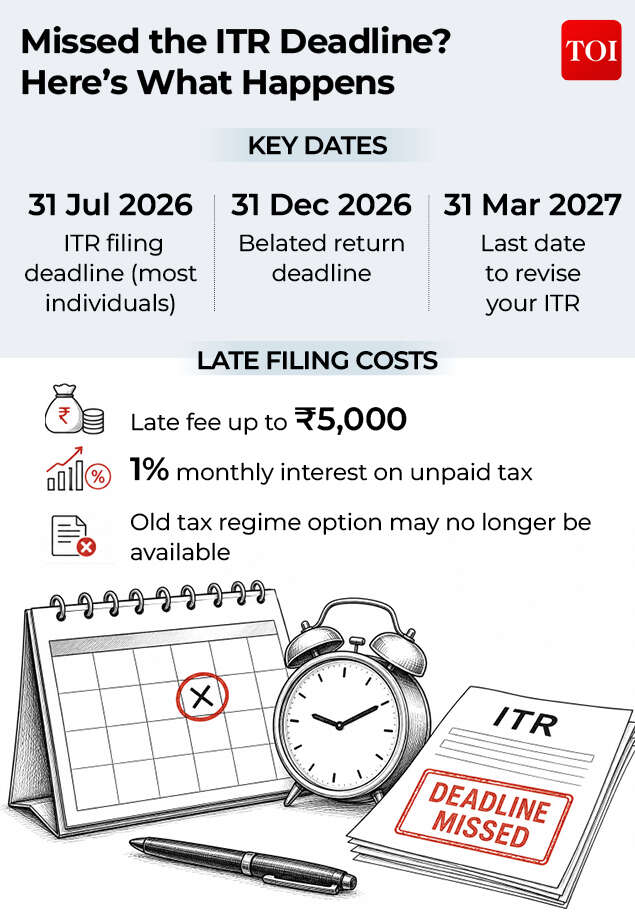
But, let’s say you miss the July 31, 2026 deadline. There are several consequences, though filing a belated tax return is still possible.
- When filing after July 31, 2026 you can only file your return under the new tax regime. So if you plan to opt for the old regime, the deadline assumes more significance for you.
- The earlier you file the faster your refund, if any will be processed. Filing after the due date may invite unwanted scrutiny which could delay the process and your refund.
- One major drawback of late filing is that taxpayers cannot carry forward losses, except losses from house property, to future years.
- A belated income tax return can be filed within nine months from the end of the relevant tax year. So it is by December 31, 2026, for FY 2025-26. But you have to pay a late filing fee of up to Rs 5,000. For taxpayers whose income is below Rs 5 lakh, the fee is capped at Rs 1,000.
- However, any unpaid tax at your end will attract penal interest at 1% per month from the original due date until the return is filed. Interest on any default in the payment of advance tax will also continue to accrue.
Finance Act, 2026 provides greater flexibility by allowing taxpayers to revise both original and belated income tax returns within 12 months from the end of the relevant tax year.
Missed ITR deadline? Here’s what happens
For tax year 2025-26, this means a revised return can be filed up to March 31, 2027, on payment of the applicable fee of Rs 5,000 or Rs 1,000.Even if a taxpayer misses the deadline for filing a belated return, or wants to make changes after submitting a return, there is still an option to file an Updated Income Tax Return (ITR-U) by paying the prescribed additional tax.