






ITR filing: How to claim HRA exemption when filing income tax return – top points to keep in mind


ITR filing FY 2025-26: If you opt for the old income tax regime while filing your tax return, chances are that you avail the benefit of House Rent Allowance (HRA). This is a popular exemption available for taxpayers, allowing for lower tax outgo.It’s important to note that the HRA exemption is available only to taxpayers who opt for the old tax regime. It is not an option under the new income tax regime.
HRA exemption: What taxpayers should know
Under the existing provisions applicable for FY 2025-26, where the rented accommodation is situated in the four metro cities—Delhi, Mumbai, Kolkata, or Chennai—the exemption is computed with reference to 50% of salary; in all other cases, the limit is 40% of salary.Also Read | ITR filing FY 2025-26: Can you switch between new and old income tax regime every year?HRA tax exemption is available only to salaried employees who receive HRA as part of their salary and live in rented accommodation. The exemption is limited to the lowest of the following: (1) Actual HRA received (2) Rent paid minus 10% of basic salary, or(3) 50% of basic salary if living in a metro city (Delhi, Mumbai, Chennai or Kolkata) or 40% for non-metro cities.
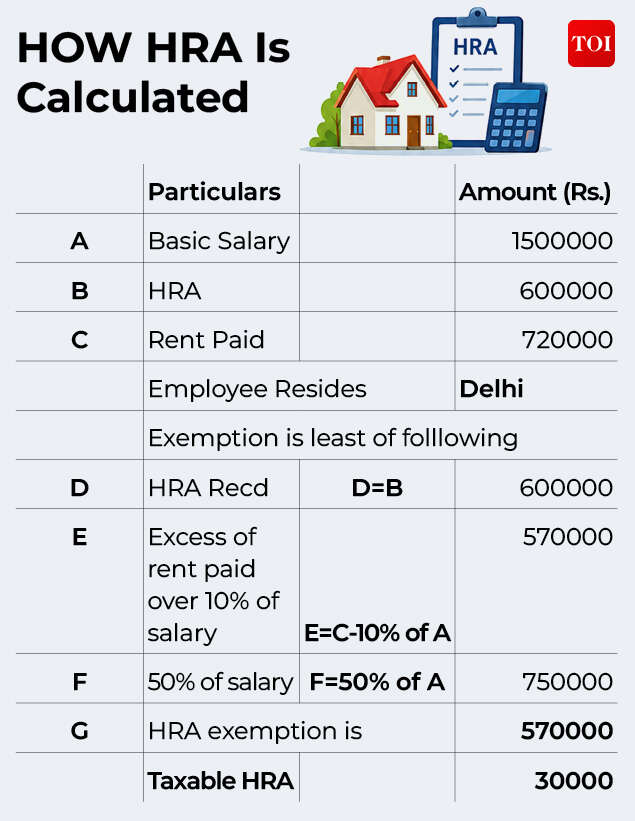
How HRA is calculated
Tanu Gupta, Partner at Mainstay Tax Advisors LLP says taxpayers claiming HRA should keep the following considerations in mind:
- Where monthly rent is Rs 50,000 or more, the tenant may be required to deduct tax at source and comply with the prescribed reporting requirements.
- Where rent is paid to relatives, such as parents, the arrangement should be genuine and properly documented. The recipient relative should appropriately disclose the rental income in their
income tax return , as the tax authorities increasingly use data analytics and information matching tools to cross-verify such claims. - Taxpayers should retain rent receipts, lease agreements, proof of rent payments, and other supporting documents, as these may be called for during assessment or verification proceedings.
How to claim HRA while filing tax return
According to Tanu Gupta, in cases where the taxpayer has informed the employer of opting for the old tax regime, details such as rent paid, rent receipts, rent agreement, PAN of the landlord (where the annual rent exceeds Rs 1,00,000), and other supporting documents are generally required to be submitted to the employer so that the eligible HRA exemption can be considered while computing tax deduction at source (TDS) on salary. “However, if these details were not furnished to the employer during the year, the taxpayer may still claim the eligible HRA exemption while filing the income tax return, subject to maintaining adequate supporting documentation,” Tanu Gupta tells TOI.She explains the steps:
- For FY 2025-26 (AY 2026-27), the return utility introduces a new
Schedule EA [Section 10(13A)] for reporting HRA exemption. - Instead of merely entering the exempt amount, taxpayers are now required to furnish details such as salary, HRA received, rent paid, and the applicable percentage of salary (50% or 40%, as the case may be).
- Based on these inputs, the utility automatically computes the eligible exemption.
- Consequently, taxpayers may not find Section 10(13A) HRA exemption separately listed in the drop-down menu under exempt allowances.
Also Read | ITR filing: Which is the correct tax return form for you? ITR-1 to ITR-7 eligibility explainedAccording to the tax expert, the requirement to provide detailed information in Schedule EA [Section 10(13A)] appears to be aimed at strengthening verification mechanisms and reducing instances of incorrect or unsupported HRA claims.The Income-tax Rules, 2025 have expanded the list of cities eligible for the higher 50% salary threshold to include Bengaluru, Hyderabad, Pune and Ahmedabad. However, this amendment takes effect from 1 April 2026 and, therefore, will apply from FY 2026-27 (AY 2027-28) onwards and not for FY 2025-26, Gupta adds.Also Read | ITR filing FY 2025-26: Old vs new income tax regime – how salaried taxpayers can lower tax outgo