






Japan does not cut down centuries-old trees for development. Instead, experts spend months preparing their roots and relocating them |
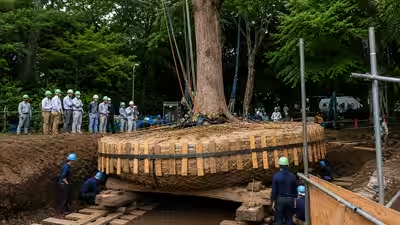
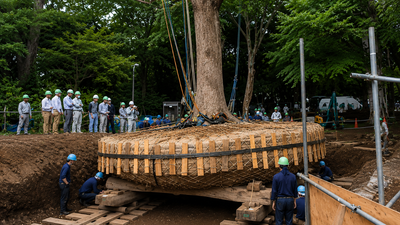
When roads, railways or new buildings are planned, centuries-old trees are often among the first casualties of development. In Japan, however, some of the country’s most valuable trees are given a second chance. Rather than cutting them down, arborists and horticultural experts sometimes relocate them using a painstaking process that can take months or even more than a year. Before a tree is moved, specialists carefully prepare its root system to improve its chances of surviving in a new location. The technique, known as nemawashi, combines centuries of horticultural knowledge with modern engineering and reflects Japan’s long-standing respect for nature and cultural heritage.
Why Japan relocates some centuries-old trees instead of cutting them down
Not every tree standing in the path of development is relocated. The practice is generally reserved for trees with exceptional historical, cultural or ecological value. Many of these trees are found in temple grounds, shrines, traditional gardens, parks or historic neighbourhoods, where they have stood for generations and are considered part of the local heritage.In some cases, moving a mature tree also helps preserve biodiversity and the character of a landscape while allowing infrastructure projects to continue. Because the process is expensive and technically demanding, authorities carefully evaluate whether relocation is practical before deciding against removal.
The months-long preparation hidden beneath the ground
The most remarkable part of the relocation process happens long before cranes arrive.Months before transplantation, specialists begin carefully pruning the tree’s roots. Instead of uprooting the entire root system at once, they gradually trim selected roots around the tree. This encourages the growth of new, fine feeder roots closer to the trunk.These feeder roots are essential because they absorb most of the water and nutrients needed for survival. By allowing them to develop before relocation, experts significantly reduce transplant shock and improve the tree’s chances of adapting to its new environment. Depending on the size and species, this preparation may take anywhere from six months to over a year.
What is nemawashi and why does it matter?
The root preparation process is known in Japan as nemawashi, a term that literally translates to “going around the roots.”Originally a horticultural practice, nemawashi has become a widely used expression in Japanese business and politics, where it refers to quietly laying the groundwork before introducing major changes. The metaphor comes directly from tree transplantation: careful preparation before taking decisive action leads to better outcomes.In gardening, the principle remains the same. Preparing the roots first greatly increases the likelihood that a mature tree will survive the move.
How Japan moves giant trees
Once the root system is ready, the relocation begins.Workers excavate around the tree to preserve as much of the prepared root ball as possible. The roots are wrapped in protective materials such as burlap, while the trunk and branches may also be secured to prevent damage during transport.Depending on the tree’s size, cranes, hydraulic lifting equipment or specially designed transport vehicles are used to move it to its new location. There, it is replanted in a carefully prepared pit, supported with stabilising structures and monitored closely through regular watering and maintenance until it establishes new growth.
Does every relocated tree survive?
Even with months of preparation, relocating a mature tree is never guaranteed to succeed. Larger trees experience significant stress because part of their root system is inevitably lost during transplantation.Success depends on factors including the species, age, health of the tree, timing of the move and the quality of aftercare. For this reason, Japanese arborists reserve the technique for trees whose cultural, historical or environmental value justifies the considerable cost and effort involved.
A lesson in balancing development and conservation
Japan’s approach demonstrates that urban development and environmental conservation do not always have to be opposing goals. Although relocating centuries-old trees requires careful planning, specialised expertise and significant investment, it allows some of the country’s most treasured natural landmarks to survive for future generations. Rather than viewing ancient trees as obstacles, the practice treats them as living heritage worthy of preservation, even as cities continue to grow.