









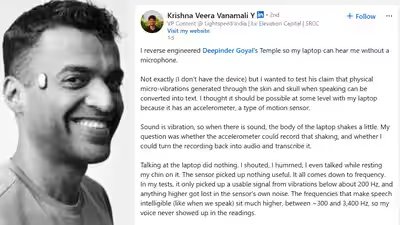
What happens when someone tries to copy the tech inside a pricey new wearable using nothing more than an everyday laptop? One guy decided to find out – and his late-night tinkering ended up catching the eye of Deepinder Goyal himself.Krishna Veera Vanamali Y, who works at a venture capital firm, posted a pretty unusual experiment on LinkedIn. He claimed he had managed to partially replicate the microphone-free voice capture behind Temple, the forehead wearable launched by the Zomato co-founder.His breakdown didn’t just stir up curiosity in the comments. Goyal actually jumped into the thread, gave him props for the hack, and offered to let him take the real hardware for a spin.“Nicely done,” Goyal commented, right before breaking down a bit of how Temple picks up speech without relying on a traditional mic. Then he threw out an open invitation: “You wanna test one for a day?”
How did the man try to recreate Temple’s technology?
Vanamali kicked off the project with a straightforward question: could a regular laptop tell what someone was saying without turning on its microphone?He had been intrigued by Goyal’s claim that Temple senses the tiny physical vibrations your body makes when you talk. Instead of waiting around to buy or borrow one, he wanted to see how close he could get using standard laptop hardware.“I reverse engineered Deepinder Goyal’s Temple so my laptop can hear me without a microphone,” he wrote in his LinkedIn post.He was upfront about the fact that he didn’t actually own a Temple unit. What he really wanted to test was whether vibrations travelling through bone and skin during speech could be translated straight into text. To pull it off, he tapped into his laptop’s built-in accelerometer – the tiny sensor meant to detect movement and tilts – and tried reading physical vibrations to turn them into words.The results came with some obvious catches. His makeshift setup only worked when slowed-down audio was blasted straight through the laptop’s own speakers. He noted that because Temple sits flush against a person’s forehead, it almost certainly packs a far more sensitive sensor built to catch faint micro-vibrations. Vanamali also pointed out why this kind of setup ignores background chatter: because it reads physical vibrations rather than sound waves floating through the air, it behaves totally differently from an ordinary mic.
Deepinder Goyal explains how Temple actually works
Goyal was impressed enough by the attempt to pull back the curtain slightly on the hardware. According to the Zomato co-founder, Temple relies on two accelerometers sampling vibrations at high speeds to lock onto the wearer’s voice.
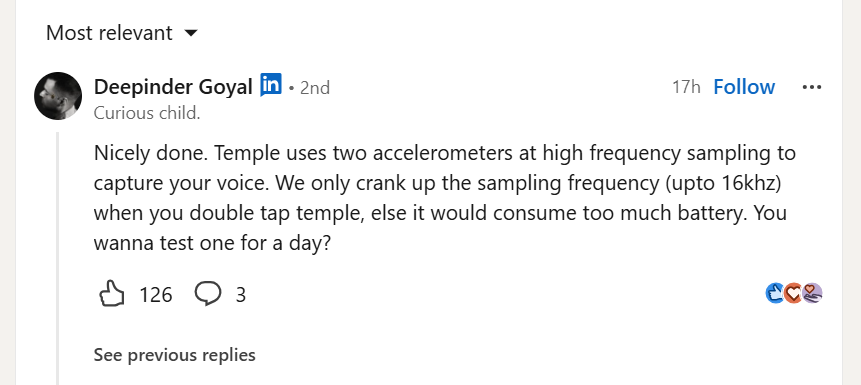
He also mentioned that the wearable doesn’t run at peak speed constantly, since doing so would chew through the battery in no time.“We only crank up the sampling frequency (up to 16 kHz) when you double tap Temple, else it would consume too much battery,” Goyal explained.Right after sharing that detail came the offer that turned a neat LinkedIn post into a viral moment: “You wanna test one for a day?” For someone who had been trying to reverse-engineer the gadget blind, getting a day with the actual device is a pretty rare chance to compare notes.
What is Temple and why has it been controversial?
Temple is a wearable designed to sit on your forehead, pitched by Goyal as a mix of fitness tracker and AI companion. Its website bills it as the world’s first precision fitness tracker featuring “Roomdeaf AI,” built specifically to hear only the person wearing it. The team says it was developed alongside a panel of scientists and researchers across several disciplines.Even so, the rollout hasn’t exactly been smooth sailing. Ever since pre-orders went live at ₹85,000 on November 1, plenty of doctors and medical experts have pushed back on the science behind the gadget. Much of the scrutiny has zoomed in on the bold claims around the hardware and what it can genuinely measure on the human body. Goyal has repeatedly stressed that Temple is not a medical device, and the official site carries a clear disclaimer noting it isn’t meant to diagnose, treat, cure, or prevent any illness.
Deepinder Goyal’s ‘not made for India’ remark also drew backlash
The steep ₹85,000 price tag wasn’t the only thing sparking heated threads online. On November 8, Goyal set off fresh pushback after posting on X that Temple wasn’t built with Indian shoppers specifically in mind.“Temple is not made for India. It’s made for the world,” he posted.That line rubbed plenty of people the wrong way. Several Indian startup founders, analysts, and prospective buyers called out the remark, pointing out that local consumers already shell out plenty of money for high-end tech when the value is there.Set against all that noise over pricing and positioning, Vanamali’s experiment offered a refreshing detour – shifting the spotlight back to how the engineering actually ticks. A laptop accelerometer obviously isn’t going to replace dedicated wearable hardware anytime soon, yet the hack got Goyal talking openly about the tech, and Vanamali might soon find out how closely his homegrown theory matches the real thing.