





Meet Anvith Yalamanchili, the 17-year-old Dubai student who watched his brother’s school commute triple to 45 minutes and built a free carpool service that drew 1,000 sign-ups

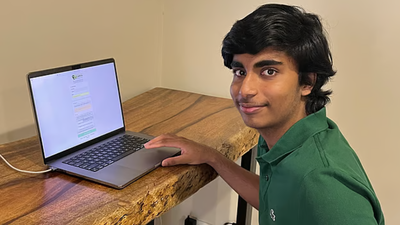
When a student’s morning school journey in Dubai Sports City suddenly tripled from 15 minutes to 45 minutes after three new campuses opened nearby, his older brother decided to find a way to solve the traffic problem. Anvith Yalamanchili, a 17-year-old International Baccalaureate student at Dwight Global, created a free, web-based carpooling platform to reduce the number of private cars filling the area’s roads. What started as an effort to make his brother’s morning journey easier has since grown into a larger organised initiative. According to UAE news outlet The National, the platform, called Community Carpool, has now attracted more than 1,000 registered users across Dubai. “Three new schools opened in the same area, which caused an increase in cars in that area, causing traffic and delays,” Yalamanchili told The National. “I noticed a lot of these cars were coming from the same communities, like Arabian Ranches or Sports City, and they all had empty seats. It made me realise people should be able to carpool and that would speed up travel times at the busiest time of day.”
Algorithmic matching replaces manual mapping
At first, Yalamanchili handled the carpooling arrangements himself. He marked users’ locations on digital maps and manually looked for people whose routes could be combined. “In the beginning, I was manually matching people who had signed up on a map,” Yalamanchili explained to The National. “I would put pins down and try to see how far everyone was away from each other. But then I realised that the more people involved, the more difficult that was to do, so I created a system.” To automate the process, Yalamanchili built a website, communitycarpool.org, using the Haversine mathematical formula. The system calculates the distance between two points on the surface of a sphere. This allows it to match users based on their locations, travel schedules and personal preferences. Unlike commercial ride-hailing services, the platform does not require an app download, subscription fee or extensive data tracking. In an interview with Gulf News, Yalamanchili said the aim was to make carpooling as simple as possible for families and commuters. “The core idea is simplicity. There is no app to download, no logins and no unnecessary data collection,” Yalamanchili told Gulf News. “We are fully aligned with GDPR principles, meaning users have complete control over their information. The goal was to remove every possible barrier so that participating feels natural rather than like extra effort.”
Privacy protection and corporate backing
To address concerns about sharing rides with strangers, the browser-based platform uses an anonymous matching system. The system checks routes and alerts potential matches without revealing personal contact information until both users agree to share it. “There are no fees at any point, so there is no financial barrier. The matching process is anonymous until both sides provide their acceptance, which removes the social awkwardness,” Yalamanchili told Gulf News. “And users don’t need to actively search through others’ routes. The system scans and notifies them when a suitable match is found, which saves time.” The platform received a major boost when UAE property developer Damac Properties began using it for its employees. According to Gulf News, Damac executive Nicola Spadoni contacted Yalamanchili after seeing details of his work in a community messaging group. This eventually led to the system being introduced to Damac’s 3,500 employees.
Expanding the team for broader adoption
Yalamanchili has since built a small team of student interns who help promote the free platform in local schools and support its technical maintenance. While established transport companies and technology firms continue to offer paid school transport services in the UAE, Yalamanchili sees his non-commercial platform as a simple, community-led alternative. “I want this to grow as much as possible in the UAE, and to expand in other areas of the world with similar traffic situations,” Yalamanchili told The National. “I think places like India and some cities in America could really benefit from this. My parents and friends have signed up, and the feedback has been quite positive.”