





Nasa’s New Horizons reached Arrokoth in 2019, revealing a frozen world that preserves clues to the early solar system |
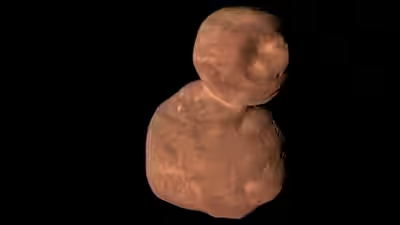
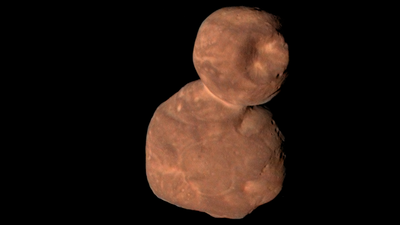
When Nasa’s New Horizons spacecraft left Pluto behind, its journey was far from over. The probe had already travelled farther than any spacecraft sent specifically to explore Pluto, but it continued into the dark outer reaches of the solar system. On 1 January 2019, New Horizons passed a small object in the Kuiper Belt that had never been seen up close before. The object, now called Arrokoth, was roughly four billion miles from the Sun and appeared in the spacecraft’s images as two rounded lobes joined at a narrow middle. It looked simple from a distance. Up close, however, its shape, surface and chemistry offered scientists an unusually well-preserved glimpse of the material from which the early solar system was assembled.
Why Nasa named the Kuiper Belt object Arrokoth
New Horizons launched in January 2006 with Pluto as its main destination. After using Jupiter for a gravity assist in 2007, the spacecraft continued towards the outer solar system and eventually made its historic Pluto flyby on 14 July 2015. The encounter transformed Pluto from a distant point of light into a world with mountains, plains, valleys and an atmosphere.The spacecraft did not stop there. Beyond Neptune lies the Kuiper Belt, a broad region populated by small bodies made largely of frozen material left over from the solar system’s formation. New Horizons was directed towards one of these objects after its Pluto encounter. The target was first discovered in 2014 by members of the New Horizons team using the Hubble Space Telescope and was initially designated 2014 MU69.Nasa later gave it the name Arrokoth, a Powhatan/Algonquian word meaning “sky”. According to Nasa, the name was chosen with the consent of Powhatan tribal elders and representatives and was formally submitted to the International Astronomical Union and the Minor Planet Centre.By the time New Horizons approached Arrokoth, scientists knew very little about what they would find. Even from Earth, the object was too small and distant for its physical form to be clearly resolved. The spacecraft’s encounter changed that within hours.
Nasa New Horizons reveals Arrokoth’s unusual two-lobed shape
The first detailed images revealed something unlike the usual mental picture of a small asteroid. Arrokoth had two distinct lobes, one larger than the other, connected by a comparatively narrow region. The outline gave it the appearance of two snowballs that had come together and remained attached. The shape was not simply an unusual feature of its surface. It carried information about how the object itself formed.According to Nasa, the two lobes were probably separate bodies in the early solar system that orbited one another before eventually merging at a very low speed. The collision was gentle enough that neither body was shattered. Instead, the pair came together and remained as a single object. That matters because many objects in the solar system have been altered by billions of years of impacts, heating and internal activity. Arrokoth appears to have experienced much less of that disruption. Its lobes are remarkably flattened, their orientations are closely aligned, and there is little evidence of the kind of violent collision that would have dramatically reshaped them. The merger is thought to have happened at only a few metres per second, or possibly less. In astronomical terms, that is an unusually gentle encounter.The implication is that Arrokoth may preserve a physical record of how small bodies assembled before the planets themselves reached their present forms.
Nasa’s New Horizons finds Arrokoth is intensely red
Arrokoth’s location helps explain why scientists are interested in it. The object orbits in the Kuiper Belt, far beyond Neptune, where temperatures are extremely low, and sunlight is weak. Bodies in this region have not undergone the same degree of heating and geological alteration experienced by objects closer to the Sun. New Horizons’ observations showed that Arrokoth is intensely red. The smaller lobe is somewhat redder than the larger one, while the narrow region between them has different thermal properties from much of the surrounding surface. The reddish colour could be associated with tholins, complex organic substances produced when radiation acts on simpler compounds on an icy surface. Similar reddish materials are known elsewhere in the outer solar system, including on Pluto and Saturn’s moon Titan. The exact chemistry at Arrokoth is more complicated, but the colour gives scientists another clue about what has happened to its surface over enormous stretches of time.The spacecraft also found a world that is surprisingly smooth in places. There are impact craters, including a much larger feature informally called Maryland, but broad areas of the surface show relatively little disturbance. Its temperature is correspondingly extreme. Plotted brightness temperatures in some regions are below minus 350 degrees Fahrenheit. The narrow neck between the lobes was measured as relatively warmer, by as much as several degrees. There are no obvious rings surrounding Arrokoth, and no collection of small companion objects was found orbiting it during the encounter.
How Arrokoth formed more than four billion years ago
The significance of Arrokoth lies less in its size than in what its condition may reveal. It is thought to have formed more than four billion years ago, when the solar system was still developing from a rotating cloud of gas and dust around the young Sun. Tiny particles gradually accumulated into larger concentrations. In some parts of the nebula, these concentrations could have remained relatively local rather than being repeatedly mixed through violent collisions. Arrokoth’s composition and structure are consistent with that quieter kind of assembly.The uniformity of its colour and composition supports the idea that the material forming the object originated from a relatively small, local region of the solar nebula. Its two lobes may therefore represent material that formed together before eventually joining. This makes Arrokoth different from a conventional planetary body whose interior and surface have been extensively modified. It is closer to a preserved remnant of the raw material from which larger solar-system objects developed. Scientists have also identified evidence for materials such as methanol ice and complex organic compounds. Water ice, common on many other icy bodies, was not clearly detected on the visible surface. Some of the organic material may have existed in the original solar nebula, while other compounds could have formed later as radiation altered methane and other substances on the surface.The distinction is important because seeing an organic molecule on an ancient object does not by itself mean that life was present. These compounds can be produced through non-biological chemical processes. What Arrokoth offers instead is a chance to examine the chemistry of primitive material that has spent most of its existence in the cold outer solar system.
Nasa’s New Horizons completes the Arrokoth flyby in 2019
The Arrokoth flyby was completed on New Year’s Day in 2019, nearly three and a half years after New Horizons passed Pluto. At that point, the spacecraft was already billions of miles from Earth, operating in a region where even basic observations required careful planning. The images collected during the encounter were later combined with observations taken from different viewing angles to reconstruct Arrokoth’s three-dimensional form. That work helped establish that its unusual flattened shape was real and was closely connected to its formation history.Arrokoth is the most distant and most primitive object ever explored by a spacecraft. Its orbit takes about 298 years to circle the Sun, while it rotates roughly once every 16 hours.The spacecraft’s journey also demonstrated why the Pluto mission did not have to be the end of New Horizons’ scientific usefulness. After crossing Pluto’s orbit, the probe continued into a region containing many remnants from the solar system’s earliest period. Arrokoth became the first of these distant Kuiper Belt objects to be examined at close range.What New Horizons saw was a small, cold and largely undisturbed body whose shape still reflects the circumstances under which it formed. Rather than being heavily remodelled by geological activity, Arrokoth appears to have spent billions of years preserving much of its original character.