





On This Day in Space: NASA launched the 100-foot Echo 1A balloon on August 12, 1960; the passive satellite reflected telephone, radio and television signals across Earth
Exactly sixty-six years ago from today, on August 12, 1960, NASA launched Echo 1A, a 100-foot-diameter balloon that became the agency’s first successful communications satellite. Unlike modern communication satellites, Echo 1A did not actively transmit signals. Instead, its large reflective surface bounced telephone, radio and television signals between distant points on Earth.According to NASA, the satellite was launched on a Thor-Delta rocket from Cape Canaveral, Florida. Once in orbit, residual air inside the folded balloon expanded, turning it into a large reflective sphere about 30 metres wide.The launch was part of NASA’s early effort to explore how objects in space could be used to improve long-distance communication. The idea was to send a signal towards a large object in orbit, reflect it off the surface and receive it at another location on Earth.Echo 1A was designed specifically for this purpose. It was a passive communications reflector. It did not receive and retransmit signals using its own communication system, but its job was to act as a giant reflector in space.The spacecraft was made from Mylar polyester and measured about 100 feet in diameter. Its large, shiny surface allowed it to reflect signals back towards Earth. The balloon was also bright enough to be seen from the ground as it passed overhead.
Echo I and 1A
The successful launch of Echo 1A came after an earlier attempt to put a similar satellite into orbit had failed. The original Echo I satellite was lost during an unsuccessful launch attempt in May 1960.NASA then launched Echo 1A on August 12. Once in orbit, the balloon expanded and became a large reflective surface around Earth.The satellite was built from a very thin sheet of Mylar polyester film. The sheet covered about 31,416 square feet and was 0.0127 millimetres thick. It was covered with a reflective aluminium coating, while the entire spacecraft weighed about 132 pounds.
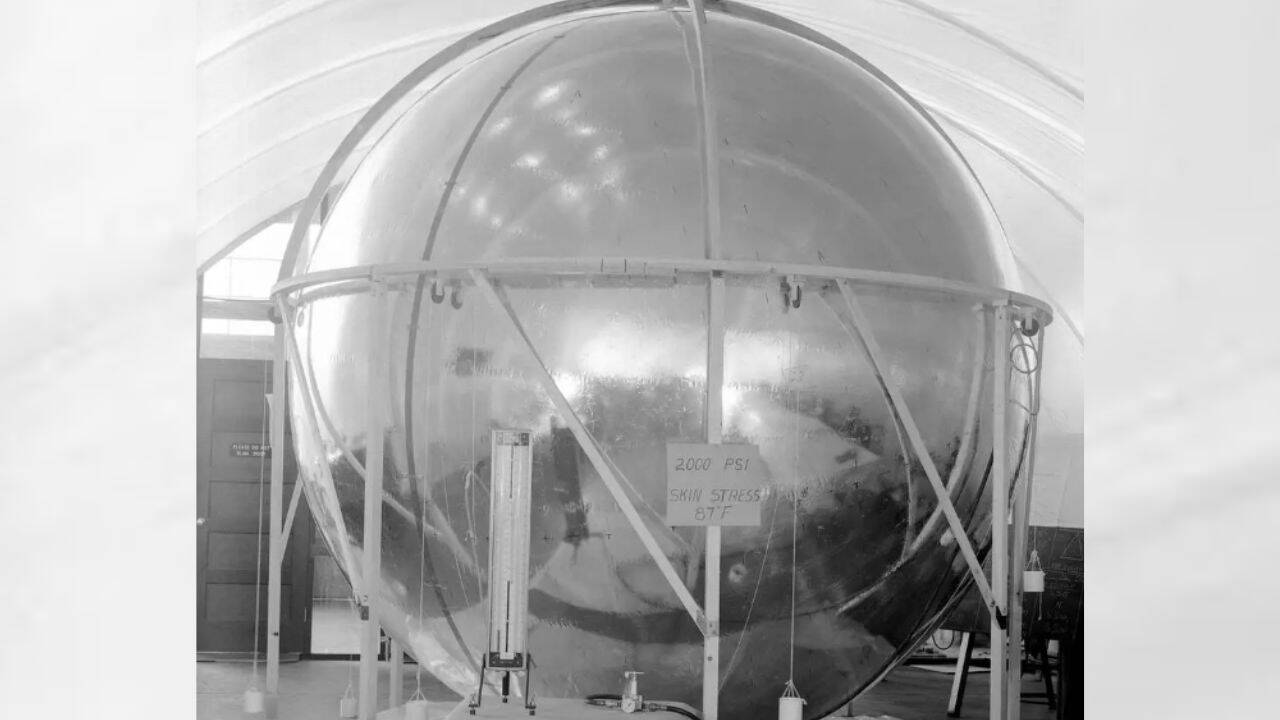
A giant balloon in orbit reflected signals between distant points on Earth.
The first signal
Echo 1A could be used for transcontinental and intercontinental telephone, radio and television signals. A few hours after its launch, the satellite reflected its first message. The radio signal travelled from California to Bell Labs in New Jersey after bouncing off Echo 1A.The message was an address by then US President Dwight Eisenhower. He said, “The satellite balloon, which has reflected these words, may be used freely by any nation for similar experiments in its own interest.”According to EDN, Echo 1A was also used by amateur radio operators, who were able to bounce signals off the satellite. NASA released daily schedules showing when and where the balloon could be seen overhead.
| Echo 1A At A Glance | Details |
|---|---|
| Launch date | August 12, 1960 |
| Launch vehicle | Thor-Delta |
| Diameter | 100 feet, or about 30 metres |
| Material | Aluminised Mylar polyester film |
| Function | Passive reflector for microwave, telephone, radio and television signals |
| First major relay | Goldstone, California, to Bell Labs in Holmdel, New Jersey |
| Re-entry | May 24, 1968 |
Use in research
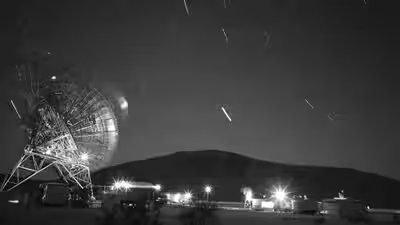
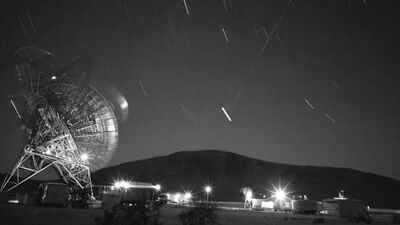
The satellite was not limited to communication experiments. NASA used Echo 1A to collect information that helped with calculations of atmospheric density and solar pressure.The spacecraft was also used to examine the technical feasibility of satellite triangulation, which could improve mapping precision.At the Goldstone tracking station in California’s Mojave Desert, Jet Propulsion Laboratory used two 85-foot-diameter antennas to send and receive signals through Echo 1A.Those antennas later became part of NASA’s Deep Space Network, which communicates with spacecraft travelling to the Moon and beyond.The Echo programme continued after the launch of Echo 1A. NASA launched Echo 2, a similar but larger satellite balloon, in January 1964. Echo 1A eventually ended its time in orbit on May 24, 1968, when it re-entered Earth’s atmosphere.Echo 1A was an important proof of concept, but it was not a full communications network. Its passive design needed powerful ground transmitters and large receiving antennas, making it less practical than the active satellites that came later.Still, it showed that signals could be sent through space, paving the way for satellite-based television, telephone links, navigation and global data networks. By the time Echo 2 launched in 1964, active communications satellites had already shown greater potential.