






Psychology reveals why some people happily choose a 10-hour train journey over a two-hour flight |
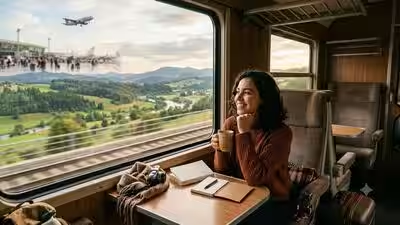
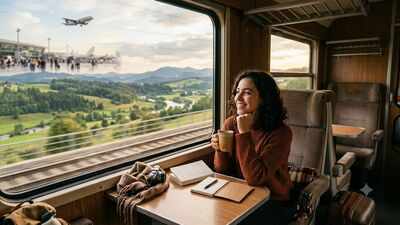
For many travellers, the fastest route is not always the most appealing one. A flight can cut hours from a journey, yet some people still choose a train seat, a window view and the steady movement of a railway carriage. They may spend longer reaching their destination, but the experience along the way matters. The changing scenery, the ability to move around, and the quieter pace can make the journey feel less like a delay and more like part of the trip itself. This preference is not simply about avoiding planes. Psychology suggests that several different factors can shape why rail travel feels more rewarding to certain people.
The psychology of why people love train travel
Modern travel often places importance on speed. Airports, schedules and connections are designed around reducing the time spent between two points. Train travel works differently. For some passengers, the hours spent travelling are not something to remove from the experience but something to enjoy.This connects with ideas from Self-Determination Theory, a psychological framework developed by Edward Deci and Richard Ryan. The theory suggests that people tend to feel more engaged when they experience a sense of choice, independence and personal satisfaction.A train carriage often provides small freedoms that are difficult to find on a plane. Passengers can stand up, walk to another carriage, look outside, open a book, work on a laptop or simply watch the world pass by. The trip can unfold at a slower pace, giving travellers a feeling that they are participating in the journey rather than just waiting for it to end.For someone travelling through mountain landscapes, coastal routes or rural countryside, the scenery may become one of the main attractions. The destination is important, but the path towards it also carries meaning.
Having more control can make travel feel easier
The feeling of being in control has a strong connection with stress levels. When people understand their surroundings and feel able to make choices, unfamiliar situations can become easier to manage. Rail travel often involves fewer restrictions once passengers arrive at the station. They can usually move freely, spend time on the platform and settle into their journey without the same sequence of procedures associated with flying.Air travel requires passengers to follow a more structured process, including security checks, boarding queues and strict timings. For many people, this is simply part of travelling and causes no concern. But others may find the additional procedures mentally tiring, especially when repeated frequently.Choosing a train does not automatically mean someone dislikes flying. It may simply reflect a preference for a travel environment that feels more relaxed and predictable.
Slower journeys can create space for the mind
A train ride offers something that is increasingly difficult to find in daily life: uninterrupted time. There is often little pressure to do anything except sit, observe and allow the journey to continue.This links with the concept of mindfulness, where attention is directed towards the present moment rather than constantly moving towards the next task. A passenger watching fields disappear into the distance or noticing small towns along a route may naturally enter a calmer state of attention.Unlike a flight, where much of the experience happens inside a confined space above the clouds, a train keeps travellers connected to their surroundings. The passing landscape provides a changing background, while the rhythm of the tracks can create a sense of routine and familiarity.
Nature outside the window may affect how people feel
The landscapes visible from a train window are not just a pleasant distraction. Environmental psychology has explored how natural surroundings can influence mental restoration.Attention Restoration Theory, developed by psychologists Stephen Kaplan, publihsed in Journal of Environmental Psychology, titled, ‘The restorative benefits of nature: Toward an integrative framework‘, suggests that certain environments help the mind recover after periods of concentration and mental effort. Natural scenes, such as forests, rivers and open landscapes, can capture attention in a gentle way without demanding intense focus.Rail routes often pass through areas that are difficult to experience from the air or from a motorway. A journey may include farmland, villages, hills and waterways that slowly change over several hours.Environmental psychology suggests that natural surroundings can play a role in mental restoration. Journal of Environmental Psychology, titled, ‘Stress recovery during exposure to natural and urban environments’ reveals that people exposed to natural environments showed stronger recovery from stress compared with those exposed to urban settings, highlighting the potential calming effects of nature.This gradual exposure to natural scenery may help explain why some travellers arrive after a long train journey feeling calmer than expected. The travel time has included moments of rest rather than simply a period of waiting.
Early memories can shape travel choices
Personal history also plays a role in the way people connect with different forms of transport. A childhood train journey, a family holiday by rail or memorable trips with friends can create strong emotional associations.This idea relates to classical conditioning, first explored through the work of Ivan Pavlov. Experiences that repeatedly occur alongside positive emotions can become linked with those feelings over time.Someone who remembers exciting railway adventures from childhood may continue to associate trains with discovery, comfort or togetherness years later. Those memories can quietly influence choices in adulthood, even when faster alternatives exist.A plane might represent efficiency, while a train might represent familiarity and connection. The preference is often shaped by personal experiences rather than a simple calculation of travel time.
Personality differences may influence preferences
People do not all look for the same things when they travel. Some enjoy speed, efficiency and getting to their destination as quickly as possible. Others value exploration, atmosphere and the experience of moving through different places.Research into the Big Five personality traits has suggested that people with higher levels of openness to experience often enjoy discovering unfamiliar environments and paying attention to details around them. For such travellers, a slower train route may provide more opportunities to observe local landscapes, architecture and everyday life. The gradual transition between places can feel rewarding.At the same time, someone who prefers flying may not be less curious or less interested in the world. They may simply place greater importance on saving time or reaching their destination quickly.
A love of trains is not the same as fear of flying
It is easy to assume that anyone who chooses trains over planes must be uncomfortable with air travel. Psychology does not support such a broad conclusion.Many people enjoy both forms of transport depending on the situation. They may fly for work when time matters but choose trains for holidays when the journey itself is part of the experience. Practical considerations also influence these decisions. Cost, convenience, environmental concerns, comfort, accessibility and the location of stations or airports all contribute to travel choices.For some people, a train journey offers a combination of independence, scenery and relaxation that a faster option cannot provide. The preference is not necessarily about rejecting planes. It is about finding value in a different way of moving through the world.