










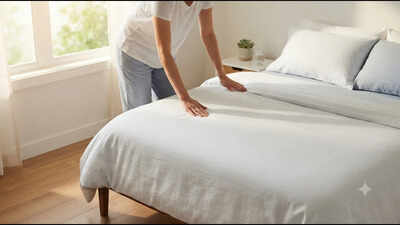
Most mornings begin the same way: an alarm, a groan, a few seconds of staring at the ceiling. Then comes a choice so small it barely registers. Pull the covers straight, or walk away from the tangle. Psychologists don’t claim this choice decides anyone’s fate. But a growing body of thinking suggests that tiny domestic routines may shape something that matters a lot: the feeling of having a grip on one’s own life.
The feeling matters more than the fabric
Psychologists use the term “locus of control,” introduced by Julian Rotter in the 1960s, to describe how strongly people believe their actions affect what happens to them. People with a stronger internal sense of it tend to cope better with stress. A made bed doesn’t build that belief on its own. It offers a quick, visible proof of it. Something was messy, an effort was made, and now it isn’t.
The power of a win you can see
Think about the last time something small got finished early in your day. Maybe a message sent, a cup rinsed, a bed pulled straight. It’s a tiny thing, but it leaves behind a quiet feeling: that’s done. And once one thing is done, the next one seems a little easier to start.That’s the idea behind a made bed. Nobody is handing out medals for smoothing a duvet, yet the first few minutes of a day tend to set its mood. A morning that begins with a small finished task feels different from one that begins with a rumpled mess and a long list of things still to do.
Order is contagious (sometimes)
A tidy bedroom corner can nudge other choices, though the link is not guaranteed. Ellen Langer’s classic 1975 work on the “illusion of control” showed how readily people feel in command when they perform even a small, deliberate action. Whether that feeling is “real” control matters less than what it does: it steadies people enough to attempt harder things.
Where the science gets honest
The evidence here needs a careful look. Most findings linking bed-making to better wellbeing are correlational. Happier, more organized people may simply be the ones who make beds, rather than bed-making producing the happiness. No major experiment has proven that the habit itself creates calm. And for anyone who finds the ritual pointless or stressful, forcing it may add pressure instead of relief. Control is personal. For some, it comes from a made bed; for others, a glass of water, a short walk, or five quiet minutes with the window open.
A smaller idea worth keeping
The philosopher Will Durant, summarizing Aristotle, wrote, “We are what we repeatedly do.” That line fits the bed better than any productivity advice does. The real lesson isn’t about sheets at all. It’s that a day can be started on purpose, with one finished thing, however modest. Anyone who has walked into a room at night and found it quietly orderly knows the small relief of it. That relief is worth noticing, and worth borrowing for the morning.Disclaimer: This article is for general informational purposes only and is not a substitute for professional psychological or medical advice. Research on daily habits and wellbeing is ongoing and largely correlational, and individual experiences vary.