





Rohan Arni, 17, used deep learning to study mysterious space signals with 98% accuracy; now he is a US Regeneron STS finalist

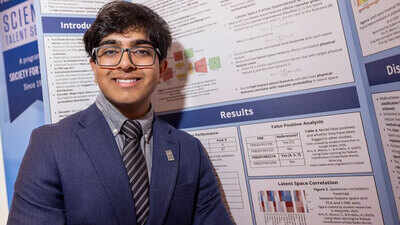
At 17, Rohan Arni is exploring one of astronomy’s most intriguing mysteries: fast radio bursts, or FRBs, incredibly powerful flashes of radio waves that can travel across the universe and last for only milliseconds. A student at High Technology High School in Lincroft, New Jersey, Rohan developed a machine-learning model that classified repeating and non-repeating FRBs with 98% accuracy.His research has earned him a place among the 40 finalists of the 2026 Regeneron Science Talent Search, one of the most prestigious science competitions for high school students in the United States. The finalists were selected from more than 2,600 entrants representing 826 high schools across 46 states, Washington, D.C., Puerto Rico, the Northern Mariana Islands and 16 countries.
A teenager investigating mysterious flashes from space
Fast radio bursts are among the most puzzling phenomena observed by astronomers. These intense flashes of radio waves can travel enormous distances before reaching Earth, yet scientists still do not fully understand what produces them or why some FRBs repeat while others appear only once.Rohan’s project, titled “Deep Learning for Classification of Fast Radio Bursts,” focuses on using artificial intelligence to study this mystery.For his research, he used data collected by the Canadian Hydrogen Intensity Mapping Experiment (CHIME), a powerful radio telescope designed to map the sky and detect radio signals, including FRBs.Instead of manually examining the enormous amount of data generated by such observations, Rohan developed a machine-learning model that could identify patterns and classify FRBs as either repeating or non-repeating.The model achieved an impressive 98% accuracy, giving researchers a potentially useful tool for analysing both existing observations and new FRBs detected in the future.
What his AI model discovered about fast radio bursts
Rohan’s research went beyond simply classifying the mysterious signals.After identifying repeating and non-repeating FRBs, he examined the data to look for hidden characteristics that could distinguish the two groups.His analysis suggested that repeating FRBs tend to be closer to Earth and have smaller frequency ranges than non-repeating FRBs.This finding could be important because one of the biggest questions surrounding FRBs is whether repeating and non-repeating bursts originate from the same types of cosmic objects or arise through different physical processes.Rohan’s results suggest that the two categories may come from different places in the universe.Scientists are still investigating the origins of FRBs, and researchers have proposed several possible explanations involving extreme cosmic objects such as neutron stars and magnetars. However, the precise mechanisms responsible for all observed FRBs remain an open question.By providing a machine-learning approach to classify and analyse these signals, Rohan’s research could help astronomers handle growing amounts of FRB data and identify patterns that might otherwise be difficult to detect.
From machine learning to physics research
Rohan’s interest in scientific computing extends beyond his FRB project.According to the Society for Science profile, he worked with researchers at Harvard University on the development of NeuroDiffEq, a library for physics-informed neural networks used by researchers around the world.Physics-informed neural networks combine machine learning with the mathematical equations that describe physical systems. Such approaches can help researchers solve or approximate complex scientific problems while incorporating established laws of physics into computational models.This experience reflects Rohan’s broader interest in bringing together artificial intelligence, mathematics and scientific research.His FRB project similarly combines astronomy with machine learning, showing how computational methods can help researchers analyse increasingly large volumes of scientific data.
A finalist among America’s top young scientists
Rohan is one of just 40 finalists selected for the 2026 Regeneron Science Talent Search, a programme of Society for Science that recognises outstanding high school research.The finalists come from 35 schools across 15 states. Together, they are competing for $1.8 million in awards and were invited to attend the Regeneron Science Talent Institute.The competition recognises research based not only on scientific quality but also on its potential to contribute to important questions facing science and society.For Rohan, that question lies far beyond Earth.FRBs may last only milliseconds, but the information contained in those brief flashes could provide clues about some of the most extreme environments in the universe. Developing better ways to identify and classify them could therefore become increasingly important as astronomers discover more of these signals.
Beyond the science project
Rohan’s interests are not limited to research and coding.He serves as the president of his school’s robotics and coding club and has coached more than 100 younger students in STEM fundamentals.His involvement also extends beyond science. He volunteers as a tour guide with the Monmouth County Historical Association, combining his technical interests with an interest in sharing knowledge with others.There is also a simple personal habit that reflects his attention to small details. Rohan makes it a point to return shopping carts instead of leaving them in the middle of a parking lot because, as he puts it, the small gesture might make someone else’s life easier.From helping younger students learn STEM to developing AI tools for studying signals from distant galaxies, Rohan’s work demonstrates how scientific curiosity can extend well beyond the classroom.
Using AI to look deeper into the universe
The universe is filled with signals that humans are only beginning to understand. Fast radio bursts are particularly intriguing because of their extraordinary intensity, short duration and mysterious origins.Rohan Arni’s research does not claim to solve the mystery of FRBs. Instead, it offers something potentially just as valuable for future research: a computational tool capable of rapidly identifying patterns within a growing body of astronomical data.His 98% accurate model and analysis of repeating and non-repeating FRBs could help researchers ask better questions about where these signals originate and whether different types of FRBs have different cosmic origins.For a 17-year-old high school student, turning mysterious flashes from billions of light-years away into a machine-learning problem is an extraordinary example of how young researchers are using modern technology to explore some of science’s biggest unanswered questions.Disclaimer: The scientific findings and observations mentioned are based on the student’s research and information provided by Society for Science and have not been independently verified by The Times of India.