






Scientists revive a 24,000-year-old ‘zombie worm’ from Siberian ice and it starts reproducing
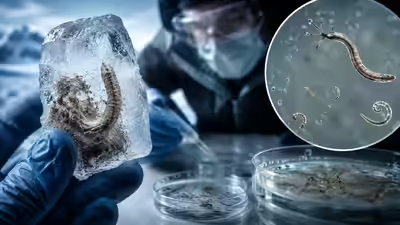
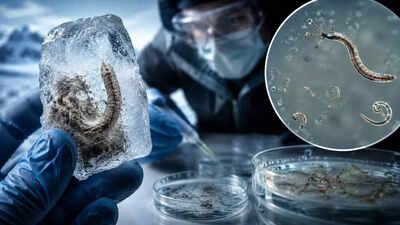
In a discovery that feels almost unreal, scientists have revived a microscopic organism that had been frozen in Siberian permafrost for around 24,000 years. The tiny creature, often referred to in media reports as a ‘zombie worm,’ was thought to be long dead. Instead, it returned to life in a laboratory setting and showed signs of normal biological activity. Even more surprisingly, it reportedly began reproducing after being thawed. The finding has left researchers both fascinated and cautious. It raises questions about how life can survive extreme conditions for such vast periods of time and what other ancient organisms might still be trapped beneath frozen ground.The discovery, published in Current Biology, is being described as one of the strongest pieces of evidence so far that multicellular organisms can survive extreme long-term freezing through cryptobiosis.
24,000-year-old ‘zombie worm’ found frozen in Siberian ice
The organism is a microscopic animal known as a rotifer. It is not a worm in the traditional sense, but a small multicellular life form commonly found in freshwater environments. Rotifers are known for their resilience, but this case goes far beyond anything previously recorded.As reported by The New York Post, the specimen was extracted from deep layers of Siberian permafrost, where it had remained frozen since the Late Pleistocene era. This was a time when Ice Age conditions dominated much of the Northern Hemisphere. Scientists believe the ice preserved the organism in a stable state, preventing decay or biological breakdown for thousands of years.
How it came back to life
Scientists gradually thawed out the frozen specimen through a series of controlled experiments in the lab. No hopes for revival were raised at first, since many living beings can withstand the process of being frozen for short periods of time. But after the warming-up stage was completed, the organism showed obvious biological signs of life. The creature began showing signs of normal biological behaviour. As stated by the study published in the journal Current Biology, the organism not only survived but also started being active in an unexpected way. This sort of behavior is associated with a survival technique known as cryptobiosis. In this condition, the metabolism of the organism slows down to near-zero levels, allowing it to withstand extreme states like freezing, dehydration, and oxygen deprivation.
Scientists shocked as ancient rotifer reproduces after 24,000 years in ice
After reviving, the rotifer reportedly began reproducing asexually. This means it was able to create new organisms without needing a partner. Scientists were particularly struck by this because reproduction requires complex cellular systems to function correctly. For an organism that had been frozen for around 24,000 years, the fact that these systems still worked is remarkable.