




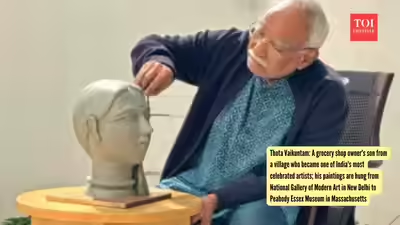
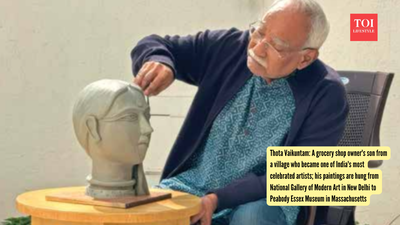
Thota Vaikuntam: A grocery shop owner’s son from a village who became one of India’s most celebrated artists; his paintings are hung from National Gallery of Modern Art in New Delhi to Peabody Essex Museum in Massachusetts
Art has the most beautiful way of finding its people. Not always in galleries or art schools, but sometimes in the middle of a paddy field, at the edge of a village stage, or in the silent determination of a mother who never once wasted a moment of her day.Thota Vaikuntam grew up in Burugupalli, a small village in Telangana’s Karimnagar district, where his father ran a simple grocery shop, and life moved to the rhythms of farm work, festivals, and travelling theatre groups. Nothing about his early years looked likely to have international acclaim. And yet, today, his paintings hang in some of India’s most prominent public spaces, are held in museums across three continents, and proclaim serious attention in auction houses from Mumbai to New York.His journey from a village boy to one of India’s most celebrated contemporary painters is not a story of overnight success but one of decades of doubt, quiet labour, and a return to the place he had always carried within him.
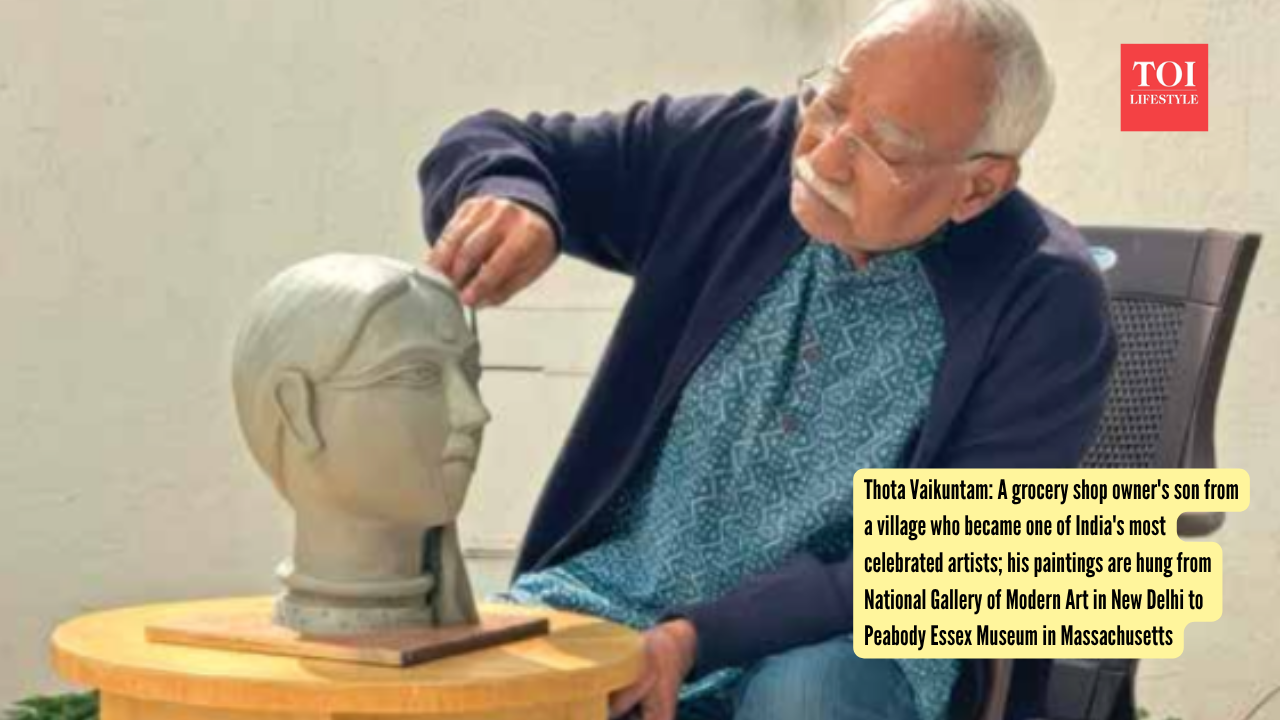
Thota Vaikuntam (Photo: thotavaikuntam.in)
Thota Vaikuntam: A simple grocery shop owner’s son who became one of the most celebrated artists
Thota Vaikuntam was born in 1942 in Burugupalli, a village in the Karimnagar district of Telangana. His father, Venkaiah, ran a small grocery shop, while his mother, Satyamma, played a central role in both his upbringing and his artistic imagination.As a child, Vaikuntam was captivated by local theatre performances where male actors portrayed female characters from mythological tales which left a deep impression on him and inspired his earliest sketches of figures like Rama, Hanuman, Krishna, and Ravana.At just nine years old, his talent was recognised when he won an art competition in his village and was awarded a pen by the district collector.Despite his father’s condemnation of an art life, Vaikuntam moved to Hyderabad to study art, even though his father did not want him to, and chose to follow his own path instead of doing what was expected.He enrolled at the College of Fine Arts and Architecture in Hyderabad in 1960, completing his studies in 1970. Financial constraints along the way forced him to work with unconventional materials like charcoal, pencil, and ink.
After several years of struggle, a turning point came in Baroda
The 1970s proved deeply challenging. Vaikuntam faced personal difficulties and limited recognition, working as an art teacher for fifteen years while continuing to paint.In 1971, however, came a moment that would change everything. He was awarded a fellowship by the Andhra Pradesh Lalit Kala Akademi to study at the Maharaja Sayajirao University in Baroda, where he trained under the legendary K.G. Subramanyan.
His work is inspired by what he saw in his village
Speaking about this time in an interview with Laasya Art, Vaikuntam recalled the directness of his mentor, “He told me upfront, first you decide what you want to do, figure out what you want to paint about, something that is unique to you.”It was Subramanyan who sent him back to where it had all begun. “So Manida suggested that I go to my village for 15 days, Kaam karke aao (do some work and come back),” Vaikuntam recalled. And then came the harder instruction. “Manida told me gently, I should pay keen attention to the details of the village, understand it in depth, not just superficially.”Those fifteen days were transformative. Vaikuntam returned with a clarity he had been searching for through years of wandering between styles. S
The mother, the village women, and the signature style
A further turning point came in the early 1980s when Vaikuntam returned to his village to care for his ailing mother. He travelled to villages across Telangana, sketching rustic scenes of farmers, labourers, priests, and women. Inspired by his admiration for his mother, he began depicting the strength and beauty of the women he saw around him.His mother, Satyamma, was the quiet engine behind much of this work. As he told Open The Magazine, “At the centre of his remembered village were women, especially his beloved mother, who never knew a moment of idleness.”The Telangana woman, dusky-toned, full-bodied, adorned with jewellery, turmeric, and vermilion, became his unmistakable signature. Bright, primary colours evoking nature ended up in his fine brushstrokes, resulting in his sensuously rendered women with lustrous skin and sturdy bodies hardened by labour yet decorated in jewellery and flowers.
From village boy to celebrated artist
He held his first solo exhibition at the Kala Bhavan in Hyderabad in 1973, and since then has had regular shows at galleries in Hyderabad, Bangalore, New Delhi, Kolkata, and Mumbai. His work is held in the collections of institutions including the National Gallery of Modern Art in New Delhi, the Peabody Essex Museum in Massachusetts, and the Glenbarra Art Museum in Japan.In 1993, he received the National Award for Painting one of the highest honours in Indian art.Now in his eighties, Vaikuntam still paints every day.