






What can get you hired & at a premium


The Indian IT sector is in the midst of an employment flux – hiring, firing, and increment trends are fast changing. The advent of artificial intelligence has rendered some roles redundant while also introducing newer job positions for specialised talent.The phase is marked by slower and more niche hiring, skewed increment trends, and a growing emphasis on talent acquisition that offers specialized skills.Experts believe that the era of broad-based recruitment and hefty pay hikes is over. Companies are now tightening hiring at the entry level, while at the same time competing to get experienced professionals in select areas.For IT professionals, this means the path to higher salaries is changing. Instead of relying on frequent job switches or industry-wide pay hikes, career growth is now increasingly tied to expertise in emerging technologies.What does this mean for freshers, mid-level, and senior-level talent? Which IT jobs are paying more than others? And what will be the trend over the next two years? Let’s decode what’s happening:
Changing trends in IT sector salaries & increments
Despite the growing uncertainty, the Indian IT sector continues to be among the leading compensation providers across sectors in the country.But the trend has seen a shift within the industry. Experts note that the post-pandemic area increment era is long gone and was an aberration in the overall trend.During 2021-22, driven by rapid global digitization, IT salary increments peaked at 12%–15% averages. During 2023-24, as major tech buyers in North America and Europe curtailed discretionary IT spending, average increments recalibrated to 8%–9%. Hiring shifted toward bench optimization and cost rationalization.
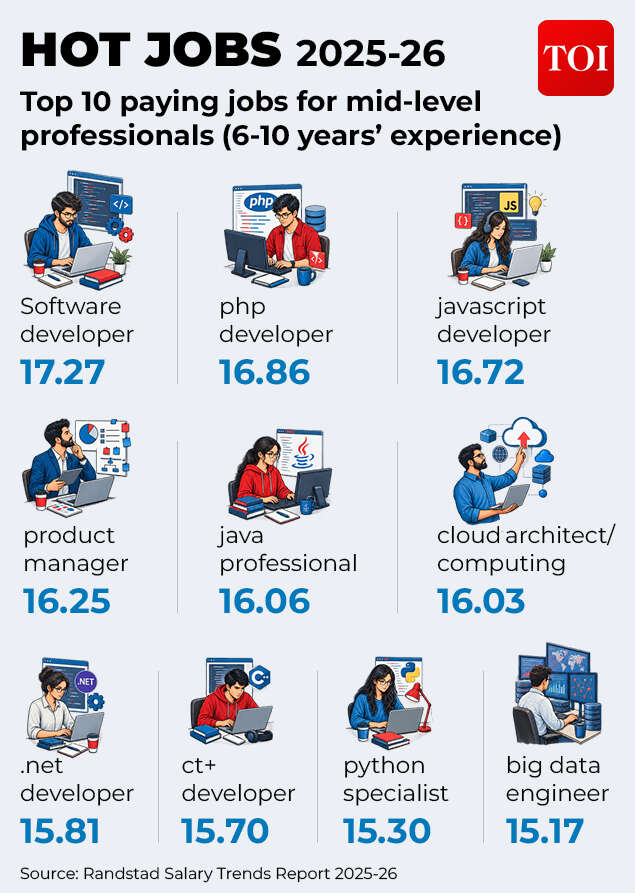
Hot jobs in 2025-26
Milind Shah, Managing Director at Randstad Digital India notes that the IT sector continues to lead absolute compensation rankings across all experience levels in India, and that’s being driven largely by intense demand for specialists in Artificial Intelligence/Machine Learning, cloud computing and cybersecurity.He tells TOI that over the last 18 months or so, compensation growth has stabilized at an aggregate 6.8%–7.5% for traditional IT services, while total compensation budgets have been redirected toward niche technical talent.“Overall, salary growth in the Indian IT sector has undergone a fundamental shift over the past four years, moving from unprecedented post-pandemic hyper-inflation to a state of structural discipline and skill-differentiated compensation,” he says.Neeti Sharma, CEO, TeamLease Digital says IT salary hikes have been moderate. “Increments are around 6.9% this year, down from 7.6% last year,” she says.However, this does not necessarily mean that companies are cutting salary budgets.“They are becoming more selective about where they spend them. Instead of giving similar hikes to everyone, they are paying a bigger premium for scarce, specialised skills. We are also seeing a greater role for variable pay and performance-linked bonuses,” Neeti Sharma tells TOI.A recent Randstad report on salary trends also reiterates the same distinction. “The IT industry has moved to performance-linked incentives and skills-based pay models to attract and retain in-demand talent – for whom they are willing to compensate handsomely,” the report says.Francis Padamadan, CEO at Xpheno says the trend of increments in the sector have been highly elastic over the last few years owing to sustained challenges in order books and pressure on margins.“The 45-50% drop in overall active demand for talent and job openings in the sector has also reduced the market forces on enterprises to offer high increments. Changes in manpower plans & drop in hiring volume due to geopolitical pressures are now amplified by the trend of AI-adoption across sectors,” he tells TOI.
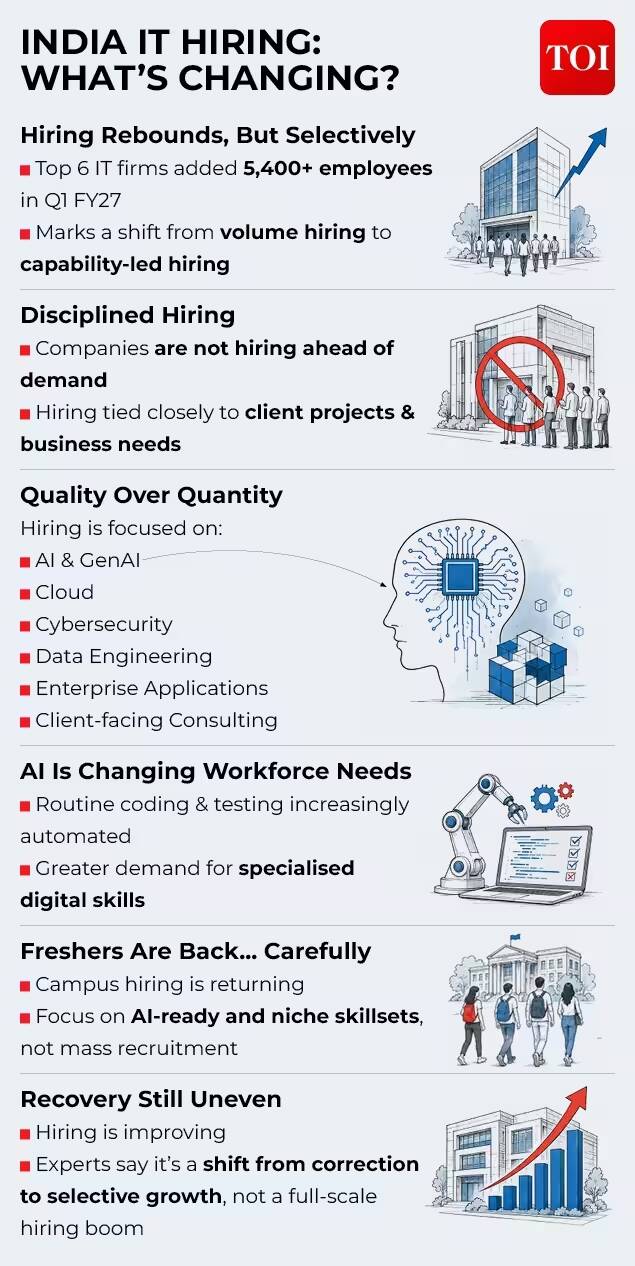
India IT hiring: What’s changing?
Which IT roles are commanding a premium?
Within the IT sector a clear divide is emerging. Niche and skill-based hiring is clearly commanding a premium, even as layoffs in some packets continue silently. So which roles are seeing a demand and getting handsome salaries?“Talent equipped with niche deep tech skills are commanding the highest premiums. Specialists in AI/ML, cloud computing and cybersecurity are the ones commanding the sharpest premiums right now, which is exactly what’s driving IT’s lead over every other sector in our overall salary rankings. Additionally, software developers, cloud architects and product Managers are the standout roles at the mid-level,” Milind Shah of Randstad Digital India reveals.
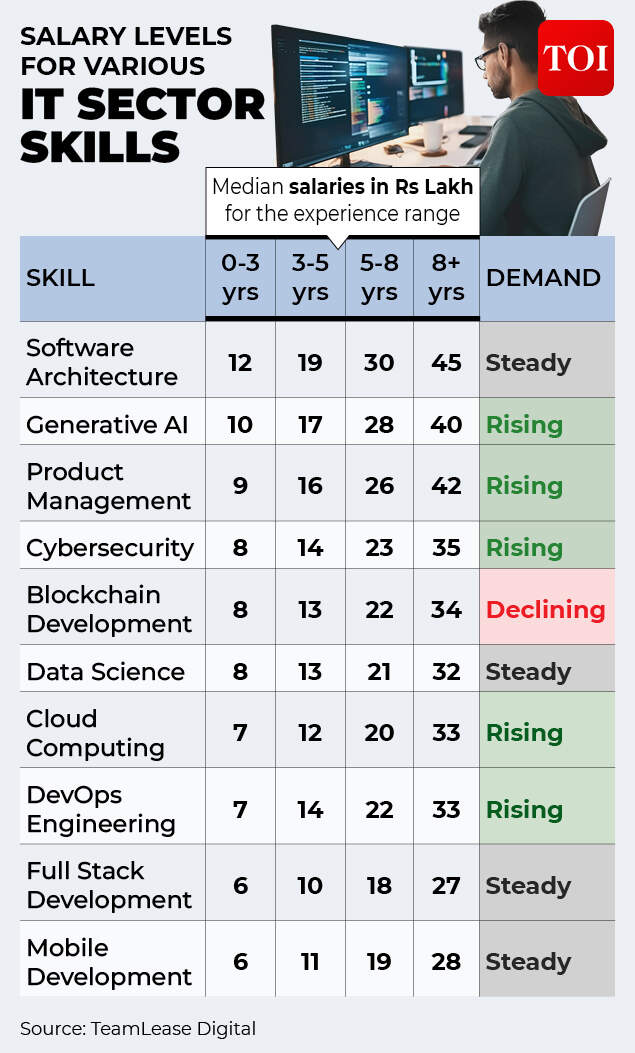
Salary levels for various IT skills
According to a Randstad report earlier this year, Indian IT companies are significantly increasing their investment in talent acquisition for specialist skills such as Java and Salesforce developers, cloud architects, blockchain developers, devOps data scientists, AI/ML engineers, AI model trainers, prompt engineers and cybersecurity engineers.In fact, Milind Shah says that positions in AI/ML engineering, MLOps, Generative AI architecture, AI governance, cloud infrastructure, and cybersecurity are commanding salary premiums of 20% to 35% above traditional software engineering bands.Neeti Sharma of TeamLease Digital points to an emerging trend: The premium is moving away from generic technology experience towards skills that are scarce and can be deployed immediately.“Specialised technology skills can command a 30-40% premium in some cases. But increasingly, the biggest advantage comes from having a combination of skills,” she tells TOI.For example, AI plus domain expertise, or cloud plus the ability to actually deploy solutions in production.“We are also seeing demand grow for newer roles such as MLOps, Agentic AI developers and Forward Deployed Engineers. FDE postings, for example, have grown almost 800% year-on-year,” she adds.
Salaries & Increments: What to expect in the next few years
Xpheno’s Francis Padamadan sees slow-paced recovery in volume and velocity of hiring, if there are no new adverse developments or headwinds in the sector.“Considering that the overall growth in the tech sector could be around the 5% to 6% range, salary increments if any in the 8% to 11% range should be considered a healthy hike in general. Any further pressure on the growth margins, will significantly drop the percentage for increments and offer hikes,” he says.
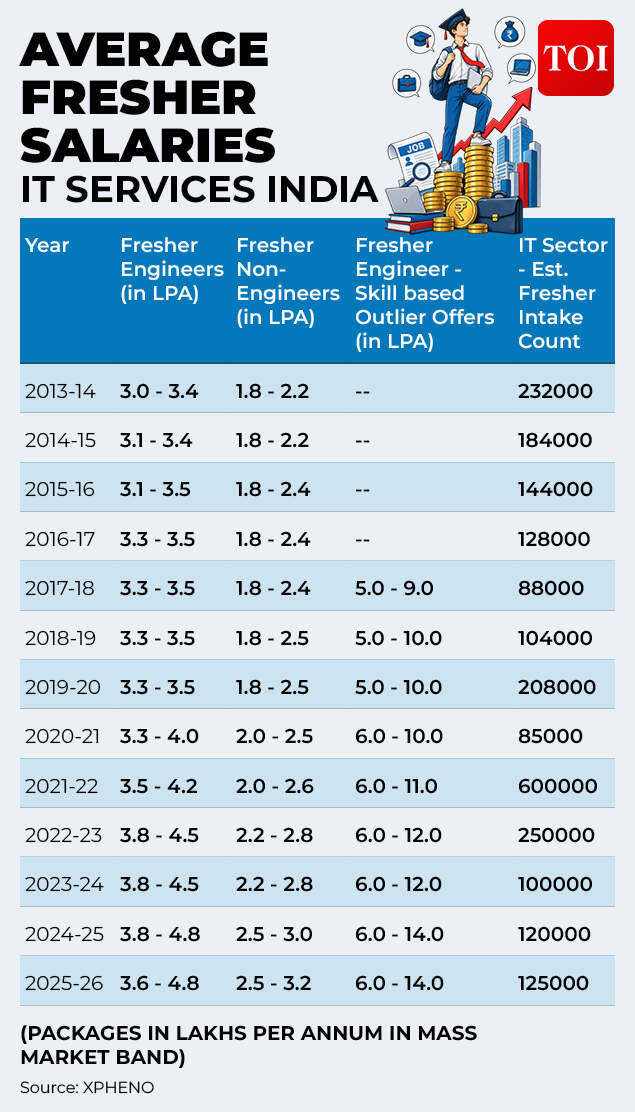
Average fresher salaries for IT services in India
Fresher hiring, while showing some signs of pickup, is largely flat, feel experts and entry-level packages continue to be stuck.According to Xpheno, fresher intake and salary packages at the bottom of the talent pyramid are hit by dilution due to high availability of talent.“The average annual salaries of freshers remained in the sub $5000 level for over a decade till early 2020. Since 2020, a couple of rounds of package correction by IT bellwethers have marginally moved fresher packages over the $5,000 mark,” Francis Padamadan notes.Furthermore, since entry level talent is not directly deployable in revenue generating roles and employers make investments by way of training spends.“These factors have traditionally driven low compensation costs at the bottom of the pyramid, and now the AI-enablement of entry-level roles has added another layer of complexity in fresher intakes,” Francis Padamadan adds.On the hiring and increment side, experts continue to see niche roles getting better hikes.Randstad Digital India’s Milind Shah expects the two trends already visible in this year’s data to continue strengthening: sustained premium pay for AI/ML, cloud and cybersecurity specialists, and further convergence between Tier-1 and Tier-2 compensation at the senior level.“The IT employment market is moving from broad-based volume recruitment to capability-led hiring. The hiring landscape over the coming 12 to 24 months will be defined by a K-shaped compensation curve: high-demand specialists in AI governance, cloud architecture, data platform engineering, and cybersecurity can expect double-digit salary growth (15% to 25%+), while professionals in commoditized or legacy engineering roles will likely experience single-digit increments in the 5% to 8% range,” he tells TOI.
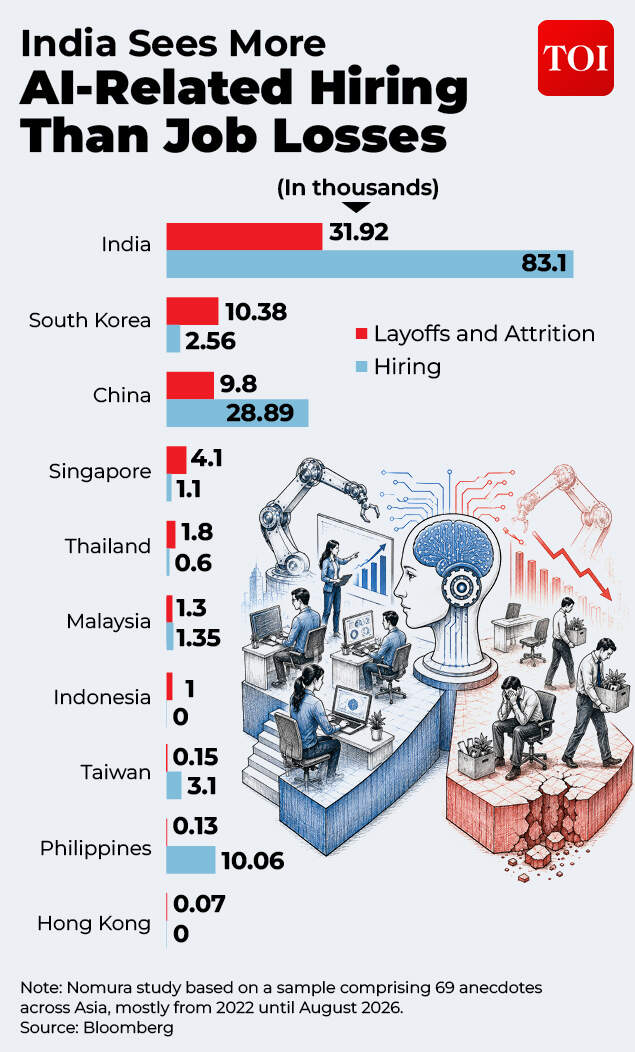
India Sees More AI-Related Hiring Than Job Losses
A clear salary divide may also emerge.Diwakar Chittora, Founder and CEO, Intellipaat says professionals with generic or outdated skills may experience slower salary growth, while people with strong development capabilities and expertise in AI, cybersecurity, analytics and other emerging technologies could command substantially higher premiums.“Interestingly, this is also a great opportunity for freshers. AI is creating a new technology landscape that everyone is learning at the same time. A professional with 10 years of experience and a student entering the industry are both relatively new to many of the latest AI capabilities,” he says.“That gives ambitious freshers an opportunity to close the traditional experience gap much faster. Over the next two years, the biggest differentiator will not simply be how many years you have worked, but how quickly you can learn, adapt and apply new technologies to real-world problems,” he adds.The biggest takeaway for entrants in the Indian IT sector, mid-level and senior employees is the same: overall salary increments may remain moderate, but people with scarce, relevant skills will continue to command much higher premiums.As Neeti Sharma of TeamLease Digital points out: AI talent demand is growing faster than the available skilled supply, and that gap will keep putting upward pressure on specialised salaries. At the same time, routine technology roles will see more pressure on hiring and pay.Her advice to professionals is simple: don’t focus only on getting a higher percentage hike. Build a skill that makes you more valuable. One strong, demonstrable AI, cloud, cybersecurity or data skill backed by actual business outcomes will increasingly be worth more than several years of generic experience.