







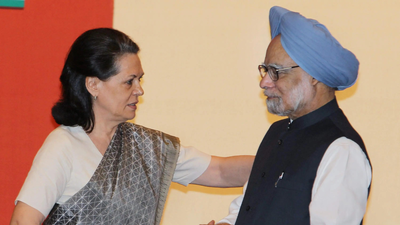
NEW DELHI: Congress leader Sonia Gandhi has revealed what went through her mind when she decided against becoming prime minister after the Congress-led United Progressive Alliance (UPA) won the 2004 Lok Sabha elections.In her newly released memoir, Belonging: A Journey of Love, Sonia recalls how she eventually listened to her “inner voice” and decided to turn down the top post, despite initially being expected to lead the government. She also explains why she chose Manmohan Singh to become prime minister, describing him as a leader of “unquestionable” integrity with a deep understanding of governance.The memoir, which hit bookstores across India on Tuesday, revisits the crucial political decision that shaped the UPA government’s first term. Sonia also shares details of the discussions with senior Congress leaders and her final conversation with her son, Rahul Gandhi, before announcing her decision.
‘Sonia, be true to yourself’: What made her change her mind
Sharing an excerpt from the memoir in an article published by The Indian Express, Sonia Gandhi recalled the moment she finally resolved not to become prime minister.“My mind suddenly cleared itself of the last shreds of doubt. “Sonia, be true to yourself,” I could hear myself say. “You’ve always known it. Just leave it!” From Belonging – on the decision not to become Prime Minister,” she wrote in a post on X.In the book, she describes how she woke up a few hours later and went straight to Rahul’s room to tell him about her decision.“I woke up in a few hours, went straight to my son’s room, and knocked on the door. “I’ve made up my mind. I’m going to stick to my stand,” I told him. He stepped up to me and with his arms around me said, “It’s the right decision.””The CPP President also recalls returning to the Congress Parliamentary Party meeting after making up her mind.“I enter the hall to thunderous applause. The members of Parliament stand up in their places, thumping their palms on the wooden ledges in front of them. I find my place at the centre of the long table for the leaders of the party and remain standing till someone gestures for them to stop, and we all take our seats,” she wrote.
Why Sonia Gandhi chose Manmohan Singh as prime minister
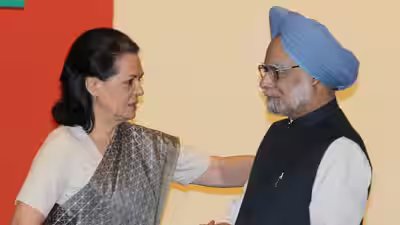
After deciding against taking the top post, Sonia had to identify someone who could lead the new government. She says several senior Congress leaders were qualified for the position, but Manmohan Singh stood out.“There were several senior colleagues, seasoned and qualified for the post, who would have been more than willing to accept it but amongst all of them was one who had long been in my sight as a person above reproach, and possessed a deep and consummate understanding of governance. That was Dr Manmohan Singh, a member of the Congress Working Committee,” she writes.Sonia points to Singh’s experience as finance minister in the early 1990s, when he introduced economic reforms under the government of then prime minister PV Narasimha Rao.She also believed his appointment would reassure people about the UPA’s economic policies, particularly as the alliance was supported by the Communist parties.“He was not allied to any camp in the party. Over a period of time, the Congress had been painted as being left of centre, and our government would now be supported by the Communist parties as well. I thought Dr Manmohan Singh would assuage the doubts of many about our ability to manage and continue the policies that had been begun years ago,” she says.Sonia also recalls Manmohan Singh’s personal journey, from a village in Punjab, now in Pakistan, to the universities of Oxford and Cambridge. She describes him as a hardworking scholar and technocrat who had overcome considerable hardship.“Aside from all his accomplishments as a scholar and technocrat, what I knew best about Dr Singh was that he had a kind and compassionate heart, and his integrity unquestionable,” she writes.She says she was convinced that the country would be in safe hands under his leadership. After consulting senior colleagues, she proposed his name. They did not oppose the choice.Manmohan Singh was approached privately about taking up the position. Although he initially declined, the CPP President says he was eventually persuaded to accept it.
How the decision unfolded at Rashtrapati Bhawan
Sonia Gandhi also recounts the events of May 18, 2004, when she went to Rashtrapati Bhawan to stake the UPA’s claim to form the government. She was accompanied by Singh.Recalling her arrival, she describes an emotional moment as she walked through the building where she had earlier visited with her mother-in-law, former prime minister Indira Gandhi, and her husband, Rajiv Gandhi.“I felt a sudden surge of emotion as our cars pulled up at the entrance. I’d been there many times before with my mother-in-law and with Rajiv, but this time I was walking through the long, dark corridors of Rashtrapati Bhawan for a different purpose,” she writes.After the meeting, the two returned to her residence at 10, Janpath. Sonia Gandhi says she did not discuss the prime ministership with Singh, who, like everyone else, assumed she would take the post.“We returned from Rashtrapati Bhawan to my home at 10, Janpath. I saw Dr Singh to his car. There had been no discussion about the prime ministership between the two of us on the drive back nor had there been before that. I said nothing to him even now. He had quite naturally assumed, like everyone else, that it would be me,” she recalls.
Sonia recalls Pranab Mukherjee’s PM ambition
Sonia Gandhi has recalled how Pranab Mukherjee hinted at his “long-held desire” to become prime minister during a 2010 conversation, when he suggested that “it was time for a change at the top”, according to her newly released memoir.Rejecting criticism that she was a “back seat driver” during the UPA years, Sonia said she respected Manmohan Singh’s position as prime minister and believed it was her duty to defer to him, even when they disagreed.“Further. I was determined not to be under any circumstance the cause of a misunderstanding that could give our opponents occasion to rejoice and weaken our government,” she writes in the book, released on Tuesday.
What else Sonia Gandhi’s memoir cover
Belonging: A Journey of Love traces Sonia Gandhi’s life from her childhood in post-war Italy to her marriage to Rajiv Sonia Gandhi and her eventual move to India.Born in Italy, she was 19 and studying in Cambridge, England, when she met Rajiv in 1965. The couple married on February 25, 1968. The memoir recounts her introduction to Indira Gandhi and her efforts to adjust to life in India, including learning Hindi, wearing saris and adapting to Indian food and culture.It also revisits the personal tragedies that shaped her life, including the death of Sanjay Gandhi in a plane crash, Indira Gandhi’s assassination in 1984 and Rajiv Gandhi’s assassination in 1991.Among the most personal accounts is her recollection of the night Rajiv was assassinated in Sriperumbudur, Tamil Nadu, on May 21, 1991. She recalls how their daughter Priyanka broke the news to her and how she struggled to accept that her husband was dead.
Share your thoughts in the comments
Be respectful · TOI community guidelines
The memoir also recounts Rahul’s concerns about his father’s security. Two months before the assassination, Rahul had warned his mother: “If something isn’t done about Pa’s security, I know I’ll soon have to come back for his funeral.”Publisher Alfred A Knopf announced on August 18 that the memoir would be released on November 10. Published in India by HarperCollins, the book is now available across several bookstores nationwide, including Higginbotham in Chennai, Bahrisons and Midland in Delhi, The White Crow and Title Waves in Mumbai, Mathrubhumi Books in Kerala, Blossoms and The Bookworm in Karnataka, and Crossword outlets across multiple states.