




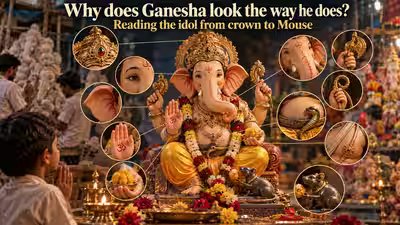
Why does Ganesha look the way he does? Reading the idol from crown to Mouse
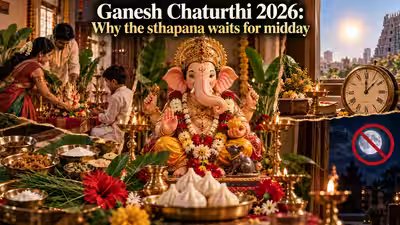
At the idol markets in Pen, the small Konkan town that supplies much of Maharashtra’s Ganesha idols every year, buyers do something you won’t see at a shop selling any other kind of statue. They pick the idol up, turn it slightly, and check which way the trunk curves before they check the price. It’s worth doing the same at home this Chaturthi: stand in front of your own murti and actually look, part by part, at what you’ve brought into the house.
The Head That Thinks Big and the Eyes That Miss Nothing
Ganesha’s head is disproportionately large for his body, and traditional commentary reads this as buddhi, intellect, made visible. Big enough to hold the whole picture.His eyes, by contrast, are small and sharp, cut into that vast head almost as an afterthought: a mind wide enough to take in everything, narrowed at the point of actual attention.You can see the same idea in his ears, large and fan-shaped, resembling a shurpa, the winnowing basket used to separate grain from husk. Big ears that take in everything; a mind trained to keep only what matters.
Which Way the Trunk Turns, and Why It Matters at Home
The trunk gets curved one of two ways in idol-making, and this isn’t merely decorative variation; it’s a real distinction with a name.Vamamukhi describes a trunk curving to Ganesha’s left — which is your right as you face him — and this is by far the more common form for home worship.Dakshinamukhi, or dakshinabhimukhi, describes the rarer right-curving trunk, associated with forms considered more powerful and demanding stricter daily ritual — the kind a temple with a full priestly staff can sustain, but a household usually can’t.Mumbai’s Siddhivinayak, a right-trunk idol, is the reference point everyone cites when this comes up. If you’re buying for home, the standard advice from priests and idol sellers alike is to go left.
Tusk, Briefly
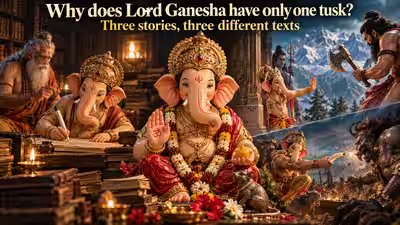
One tusk is always missing, snapped off. There’s more to that story, and it deserves its own telling elsewhere in this series, so here it’s enough to say that the break is deliberate iconography, not damage.
The Belly Wears a Snake, and the Moon Found That Funny
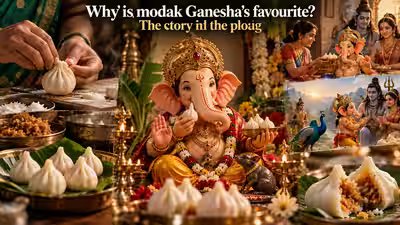
Look at the belly, and if the idol is detailed enough, look for a thin band running around it, often shown as a serpent.This comes from a well-loved story, not scripture in the strict sense: Ganesha, riding his mouse home one night stuffed with sweets, took a tumble when the mouse was startled by a snake on the path. His belly burst open, spilling the modaks, and he simply gathered them back in and tied his stomach shut with the very snake that had caused the accident.The moon, watching from the sky, laughed. Ganesha, unamused, cursed him to vanish, a curse later softened into the moon’s monthly waxing and waning rather than lifted outright.It’s a folk tale rather than a Puranic doctrine, but it’s the tale idol-makers are usually thinking of when they sculpt that little coiled line at the waist.
What the Hands Are Actually Holding — and It Isn’t an Axe
The Ganapati Atharvashirsha, in its meditation verse on Ganesha’s form, describes him as ekadantam, one-tusked, and chaturhastam, four-armed, holding pasha and ankusha, a noose and a goad.That’s the textual baseline, and it’s worth knowing because popular retellings sometimes swap in a parashu, a battle axe, which does appear in some Ganesha forms but isn’t the standard attribute the Atharvashirsha names.The noose pulls the mind back from where it wanders. The goad — the same hooked tool a mahout uses on a working elephant — prods it forward.Between them sits the modak, the sweet, and often a hand raised in abhaya, a gesture of reassurance, or varada, one of blessing.Four hands, four different instructions, held out at once.
The Sacred Thread Across the Shoulder
Look for a thread running diagonally across the chest, the yajnopavita worn by twice-born males in Brahminical tradition.On some idols, it’s rendered as a snake instead of cotton thread, folding the sacred-thread convention and the belly-snake motif into a single visual.
The Mouse He Chose to Ride, Not Crush
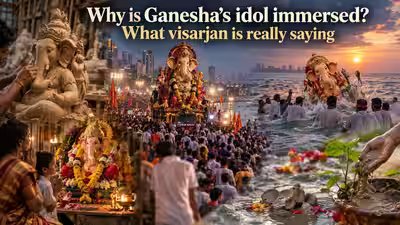
At the base sits the mouse, mushaka.Two different stories explain him. In one, told in the Ganesha Purana, he was Krauncha, a gandharva cursed into rat form after insulting a sage, who grew monstrous before Ganesha finally leashed him.In another, he was Gajamukhasura, an elephant-faced demon Ganesha defeated and transformed, choosing a vahana that was an elephant’s natural opposite.Either way, the point sculptors keep making is the same: not destroyed, just made to carry something.Next time the visarjan procession passes, take one more look before the idol goes underwater. Notice which way the trunk turned in your own home this year.