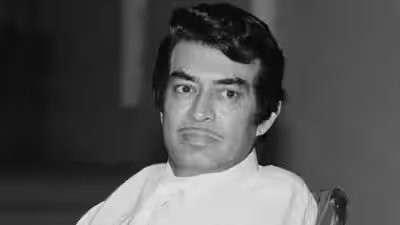






In 1972, Elton John bought his first home and named it Hercules; inside the Rocket Man’s extraordinary world of art, cars and maximalist interiors |
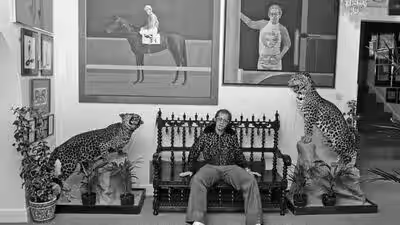
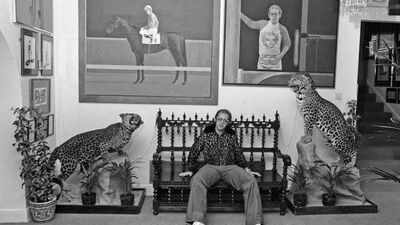
Elton John has spent more than six decades creating a visual identity that is almost as recognisable as his music. From extravagant stage costumes and towering platform shoes to colourful glasses and glittering accessories, the singer has rarely shied away from excess. His homes have reflected that same fascination with colour, art and unusual objects, although his approach to interiors has changed considerably over the years.One of the earliest glimpses of John at home dates back to 1972, when he bought his first property in Virginia Water, Surrey. He called the three-bedroom house Hercules, taking the name from the middle name he had recently adopted after legally changing his name from Reginald Kenneth Dwight to Elton Hercules John. The property also inspired the title of “Hercules,” a song from his 1972 album Honky Château.Photographs from the period show the young musician outside the house with a collection of cars, offering a glimpse into his life during a period when his career was rapidly taking off. Inside, his taste was already unmistakable. His walls were decorated with Art Nouveau posters, while his growing collection of books, records and decorative objects began turning the property into a reflection of his interests.
Woodside became the heart of his English life
In 1974, John purchased Woodside, a large estate near Windsor in Berkshire. The Queen Anne-influenced country house eventually became his longest-running residence in England and was transformed several times over the years.His relationship with the property changed dramatically as his collection grew. By the late 1980s, Woodside was packed with possessions accumulated during John’s years as an international superstar. Vintage pinball machines, costumes, lamps, memorabilia and other collectibles had filled the rooms to such an extent that the house had become difficult to navigate.According to Architectural Digest, John later described the earlier version of Woodside as being closer to an “Aladdin’s cave” than a conventional home. Following his rehabilitation in 1990, he wanted his surroundings to feel calmer and more like a traditional English country house. Designers Adrian Cooper-Grigg and Andrew Protheroe were brought in to completely rethink the interiors.
His maximalism became more carefully curated
The redesign did not mean that John abandoned his love for dramatic interiors. Instead, his collections were incorporated into rooms that had a more cohesive and traditional character.The estate features classic English furnishings, artwork, a library and extensive gardens. One of its more unusual spaces is the library, which was created from what had previously been a squash court. Another distinctive part of the property is the restored 18th-century orangery, which John turned into a peaceful retreat filled with antiques and artwork.His approach to decorating also allowed seemingly unrelated objects to exist together. Paintings, antique furniture, porcelain, photographs and decorative pieces could share the same space, creating interiors that feel personal rather than tied to one particular design trend.
His love for collecting went far beyond furniture
For John, collecting has never been limited to decorating a room. Over the years, he has accumulated major collections spanning photography, contemporary art, glass, furniture, fashion and memorabilia.Photography became one of his most important passions, particularly after he became sober. Christie’s says John and his husband David Furnish built one of the world’s largest private photography collections, with works by celebrated photographers including Irving Penn, Herb Ritts and other major names.The collection has also been exhibited publicly. John’s photographs were shown at the High Museum of Art in Atlanta in 2000 and later at Tate Modern in London. In 2024, more than 300 photographs from the collection were displayed at London’s Victoria and Albert Museum as part of Fragile Beauty: Photographs from the Sir Elton John and David Furnish Collection.
Atlanta became another canvas for his collections
John’s Atlanta home became particularly important to his life and collecting habits. He purchased a duplex apartment at Park Place on Peachtree Road in 1991, eventually combining several units into a much larger residence.Over the following three decades, the property evolved into an enormous private gallery. Christie’s records that the combined residence eventually covered more than 13,500 square feet and housed photographs, contemporary art, furniture, fashion and personal objects.The home was also closely linked to John’s creative life. During his years in Atlanta, he worked on music for projects including Billy Elliot and Aida, while the city itself became an important part of his personal and professional story.
The Atlanta collection eventually went under the hammer
After John retired from touring, the Atlanta chapter came to an end. In 2024, Christie’s presented The Collection of Sir Elton John: Goodbye Peachtree Road, a series of auctions featuring more than 900 objects from his former residence.The sale included clothing, photographs, artwork, furniture, memorabilia and some of the objects most closely associated with his flamboyant public image. The complete series realised $20,537,842, with photography accounting for approximately one-third of the lots.Among the items offered were his stagewear, platform boots, sunglasses, furniture and a 1990 Bentley Continental convertible. The auction provided collectors with an unusually detailed look at the objects that had surrounded John during more than three decades in Atlanta.
A home that mirrors an extraordinary career
The photographs of Elton John at home tell a story that goes beyond celebrity property. They show how his private surroundings evolved alongside his career and personal life.The young musician who filled Hercules with records, posters and collections eventually became an established collector with homes containing significant works of art and photography. His interiors became more sophisticated, but the instinct to surround himself with things he loved never disappeared.